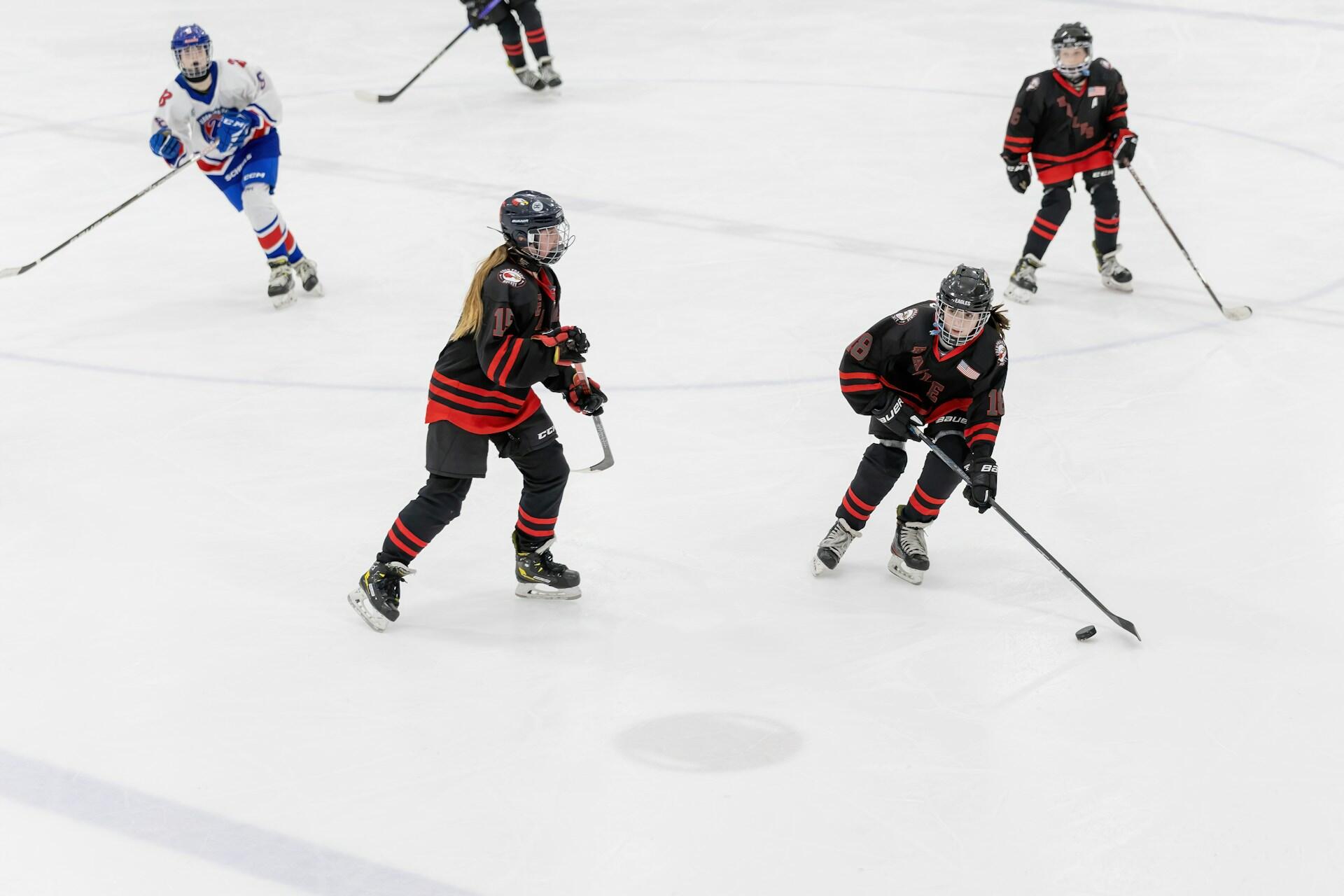

Do you know that the Canadian women's ice hockey team has medalled in every Olympic women’s hockey tournament since the sport was introduced in 1998? At the 2026 Milano-Cortina Winter Olympics in Italy, the Canadian women’s ice hockey team won the silver medal after an intense gold medal game against their long-time rival, the United States. 1
In this article, we will explore the journey of the Canadian women's hockey team in terms of their growth and achievements over the years.


👩 Historical Overview of Canadian Women's Hockey
The first newspaper report of an official Canadian women's hockey game was published by a reporter for The Ottawa Citizen on February 11, 1891, and took place at the Rideau Skating Rink.
Lady Isobel Gathorne-Hardy (nee Stanley) played a pivotal role in women's ice hockey in Canada.
Her father, Lord Stanley of Preston, the governor general of Canada, established the famous Stanley Cup, and two prestigious awards are named after her: the Isobel Gathorne-Hardy Award and the Isobel Cup, the championship trophy of the Premier Hockey Federation.
🏒 Early Beginnings and Development
Organized women's hockey games were often played at the university level from the 1890s to the 1920s. Some examples include McGill University, University of Toronto, and Queen's University.
Back then, players wore knitted turtleneck sweaters, long skirts, gloves and hats while competing, unlike today, when they wear proper uniforms consisting of jerseys and pants. 2
Modern-day hockey attire is now fully padded and offers head-to-toe protection, designed with both mobility and impact resistance in mind.
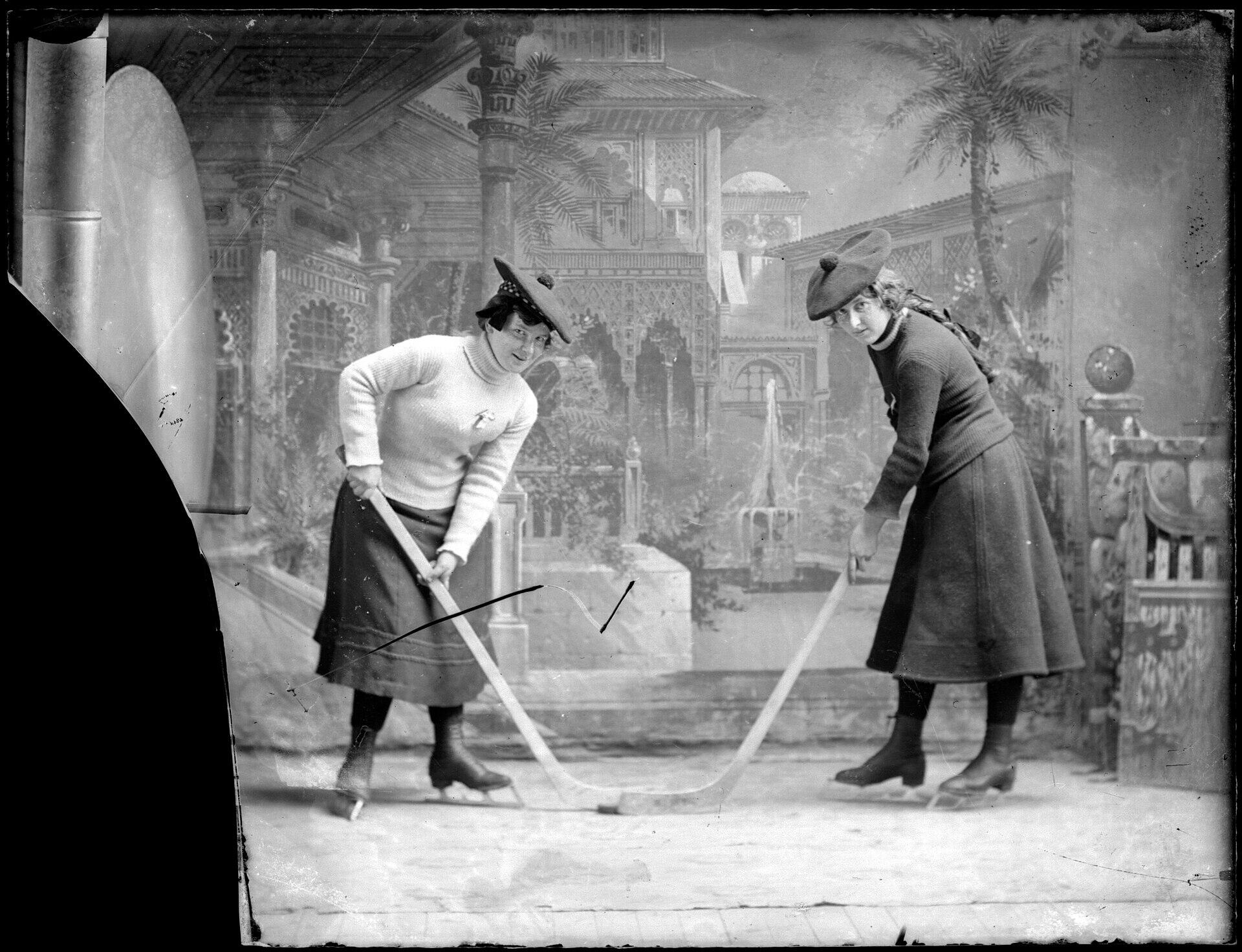
During the mid-20th century, participation in women's hockey declined due to the Great Depression and World War II. Back then, hockey was viewed as a men's sport. It was not until the 70s and 80s that Canadian women's hockey became more accessible and popular, achieving astounding results among local teams and eventually on a global scale.
Meanwhile, discover more about the hockey arenas in Canada.
🔥 Milestones and Key Achievements of Early Events
Here's an overview of key milestones and amazing achievements of Canadian women's hockey.
1889–1891
Official reports of women's hockey games in the country
1900-1920s
The rise of university women's hockey teams
1922
The Ladies Ontario Hockey Association (LOHA) was founded
The first governing body for community women’s ice hockey in Canada
1975
The Ontario Women's Hockey Association (OWHA) was founded
1982
First national women’s championship held in Canada
1987
The World Women's Hockey Tournament held in Toronto (Canada won.
First-ever major world tournament for national women's ice hockey teams
1990
First official IIHF Women’s World Championship (Canada wins)
1998
Made Olympic debut at the Winter Games in Nagano, Japan.
Won silver, lost to the United States 3–1
The Olympic debut of the Canadian women’s hockey team marked the beginning of an official rivalry with the United States team, which continues to this day.
🌟 Canada's Dominance in International Competitions
Canadian women's hockey has been a dominant force ever since their first participation in major international competitions, such as the Winter Olympics and the IIHF Women’s World Championships.
🥇 Olympic Games Performance
While the Winter Olympic Games have a long history, women's hockey games were only added to the Winter Olympics in 1998.
Here's an Olympic medal table for Canada’s women’s hockey team.
| Olympic Edition | Host City | Medal Won | Total Medals (Cumulative) |
|---|---|---|---|
| 1998 Winter Olympics | Nagano | Silver 🥈 | 1 |
| 2002 Winter Olympics | Salt Lake City | Gold 🥇 | 2 |
| 2006 Winter Olympics | Turin | Gold 🥇 | 3 |
| 2010 Winter Olympics | Vancouver | Gold 🥇 | 4 |
| 2014 Winter Olympics | Sochi | Gold 🥇 | 5 |
| 2018 Winter Olympics | PyeongChang | Silver 🥈 | 6 |
| 2022 Winter Olympics | Beijing | Gold 🥇 | 7 |
| 2026 Winter Olympics | Milan / Cortina d'Ampezzo | Silver 🥈 | 8 |
The above results show an extraordinary record of consistency, as Canada has always finished either first or second in the world at the Olympics for over 30 years.
One of the major highlights of the Canadian Women’s Hockey Team’s performance at the Winter Olympic Games was the 2014 Sochi Olympics. It was a memorable win for Canada as the team was trailing behind (2-0 late in the third period) before they managed to tie with the United States team.
During the 2014 Sochi gold medal match, the Canadian team decided to pull their goalie at 16:26 of the third period. This means removing the goaltender from the ice and replacing them with an extra skater to gain a 6-on-5 player advantage.
The risk paid off when Marie-Philip Poulin sealed the win in overtime, where the final score became Canada 3 – USA 2 (OT).
This win was both historic and iconic because it gave Canada its fourth consecutive Olympic gold medal (2002, 2006, 2010, 2014), becoming one of the most dramatic comebacks in Olympic hockey history.
🏆 Women's World Hockey Championship Success
The first-ever IIHF Women's World Championship was held in 1990. It is organised annually (except during some Olympic years) and gathers the top hockey nations alongside some emerging talents.
Here's an overview of the Canada women's IIHF Women’s World Championship results table.
| Year | Host City | Medal | Notes / Final Result |
|---|---|---|---|
| 1990 | Ottawa | 🥇 Gold | Defeated USA 5–2 in the first official IIHF Women’s World Championship final. |
| 1992 | Tampere | 🥇 Gold | Defeated USA 8–0; dominant early-era performance. |
| 1994 | Lake Placid | 🥇 Gold | Defeated USA 6–3 to secure third straight world title. |
| 1997 | Kitchener | 🥇 Gold | Overtime win 4–3 vs USA in a tightly contested final. |
| 1999 | Espoo | 🥇 Gold | Defeated USA 3–1; continued Canada–USA rivalry. |
| 2000 | Mississauga | 🥇 Gold | Overtime victory 3–2 vs USA on home ice. |
| 2001 | Minneapolis | 🥇 Gold | Defeated USA 3–2; sixth consecutive world title. |
| 2004 | Halifax | 🥇 Gold | Beat USA 2–0; strong defensive performance. |
| 2005 | Linköping | 🥈 Silver | Lost 1–0 to USA in the final; end of long gold streak. |
| 2007 | Winnipeg | 🥈 Silver | Lost 5–1 to USA in gold medal game. |
| 2008 | Harbin | 🥈 Silver | Lost 4–3 to USA in another close final. |
| 2009 | Hämeenlinna | 🥈 Silver | Lost 4–1 to USA in championship game. |
| 2011 | Zurich | 🥈 Silver | Lost 3–2 in overtime to USA. |
| 2012 | Burlington | 🥇 Gold | Defeated USA 5–4 in overtime; dramatic comeback win. |
| 2013 | Ottawa | 🥈 Silver | Lost 3–2 to USA in final. |
| 2015 | Malmö | 🥈 Silver | Lost 7–5 to USA in high-scoring final. |
| 2016 | Kamloops | 🥈 Silver | Lost 1–0 to USA in low-scoring final. |
| 2017 | Plymouth | 🥈 Silver | Lost 3–2 in overtime to USA. |
| 2019 | Espoo | 🥉 Bronze | Defeated Finland 7–0 in bronze medal game (USA vs Finland in gold final). |
| 2021 | Calgary | 🥇 Gold | Defeated USA 3–2 in overtime; first title since 2012. |
| 2022 | Herning | 🥇 Gold | Defeated USA 2–1; back-to-back world titles. |
| 2023 | Brampton | 🥈 Silver | Lost 6–3 to USA in gold medal game. |
| 2024 | Utica | 🥇 Gold | Won 6–5 in overtime vs USA; Danielle Serdachny scored OT winner. |
| 2025 | České Budějovice | 🥈 Silver | Lost 4–3 in overtime to USA in championship game. |
A recent highlight of Canada's performance was during the 2024 World Championship Final, where Canada triumphed over the United States 6–5 in overtime in the gold medal game, where Danielle Serdachny scored the game-winning goal.
Not only was Canada playing against its archrival, but it was also a high-scoring overtime thriller, with team captain Marie-Philip Poulin scoring twice in regulation before overtime.
Born in Quebec, Marie-Philip Poulin has played a pivotal role in securing victories in many Olympic and World Championship games.
She was also awarded the IIHF Female Player of the Year in 2025.

The 2024 game was a sweet victory because the Canadian women's team won the game on American ice (Utica, New York), and it happened before the 2026 Winter Olympics.
Additionally, this win marked Canada's 13th Women’s World Championship gold medal, setting a legacy of winning women’s world hockey titles more than any other nation in the IIHF Women’s World Championship.
💥 The Evolution of Professional Women's Hockey in Canada
We have to talk about the professional organizations that oversee the wommen's hockey leagues and players in Canada.
🤝 The Rise and Fall of the Canadian Women’s Hockey League (CWHL)
The Canadian Women’s Hockey League (CWHL) was formed in 2007. Operating as a non-profit entity, it was established to grow and professionalize women's hockey through structured leagues and increase visibility for the women’s game in major Canadian markets.
While the league had several partnerships in terms of organizing events like the All-Star Games and Clarkson Cup, it was not financially sustainable (low revenue) and had to cease operations in 2019.
Here's what the league covered/didn't cover:
Two main reasons contributed to the collapse of the league:
- Lack of media coverage of the Canadian women's hockey team
- Historical gender bias in sports that men's hockey is better 3
I've been to NHL games that are boring. Someone is playing the trap or maybe they just don't have it that day. They do play 82 games in a season after all. People watch women's hockey and if it isn't on-the-edge-of-your-seat-exciting for 60 minutes, it's not just worth their while.
Kristen Hagg , Calgary Inferno (former ice hockey team) general manager in an interview in 2019
🚀 Emergence of the Professional Women's Hockey League (PWHL)
Fast forward to 2023, and the Professional Women's Hockey League (PWHL) was established. Learning from the CWHL's mistake, the league is built on a strong financial backbone to create a sustainable, professional league in the North American region.
Receiving significant backing from Mark Walter (LA Dodgers co-owner) and Billie Jean King (tennis legend and gender-equality advocate), the league is committed to offering better pay and working conditions for female hockey players through a collective bargaining agreement.
The league was officially launched with the Original Six Teams before it expanded in the 2026-2026 season.
Canadian team
- Montreal Victoire: Based in Laval, Québec
- Ottawa Charge: Based in Ottawa, Ontario
- Toronto Sceptres: Based in Toronto, Ontario
- New team: Vancouver Goldeneyes. Based in Vancouver, British Columbia
USA team
- Boston Fleet: Based in Boston, Massachusetts
- Minnesota Frost: Based in Saint Paul, Minnesota
- New York Sirens: Based in Newark, New Jersey
- New team: Seattle Torrent: Based in Seattle, Washington
Feel free to explore more about Canadian junior hockey.
🥅Current Landscape of Canadian Women's Hockey
Now, let's look at the latest developments in Canadian women's hockey.
📢National Team Composition and Recent Developments
The national team changes depending on the tournament. That's because most Canadian national team players spend the regular season playing for a professional club, under the Professional Women's Hockey League (PWHL).
It is up to Hockey Canada and the relevant sports committee to select the player roster that will form the national team for the Winter Olympics and World Championships.
Here's an overview of the full roster of the 2026 Milan-Cortina Olympics team, alongside the coaches.
| Jersey Number | Name | Position/Role | Category |
|---|---|---|---|
| 35 | Ann-Rénée Desbiens | Goaltender | Player |
| 38 | Emerance Maschmeyer | Goaltender | Player |
| 82 | Kayle Osborne | Goaltender | Player |
| 2 | Sophie Jaques | Defence | Player |
| 3 | Jocelyne Larocque | Defence | Player |
| 4 | Kati Tabin | Defence | Player |
| 14 | Renata Fast | Defence | Player |
| 17 | Ella Shelton | Defence | Player |
| 23 | Erin Ambrose | Defence | Player |
| 42 | Claire Thompson | Defence | Player |
| 7 | Laura Stacey | Forward | Player |
| 10 | Sarah Fillier | Forward | Player |
| 19 | Brianne Jenner | Forward | Player |
| 20 | Sarah Nurse | Forward | Player |
| 24 | Natalie Spooner | Forward | Player |
| 26 | Emily Clark | Forward | Player |
| 27 | Emma Maltais | Forward | Player |
| 29 | Marie-Philip Poulin | Forward | Player |
| 40 | Blayre Turnbull | Forward | Player |
| 43 | Kristin O’Neill | Forward | Player |
| 88 | Julia Gosling | Forward | Player |
| 94 | Jenn Gardiner | Forward | Player |
| 95 | Daryl Watts | Forward | Player |
| — | Troy Ryan | Head Coach | Coaching Staff |
| — | Kori Cheverie | Assistant Coach | Coaching Staff |
| — | Caroline Ouellette | Assistant Coach | Coaching Staff |
| — | Britni Smith | Assistant Coach | Coaching Staff |
| — | Brad Kirkwood | Goaltending Consultant | Coaching Staff |
The roster comprises 23 players to allow for flexibility and injury substitutions, including a mixture of players, from veterans to young, emerging talents. For each match, the team has 20 skaters (12 forwards, 6-7 defenders) + 2 goalies (one backup).
👨👩👧👦 Grassroots Initiatives and Youth Development
Apart from focusing on the elite players and international achievements, there have been many initiatives to promote female participation in hockey at different levels in Canada.
For example, Hockey Alberta has seen overall hockey participation in the local girls and women’s hockey community at the provincial level, specifically in these age groups:
- 36% growth at the U15 level
- 52% increase at U13
- 62% increase at U11 4
Additionally, Hockey Canada has also launched programs like We Are Coaches and Women Master Coach Developer to help train and certify female coaches for free to foster an inclusive coaching environment and encourage younger female players to pick up the sport. 5
🔍 Challenges and Opportunities Ahead
To ensure the sustainability of Canadian women’s hockey, it is important to address ongoing challenges through practical and achievable actions, creating better opportunities for players and stakeholders in the future.
💸 Addressing Financial and Structural Challenges
One of the main challenges faced by the Canadian women’s hockey team is low revenue generation, which results in low player salaries and the suspension of operations for elite leagues.
That's the reason why the Professional Women’s Hockey League (PWHL) was launched - to create a long-lasting business model backed by substantial investment. The PWHL is continuously working to ensure a thriving structural business support through broadcast deals and sponsorship partnerships.
Broadcast deals: For the 2024-2025 season, PWHL announced the return of broadcast partnership deals with TSN and RDS, CBC/Radio-Canada. The new partner, Prime Video, will deliver all 90 Regular-Season games plus PWHL Playoffs live across Canada, including all Montréal games in French. 6
The first PWHL season was a tremendous success, and CBC/Radio-Canada is pleased to partner with the league to broadcast its second season. The public broadcaster is delighted to support women’s sport in Canada, and to bring the exploits of these exceptional athletes to Canadians.
Catherine Tait, President and CEO, CBC/Radio-Canada
Sponsorship partnerships: In 2024, the PWHL and Scotiabank announced Scotiabank as the first-ever official bank of the PWHL due to Scotiabank's commitment to advancing women’s hockey and gender equity in the sport over the years. 7
Welcoming Scotiabank as our first official banking partner is a landmark moment for our league and will greatly enhance our ability to grow our fanbase and increase hockey participation at the youth level. Scotiabank’s deep-rooted commitment to women’s hockey makes them the ideal presenting partner for our inaugural PWHL Finals.
Amy Scheer, Senior Vice President of Business Operations, PWHL
🍁 Promoting Accessibility, Inclusivity and Diversity
The sustainability of Canadian women's hockey begins at an early age, enabling female players across different cultures and social backgrounds to access good training.

To grow women’s hockey in Canada, these three elements are essential:
Acessibility
- Reducing financial and structural barriers
- Ensure talent isn't limited by income through Try Hockey and Girls HockeyFest programs
Inclusivity
- Ensure everyone feels safe and represented, for women to step up in hockey leadership roles
- Growth of women coaches through Hockey Canada programs
Diversity
- Ensure women's hockey reflects Canada's multicultural society
- Initiatives like Black Girl Hockey Club and outreach programs for underrepresented communities
The Future of Canadian Women's Hockey
Finally, let's discuss what we can anticipate in terms of upcoming competitions and the business side of hockey.
Upcoming Tournaments and Expectations
Apart from the 2026 Winter Olympics, the next big tournament for the Canadian women's hockey team is the 2026 IIHF Women's World Championship.
It will be held in Herning and Esbjerg, Denmark, from 6 to 16 November 2026. The Canadian team is one of the favorites to win, after coming second in 2025. So keep your eyes peeled and voices ready to cheer for them on the screen.
The Role of Media and Sponsorship in Growth
As mentioned earlier, media coverage and corporate sponsorship are pivotal in the sustainability and growth of Canadian women's hockey. Let's elaborate further on their significance, especially the big picture for the future.
Broader media coverage ensures regular exposure of women’s professional hockey to the local and global audience. Broadcast agreements with TSN, RDS, CBC/Radio-Canada and Prime Video will increase the game and players' visibility, attracting fans and advertisers alike.

Additionally, corporate sponsorship ensures ongoing resources through funding support and media awareness across broadcast and digital channels. The more funding and coverage there is, the more interest the audience will have in the sport: you build audience loyalty and the sport's financial strength in the long run.
We hope you have found this article inspiring and insightful about the significance of the sport and the journey of the Canadian women's hockey team through the years.
What is your favourite Canadian women's hockey moment?
References
- Tozer, J. (2026, February 19). Team Canada wins women’s hockey silver at Milano Cortina 2026. Team Canada. https://olympic.ca/2026/02/19/team-canada-wins-womens-hockey-silver-at-milano-cortina-2026/
- Jamieson, N. (2013, April 7). Women’s Hockey Herstory:^1890 to 1990. Www.hockeycanada.ca. https://www.hockeycanada.ca/en-ca/news/womens-hockey-herstory-1890-to-1990
- Spencer, D. (2019, April 29). Inferno exec says lack of media attention helped kill CWHL. CBC. https://www.cbc.ca/sports/hockey/nhl/cwhl-folding-lack-media-attention-1.5115879
- Admin. (2025, March 7). How is Hockey Alberta Growing the Female Game? | March 07, 2025. Hockey Alberta. https://www.hockeyalberta.ca/news/032025/hockey-alberta-growing-female-game-2064
- Building a coaching community. (2025). Hockeycanada.ca. https://www.hockeycanada.ca/news/building-coaching-community-2025-nvw
- PWHL ANNOUNCES CANADIAN BROADCAST PARTNERS FOR 2024-25 SEASON. (2024, November 14). Thepwhl.com. https://www.thepwhl.com/en/news/2024/november/14/pwhl-announces-canadian-broadcast-partners-for-2024-25-season
- Scotiabank Named The Official Bank Of The Professional Women’s Hockey League (PWHL). (2024, May 7). Thepwhl.com. https://www.thepwhl.com/en/news/2024/may/07/scotiabank-named-the-official-bank-of-the-professional-womens-hockey-league-pwhl
Summarize with AI:
Did you like this article? Leave a rating!

 Loading...