
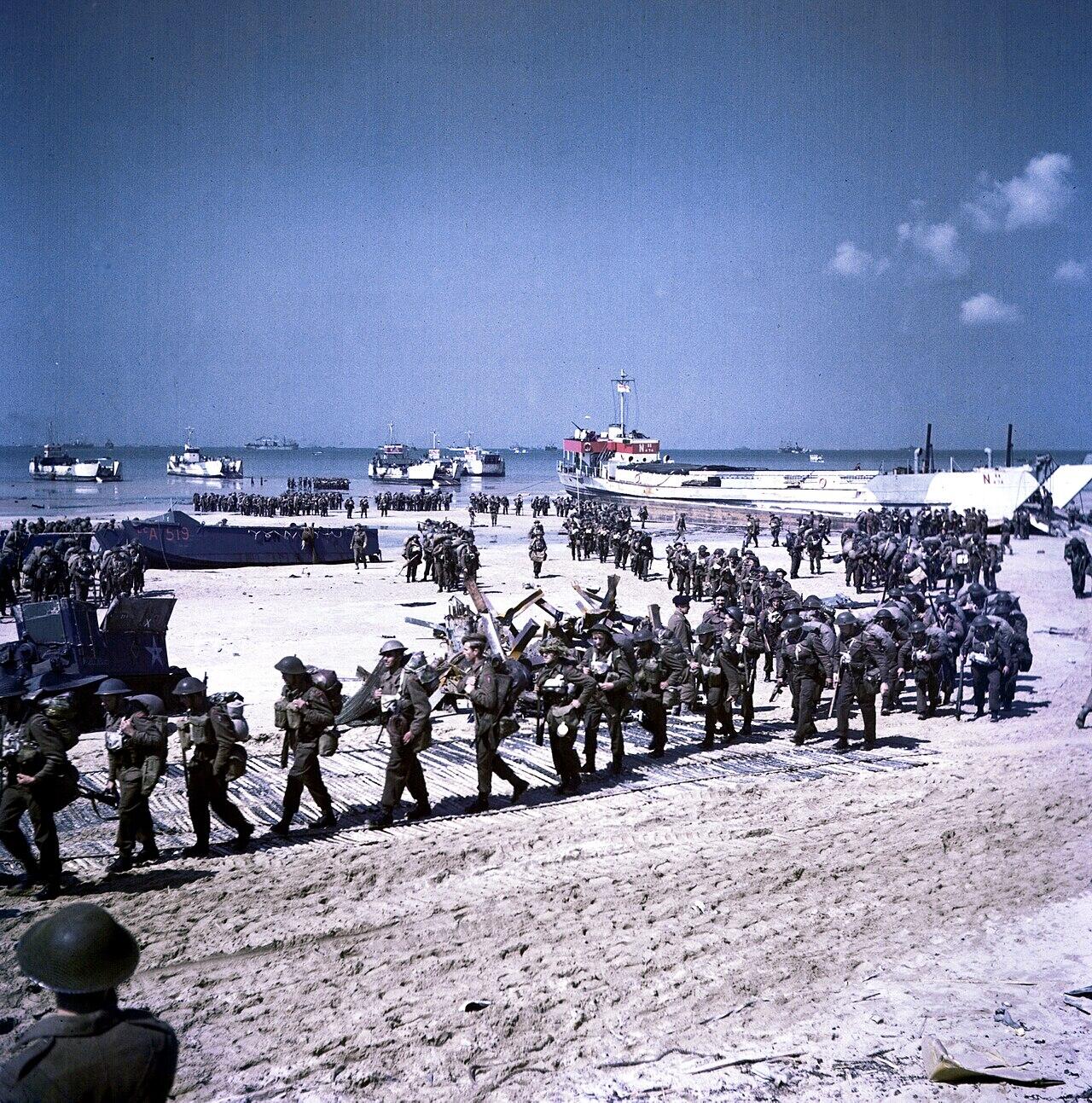

The Juno Beach battle was Canada's seaborne assault during the Allied invasion of Normandy on 6 June 1944. Canadian troops landed on a heavily defended stretch of the French coast, overcame German resistance and helped establish the beachhead from which Allied forces advanced into occupied Europe. The landing was successful, but it was neither straightforward nor cheap.
| Key aspect | Summary |
|---|---|
| Mission | Capture Juno Beach, break through German coastal defences and advance inland to support the Allied invasion of Normandy. |
| The landing | Canadian troops came ashore under heavy fire, suffering significant casualties as they fought through fortified positions and nearby villages. |
| Achievements | Canadian forces established a beachhead and advanced farther inland than many other Allied landing forces on D-Day. |
| Uncaptured objectives | Resistance, casualties and delays meant key targets, including Caen and Carpiquet airfield, remained uncaptured. |
| Significance | The landing secured an important foothold in Normandy and supported the wider Allied campaign to liberate Western Europe. |
Juno was one of five Allied landing sectors on D-Day. By nightfall, Canadian troops had advanced inland in several areas, although they had not reached every planned objective. Their achievement helped secure a vital foothold in Normandy, while the fighting that followed would continue for weeks. Juno Beach remains one of the Canadian battles that changed history through its role in the Allied liberation of Europe.


🌊 Why Juno Beach Mattered in D-Day Canada
Juno Beach formed the central part of the British and Canadian landing area in Normandy, between Gold Beach to the west and Sword Beach to the east. The Canadian 3rd Infantry Division, supported by the 2nd Canadian Armoured Brigade, was responsible for the assault. Its task was not merely to reach the sand. Canadian troops had to clear exits, capture nearby settlements and move inland quickly enough to help connect the Allied landing sectors.
Normandy coast, France, including the areas around Courseulles-sur-Mer, Bernières-sur-Mer and Saint-Aubin-sur-Mer.
3rd Canadian Infantry Division and 2nd Canadian Armoured Brigade.
Establish a secure beachhead, advance inland and help link neighbouring Allied sectors.
The invasion depended on several beachheads becoming a connected front. If one sector failed or remained isolated, German forces could concentrate against the others. Juno's success therefore mattered to the wider invasion, not just to Canada's military reputation.
Canada’s Responsibility on the Allied Left Flank
Canadian troops landed between British forces at Gold and Sword, placing them in a position where their progress affected the security of the neighbouring sectors. The assault was part of Operation Overlord, a vast Allied effort involving land, sea and air forces from multiple countries. Canada’s contribution was substantial, but it was integrated into a British-commanded operation rather than conducted as an independent national campaign.
Gold and Juno:
British and Canadian troops needed to expand their positions and maintain contact along the coast.
Juno and Sword:
The eastern side of the Canadian sector had to connect with British forces advancing from Sword Beach.
This wider role helps explain why the landing was judged by the territory secured beyond the shoreline. A beachhead had to support the arrival of more troops, vehicles and supplies, while preventing German forces from isolating individual sectors.
The Objectives That Made Speed Essential
The Canadian plan called for troops to break through the coastal defences, secure villages and advance towards objectives inland, including the area around Carpiquet airfield and the approaches to Caen. These goals were ambitious because German defences remained effective despite Allied bombardment. Delays at the waterline could leave later waves exposed and restrict the movement of armour and supplies.
Clearing exits and moving beyond the beach reduced the risk of troops and equipment becoming trapped in a narrow coastal strip. Every delay gave German defenders more time to organise a response.
The Canadians made significant progress, but the distance covered was not the only measure of success. Securing a defensible position and keeping the landing area usable were essential to sustaining the Allied advance.
🧱 The Defences Facing the Canadian Assault
Juno's defences were designed to disrupt troops before they could form up on land. German positions included machine-gun nests, artillery, mines, barbed wire, concrete structures and obstacles placed along the shore. These defences overlapped, forcing landing troops to deal with fire from fixed positions while navigating hazards in the water and on the beach.
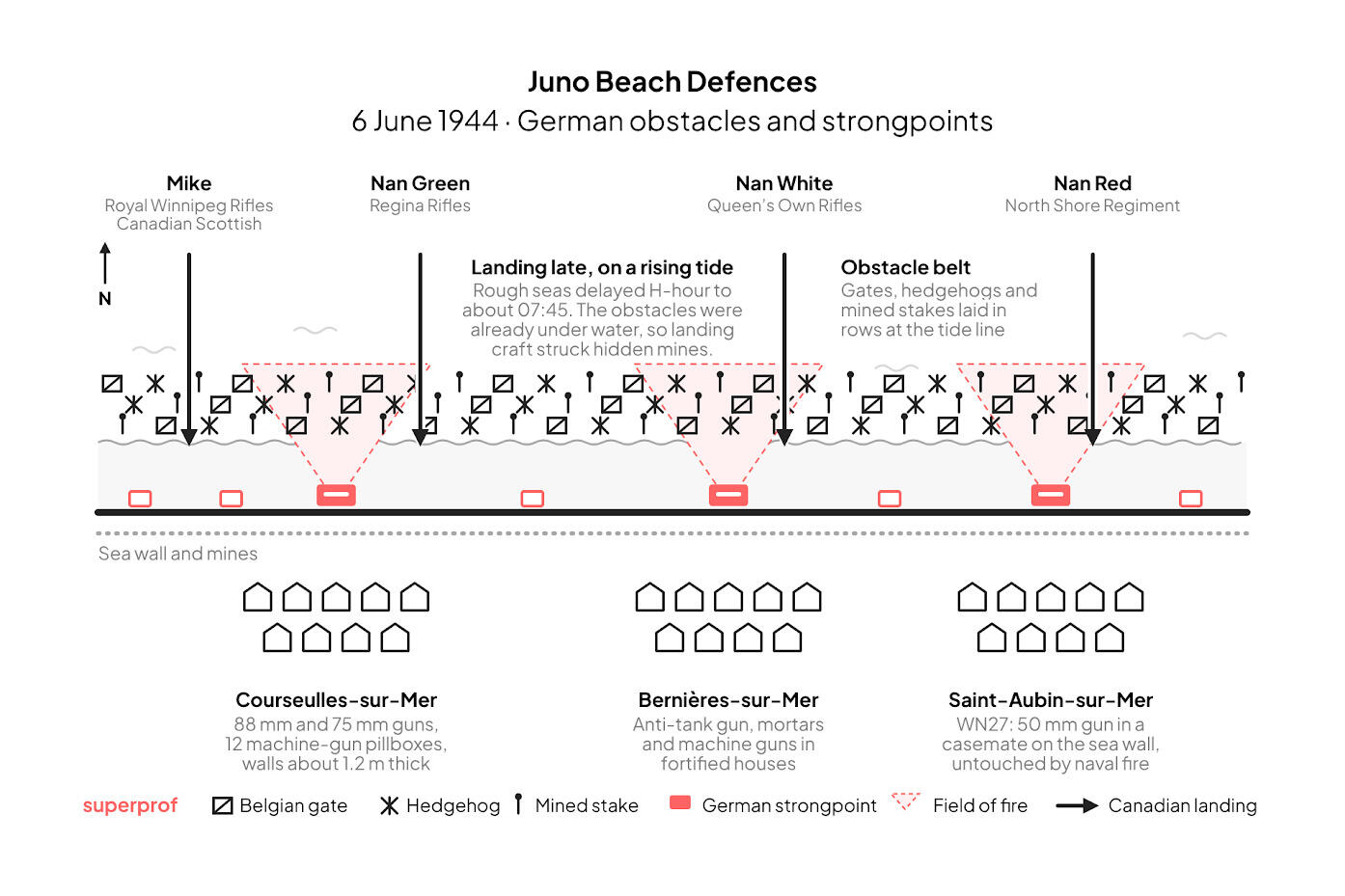
The difficulty was not simply getting ashore. Even when troops passed the first obstacles, they had to locate and suppress strongpoints, clear routes for vehicles and prevent German positions from firing into areas where reinforcements were arriving. The beach was the start of the assault, not its final objective.
Why the Tides and Beach Obstacles Changed the Attack
The timing of the landing affected what troops could see and how they approached the shore. Obstacles, mines and defensive fire made the waterline especially dangerous. Delays could disrupt the planned sequence between infantry and armour, while rough conditions complicated the movement of landing craft. Some vehicles were lost or delayed before they could provide the intended support.
The hazard:
Obstacles and mines restricted landing routes and threatened both craft and vehicles.
The consequence:
Infantry sometimes had to fight through defences before all their planned armoured support could reach them.
These conditions meant that the assault could not unfold exactly as planned. Units had to respond to the actual resistance in front of them, often under fire and with limited information.
How German Strongpoints Controlled the Exits
German defenders positioned weapons to cover routes leading inland, including gaps between coastal settlements and roads beyond the beach. A unit might clear a stretch of sand yet remain vulnerable if a nearby strongpoint continued firing. The exits were critical because troops, tanks and supplies needed to move away from the shore without being channelled into exposed approaches.
The exits were crucial as they allowed troops and vehicles to move inland and reduced congestion on the beach.
When an exit remained defended, movement slowed, units became more exposed and supporting equipment could struggle to reach the fight.
The Canadian advance depended on breaking through these positions rather than simply occupying the shoreline. Once routes were opened, troops could support neighbouring units and turn scattered landings into a more coherent front.
⚓ How the Juno Beach Landing Unfolded on 6 June
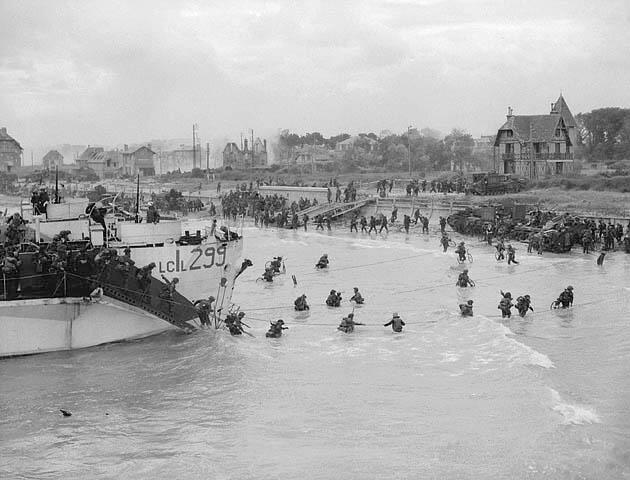
The Juno Beach landing was as much an improvised recovery as a planned assault. Strong resistance, rough seas and delays disrupted the expected sequence, and some units suffered heavy losses before reaching their objectives. Yet Canadian troops continued to clear defences, move through coastal villages and press inland. Their progress relied on small groups making decisions under fire, often without the full support originally intended.
Before dawn
Allied naval and air forces prepare the landing areas while Canadian troops approach the coast.
Morning, 6 June 1944
Canadian infantry and supporting armour land at Juno Beach.
During the morning
Troops fight through beach defences and push towards nearby villages.
Later in the day
Canadian units advance inland but encounter continuing resistance and coordination problems.
By nightfall
The Allies hold a beachhead, though several ambitious objectives remain unmet.
The landing's success should not be mistaken for a smooth operation. The beachhead was secured through persistent fighting and adaptation, and the final positions varied across the sector.
The First Wave and Its Heavy Cost
The first troops faced the most immediate danger because they had to cross the exposed beach, negotiate obstacles and engage defenders before the landing area was secure. Some units landed later than planned, and armour did not always arrive when needed. Casualties among the initial assault forces affected the strength available to clear positions and move inland.
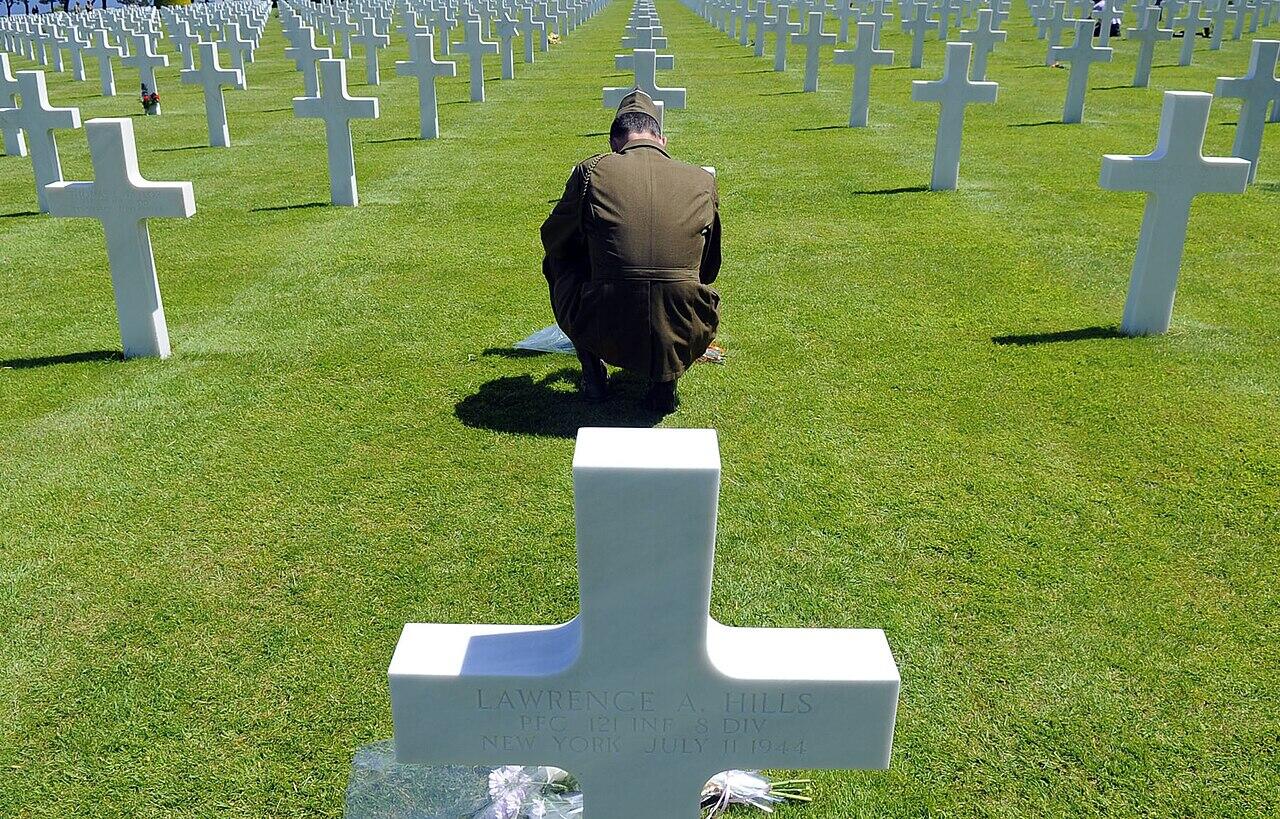
The human cost on D-Day:
Canadian casualty figures vary by source and counting method. Veterans Affairs Canada records 359 Canadians killed on D-Day, while other official commemorative sources give a higher total for deaths and wounded combined. These figures refer to different categories and should not be treated as interchangeable.
The losses were not just a final statistic. They reduced the number of experienced soldiers available to their units and placed additional pressure on those who continued the advance. The troops who survived had to reorganise and act with whatever support could reach them.
The Breakthrough From Beach to Village
Once troops moved beyond the immediate shoreline, the fighting shifted into built-up areas and routes connecting coastal settlements with inland objectives. Clearing villages required infantry to deal with defensive positions at close range, while armour and engineers helped overcome obstacles and keep movement possible. Small-unit initiative mattered when plans broke down or the next objective was obscured by smoke and confusion.
Small groups cleared strongpoints and continued towards their objectives despite disrupted plans.
Armour, engineers and supporting fire helped troops overcome obstacles and sustain movement inland.
Canadian forces made one of the deepest advances of the Allied ground forces on D-Day, although the distance varied by unit and the most ambitious objectives remained out of reach. Their gains helped establish the conditions for the longer campaign in Normandy.
🪖 The Canadian Units That Won the Beachhead
The landing depended on different military roles working together. The 3rd Canadian Infantry Division supplied the main assault troops, while the 2nd Canadian Armoured Brigade provided tank support. Engineers dealt with obstacles and routes, and naval crews transported troops and equipment under fire. The Royal Canadian Air Force also contributed to the wider invasion through operations in the air and attacks on German positions.
Infantry:
The 7th, 8th and 9th Canadian Infantry Brigades attacked through their assigned sectors and fought to clear coastal defences.
Armour:
The 2nd Canadian Armoured Brigade supported the infantry and helped tackle German positions beyond the beach.
Specialists:
Engineers and landing crews helped clear routes and move men, vehicles and supplies through the landing area.
The division's achievement was not the result of one unit acting alone. The landing worked when infantry could exploit openings, tanks could provide support and the movement of reinforcements kept the assault from stalling.
Infantry and Armoured Units at the Waterline
Tanks were particularly valuable when they could support infantry against machine-gun positions and other strongpoints.
However, rough water, obstacles and delays meant some armour could not reach the beach as planned. Infantry therefore had to confront dangerous positions without always having the expected vehicle support immediately available.
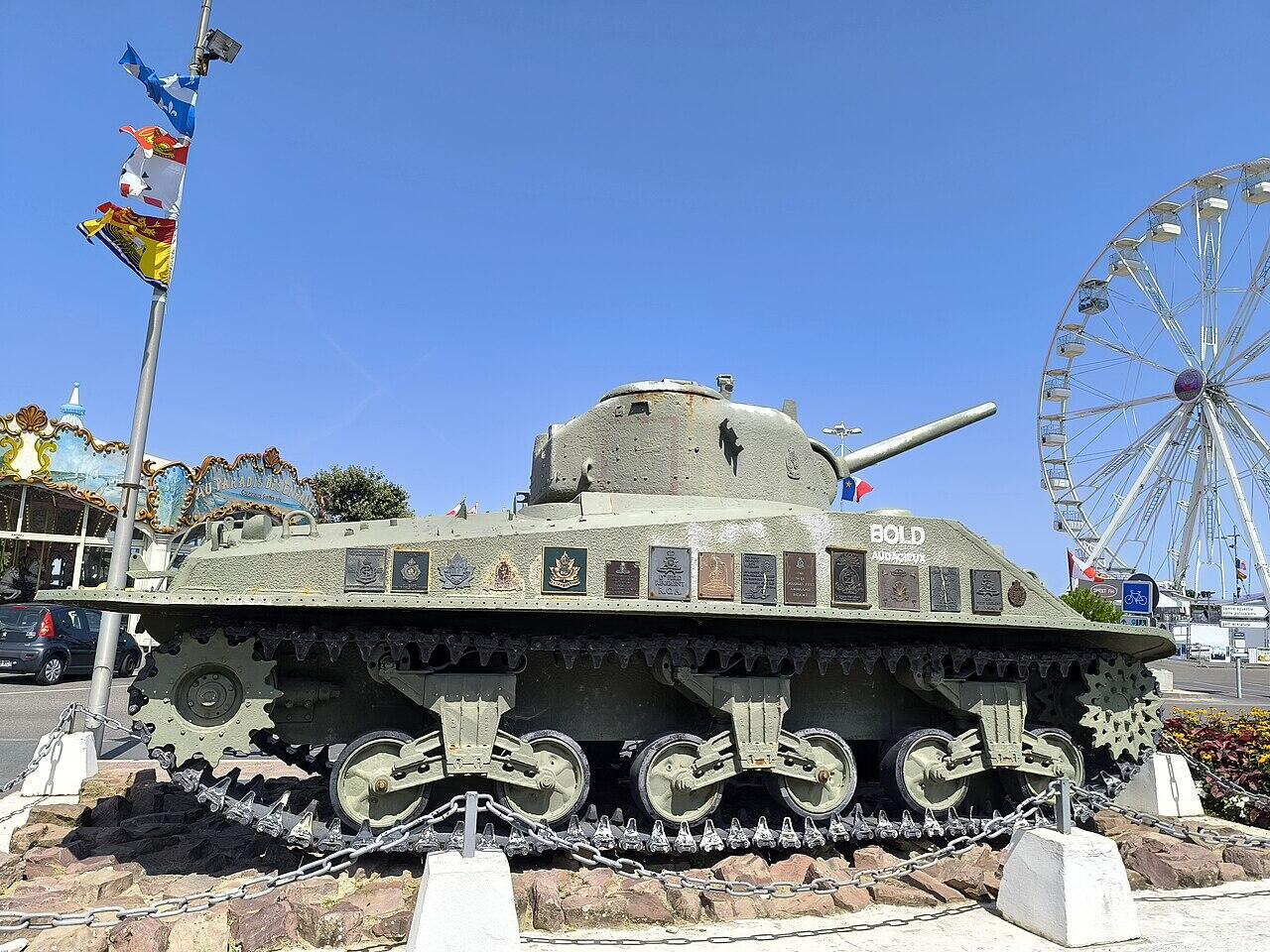
The relationship between infantry and armour was practical rather than symbolic. Tanks could provide firepower and protection, but they still depended on troops to identify threats, clear routes and secure ground they could not hold by themselves.
Engineers and Landing Crews Under Fire
Engineers helped remove obstacles and open routes, while naval crews brought successive waves of troops, vehicles and supplies to shore. These jobs were hazardous because the beach remained exposed while the assault was underway. If routes stayed blocked or landing craft could not unload efficiently, even successful infantry attacks risked becoming isolated.
Clearing a path, moving a vehicle ashore or delivering another wave of troops could determine whether an advance continued or stalled. The beachhead depended on logistics as well as combat.
These roles made the landing sustainable. The ability to bring reinforcements and equipment ashore helped transform the initial assault into a position the Allies could expand in the days that followed.
📊 Juno Beach Casualties, Gains and Limits
The Canadian landing succeeded, but the human cost was substantial. Official Canadian accounts commonly record 359 Canadians killed on D-Day, with hundreds more wounded or captured.
Canadian service members killed on D-Day
These losses occurred during an operation whose immediate purpose was to establish a foothold, not to defeat the German army in Normandy in a single day. The advance inland was impressive, but it came under pressure from intact defences and disrupted plans.
| Planned objective | Result by nightfall |
|---|---|
| Secure the beach and coastal exits | A beachhead was established despite heavy resistance. |
| Clear coastal strongpoints and villages | Canadian units captured key positions and settlements along the sector. |
| Advance towards Carpiquet and Caen | Troops made substantial inland progress but did not capture all their most ambitious objectives. |
| Connect with neighbouring Allied forces | The wider beachhead was established, but gaps and resistance remained. |
The comparison shows why Juno is best judged as a successful landing with incomplete objectives. The beachhead gave Allied forces a position from which to continue the campaign, but the fighting inland was far from over.
Did Canadian Forces Reach Their D-Day Objectives?
Canadian troops advanced farther inland than many Allied units on D-Day, but they did not achieve every planned objective. German resistance, the difficulties of moving reinforcements and the challenge of coordinating forces across a broad front limited what could be secured by nightfall.
Achieved:
Canadian forces secured a beachhead and made significant progress inland.
Not fully achieved:
The most ambitious objectives, including the area around Carpiquet and Caen, remained beyond their control.
Reaching the deepest planned objective was less important than holding the ground gained and keeping the supply route functioning.
Why the Casualty Figures Still Matter
Casualty figures show the cost of overcoming the coastal defences, but they cannot capture every consequence for survivors, families and units. The loss of experienced soldiers also affected the forces available for subsequent operations. Remembering the numbers alongside the battlefield decisions helps prevent the victory from becoming an abstract story of territory gained.
🛡️ Why Juno Did Not End the Battle for Normandy
D-Day opened the campaign to liberate Western Europe, but it did not settle the outcome of the war in Normandy. German forces continued to resist, and the Allies had to expand and supply their beachheads while capturing strategically important towns and roads. Juno became a launching point for further operations, with Canadian forces continuing to fight through the summer.
Juno Beach had to support the arrival of reinforcements, vehicles, ammunition and supplies. Its value depended on the Allies being able to move inland and maintain pressure on German forces.
The beachhead was therefore a beginning rather than a final victory. The campaign's next challenges included linking the landing sectors, securing routes and taking Caen, a key objective in the Anglo-Canadian area.
The Link-Up Problem With Sword Beach
The Canadian sector lay between British forces at Gold and Sword, but neighbouring landings did not automatically create a secure, continuous front.
The plan:
Connect the landing areas and build a continuous Allied front along the coast.
The reality:
Local resistance and uneven progress meant that connections and defensive positions had to be strengthened after the initial assault.
German resistance and delays left some objectives unmet, while troops needed time to coordinate movements and strengthen their positions. The gaps between sectors mattered because they could expose flanks and complicate the movement of reinforcements.
From Beachhead to the Battle for Caen
Caen was a major objective for the Anglo-Canadian forces, but its capture proved far more difficult than planners hoped. Canadian troops continued fighting in the campaign, including later operations aimed at breaking German resistance south of the landing areas. Juno's success mattered because it made these operations possible, not because the landing itself secured Normandy.
🇨🇦 How to Read Juno Beach as a Canadian Story
Juno Beach occupies a central place in Canada's memory of the Second World War, but the landing was part of a multinational operation involving Allied troops, sailors and aircrews. Canada's military history reaches back to earlier turning points, including the Battle of the Plains of Abraham. The Battle of Queenston Heights offers another perspective on how earlier conflicts shaped Canada's military history.
When interpreting Juno Beach, consider: the Canadian military contribution, the combined Allied operation and the experience of the French communities liberated from German occupation.
Its story includes courage and achievement, as well as planning failures, casualties and the work of people whose roles were less visible than those of front-line infantry. The costly Battle of Passchendaele provides a contrast with Juno, highlighting the different challenges Canadian troops faced in the First World War.
What Makes Juno Central to Canada’s War Memory
The landing demonstrated that Canadian forces could play a major role in a complex amphibious assault. That achievement deserves recognition, but it should be understood through the decisions and sacrifices of the people involved rather than through a simplified story of national triumph.
"If your buddies got hurt during that and the yelling and crying, you couldn’t stop, you had to keep going. If you stopped, well you were a dead duck too."
Francis William Godon, Royal Winnipeg Rifles
The 3rd Canadian Infantry Division's advance depended on collective effort and cooperation across military services. Like the Battle of Vimy Ridge, Juno Beach became an enduring symbol of Canada's military contribution.
Visiting the Sites With Historical Context
The Juno Beach Centre at Courseulles-sur-Mer offers exhibitions about Canada's role in the Second World War, while the beach and nearby memorials help visitors connect the history with the landscape. The Centre opened on 6 June 2003 and was created through the efforts of Canadian veterans and supporters. Check current opening times and visitor information before travelling.
Its significance lies in the beachhead secured on 6 June, the losses that accompanied it and the sustained campaign that followed.
Juno Beach is best understood as both a place of remembrance and a real battlefield where the outcome remained uncertain for hours. For Canada, the landing remains a defining contribution to D-Day, but its full meaning emerges when the military achievement is considered alongside the human cost and the Allied effort that made it possible.
References
- Canadian Geographic (2019) The map that guided Canada’s D-Day clash. Available at: https://canadiangeographic.ca/articles/the-map-that-guided-canadas-d-day-clash/ (Accessed: 24 October 2026).
- Veterans Affairs Canada (n.d.) D-Day and the Battle of Normandy. Available at: https://www.veterans.gc.ca/en/remembrance/military-history/second-world-war/d-day-and-battle-normandy (Accessed: 24 October 2026).
- Veterans Affairs Canada (n.d.) Juno Beach Centre. Available at: https://veterans.gc.ca/en/remembrance/memorials/overseas/juno-beach-centre (Accessed: 24 October 2026).
- Canadian Department of National Defence (2019) D-Day: Canada’s three services on Operation Overlord. Available at: https://www.canada.ca/en/department-national-defence/maple-leaf/rcaf/2019/06/d-day-canada-s-three-services-on-operation-overlord.html (Accessed: 24 October 2026).
Summarize with AI:
Did you like this article? Leave a rating!

 Loading...
