
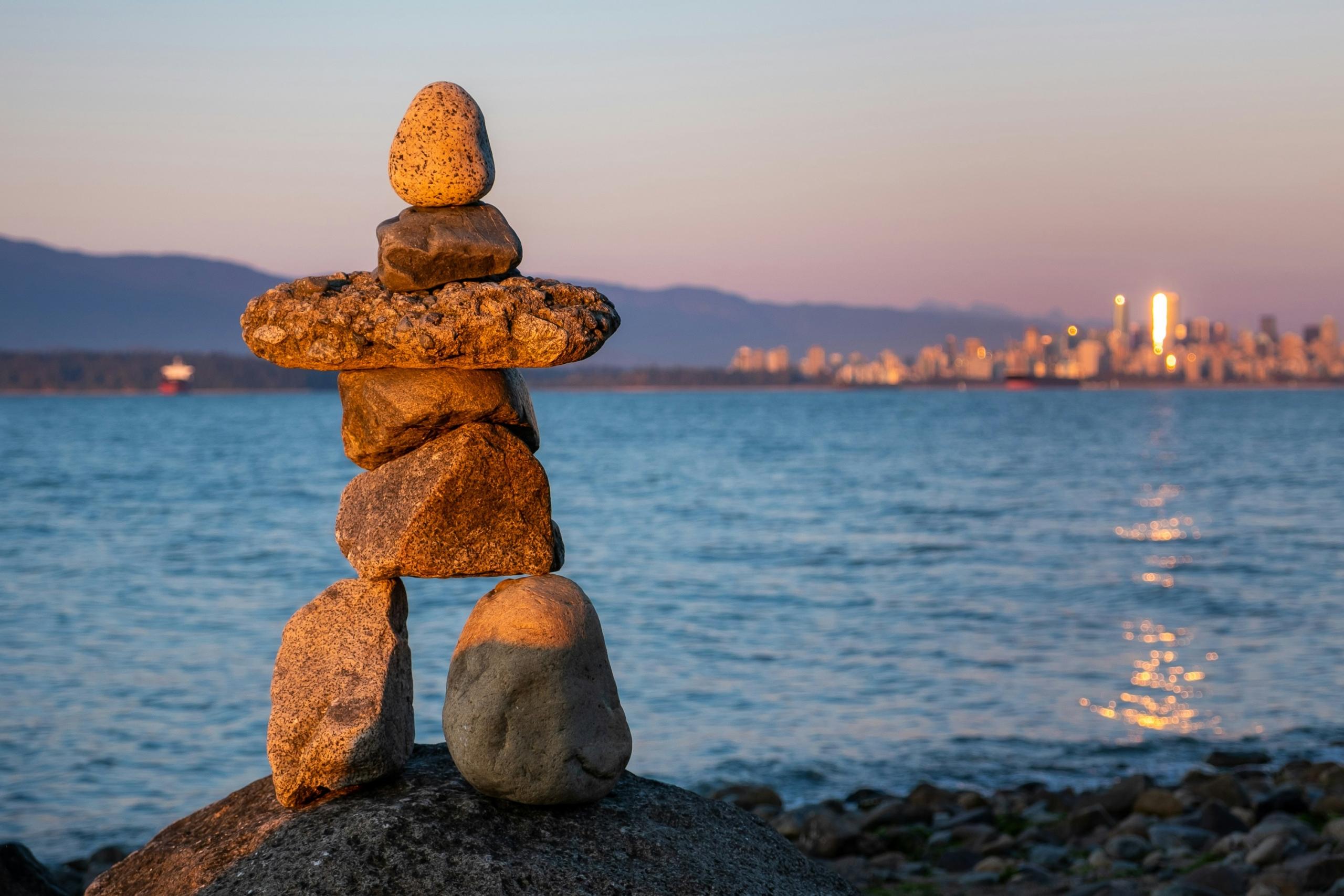

An inukshuk is a stone landmark built and used by Inuit across the Arctic. The word comes from the Inuktitut inuk ("person") and -suk ("acting in the capacity of") — literally, "that which acts in the capacity of a human." For generations these structures have guided travellers, marked caches and hunting grounds, and stood in for a human presence in a landscape with almost no other landmarks.
Today the inukshuk is one of Canada's most recognisable symbols, standing alongside other iconic Canadian symbols. This guide covers what an inukshuk means, the different types and what each was for, the difference between an inukshuk and an inunnguaq, and why building or dismantling one is more complicated than it looks.


Inukshuk or Inuksuk? Spelling and Pronunciation
Both spellings are correct, and you will see them used interchangeably.
- Inuksuk (ᐃᓄᒃᓱᒃ) is the standard romanisation of the Inuktitut word, and the spelling used by Wikipedia, the Canadian Encyclopedia and most Inuit organisations.
- Inukshuk is the older anglicised spelling. It remains the more common form in general Canadian usage and in government material.
- Inuksuit (ᐃᓄᒃᓱᐃᑦ) is the correct plural. "Inukshuks" is widely used in English but is not the Inuktitut form.
- Inukhuk is the spelling used in Inuinnaqtun, a dialect of the western Arctic.
Pronunciation:i-NUK-shook (/ɪˈnʊk.ʃʊk/), or i-NUK-suk for the inuksuk spelling. The stress falls on the middle syllable.
What Is an Inukshuk?
An inukshuk is a structure of stacked or balanced stones, built without mortar, designed to survive Arctic winters and stand for generations. Inuit built them across what is now Nunavut, Nunavik, Nunatsiavut, Greenland, Alaska and parts of Siberia — they are not unique to Canada, though Canada has adopted the inukshuk most visibly as a national emblem.
Each one was made from whatever stone was available at the site, which is why no two look alike. Their purposes were practical before they were symbolic:
- Navigation - marking safe routes and river crossings across terrain with no natural landmarks
- Hunting - lines of inuksuit were used to funnel caribou toward waiting hunters
- Communication - marking food caches, good fishing spots, or a nearby camp
- Reverence - marking sacred sites or places of significance to a community
The famous human-shaped figure - arms out, legs apart - is properly called an inunnguaq, meaning "in the likeness of a human." Many Inuit hold that an inunnguaq is a distinct form and not truly an inuksuk at all, because a traditional inuksuk is defined by its function rather than its resemblance to a person.
Much like the beaver shapes its environment by building dams and creating wetlands that support diverse ecosystems, the inukshuk shapes the Arctic landscape by marking significant locations and serving as a crucial guide in otherwise featureless terrain. Both embody resourcefulness, resilience and the importance of community.
Types of Inukshuk and What Each One Means
Inuksuit were built to do specific jobs, and their shape tells you which job. These are the main traditional forms:
| Type | Meaning of the name | What it looks like and what it was for |
|---|---|---|
| Nalunaikkutaq | “De-confuser” | The simplest form — a single upright stone. Marks a spot, confirms a route, or removes doubt about a location. |
| Tikkuuti | “Pointer” | Stones arranged in a line, largest at one end and decreasing in size, to indicate a specific direction — often toward a camp, a cache or open water. |
| Inuksummarik / Inuksukjuaq | “Great inuksuk” | Unusually large and visible from a distance. Used as a major coordination point or a regional landmark. |
| Niungvaliruluit | “With a window” | Built with a gap or opening you can sight through, framing a direction of travel or a distant landmark. |
| Inunnguaq | “In the likeness of a human” | The human figure with outstretched arms. The most famous form internationally — and, strictly speaking, a separate category rather than a true inuksuk. |

Some inuksuit also served as message centres. Hunters would place stones at the base in particular arrangements to leave information for whoever came next, extending the structure's role from a navigation aid to a means of communication across time as well as distance.
What Does an Inukshuk Symbolize?
An inukshuk symbolises guidance, community and survival. Its core message is that someone has been here before you, and that they left something behind to help you, a form of care extended to a stranger you will never meet.
In a landscape where a wrong turn could be fatal, that meaning was literal. An inuksuk was a stranger's knowledge, made permanent in stone. This is why the symbolism of cooperation and interdependence sits so naturally with it: no single person survives the Arctic alone, and the inuksuk is physical proof of that.
The inukshuk's role as a national symbol also highlights Canada's connection to Inuit culture, and a responsibility to respect the traditions that produced it. In modern contexts it appears in public spaces, national events, and global platforms such as the 2010 Vancouver Winter Olympics, though as with any borrowed symbol, the question of who is borrowing and how matters.
Why Is the Inukshuk a Symbol of Canada?
The inukshuk became a national symbol largely through the twentieth century, as Canada sought emblems that were distinctly northern and distinctly its own. Its adoption accelerated sharply after the 2010 Vancouver Olympics put a stylised inunnguaq in front of a global audience.
Its appeal as a national emblem is that it represents welcome, direction and mutual support - values Canada likes to claim. Its complication is that it belongs to a specific Inuit tradition, and its use as a general Canadian symbol was not something Inuit were consulted about.
Is It Okay to Build an Inukshuk?
This is one of the most common questions about inuksuit, and the answer is genuinely debated.
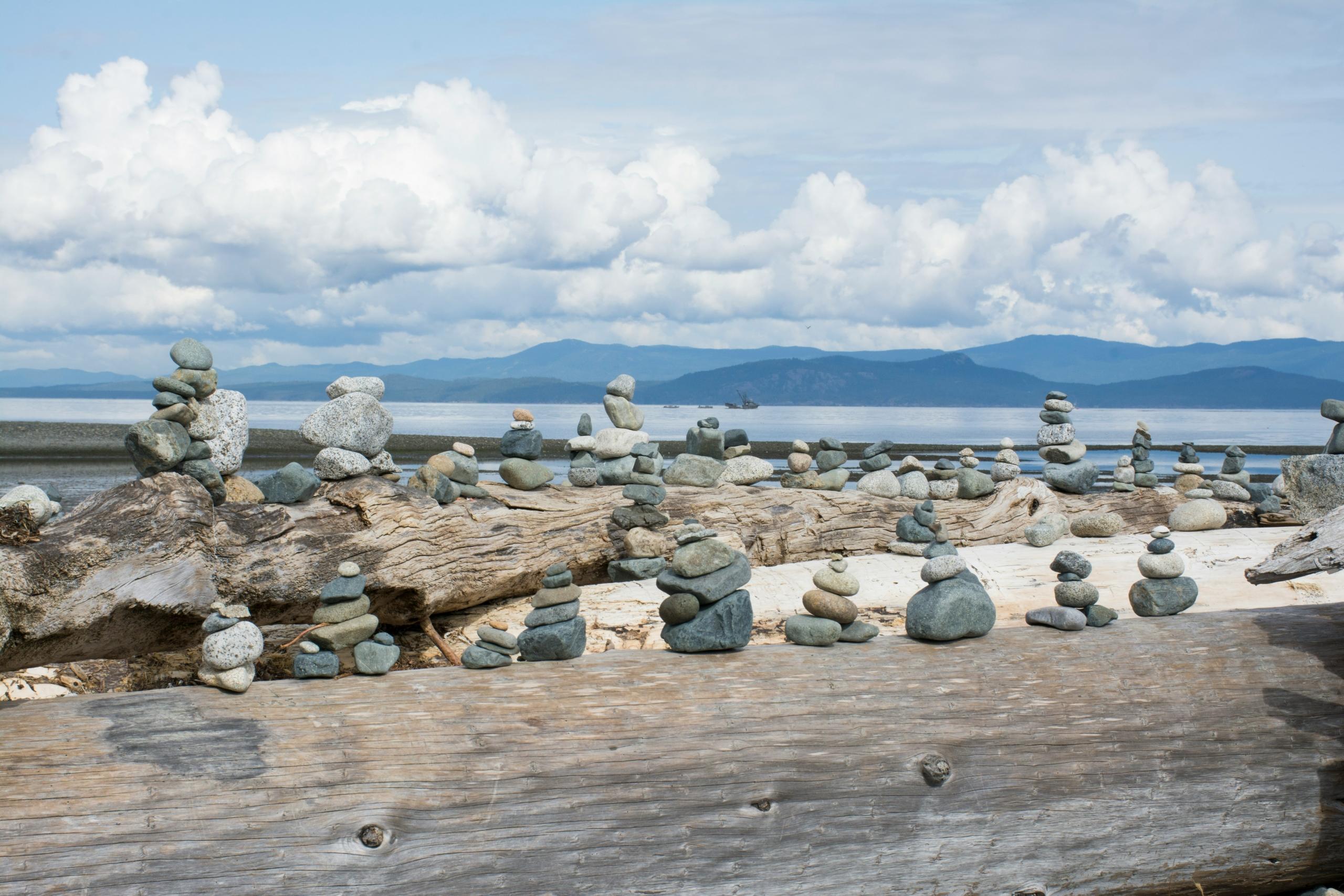
The case against casual stone-stacking is practical as much as cultural. In the Arctic, a traditional inuksuk carries information, a direction, a cache, a safe crossing. Decorative stacks built by visitors add noise to a system people rely on, and in some cases have genuinely misled travellers. Beyond the Arctic, piling stones in parks and along shorelines disturbs habitat for insects, fish and small animals, which is why several parks agencies now discourage it outright.
The case for is that many Inuit artists and educators actively teach inuksuk-building as a way of sharing the tradition, and that building one thoughtfully, with understanding of what it means, and in a place where it will not mislead anyone or damage anything, can be a genuine act of respect.
The practical guidance most sources converge on: learn what the forms mean before you build one, don't build in the Arctic or in protected habitat, and never dismantle or alter one you find.
Why Is It Forbidden to Destroy an Inukshuk?
Destroying an inukshuk is forbidden because of what these structures carry, practically, culturally and spiritually. Inuksuit have been used for centuries as essential markers in the Arctic, guiding travellers, marking sacred sites and indicating hunting grounds. They are not piles of stones but records of knowledge, built to outlast the people who made them.
The practical danger is direct. A destroyed inuksuk can leave someone disoriented in terrain where disorientation is life-threatening. Some of these markers have stood for hundreds of years and are still in active use.

The cultural harm runs alongside it. Dismantling an inuksuk erases a piece of Inuit knowledge that was deliberately placed and deliberately maintained. In a country now working to recognise and repair its relationship with Indigenous peoples, leaving these structures intact is a small and concrete form of respect.
The Inukshuk in Modern Canadian Culture
The inukshuk has become a prominent element in Canadian public life and design, much like the maple leaf. Here are four of its best-known modern appearances:
The large stone figure on the seawall at English Bay is an inunnguaq, built by Alvin Kanak of Rankin Inlet for Expo 86 and later moved to its current site. It is probably the most photographed example in Canada.
The Games logo was a stylised inunnguaq named Ilanaaq — Inuktitut for "friend." Its selection was celebrated internationally and criticised by some Inuit commentators, who noted that an inunnguaq is not an inuksuk and that the symbol was adopted without meaningful consultation.
An inukshuk stands on the grounds of the Governor General's residence, presented as a gift and recognised by Canadian Heritage as a national public artwork.
An inuksuk appears on both the flag and the coat of arms of Nunavut, adopted in 1999 — the clearest case of the symbol being used by the people it belongs to.
Respecting Indigenous Symbols
Traditional symbols like the inukshuk sit alongside emblems such as the Coat of Arms in Canada's visual identity - but they arrive differently. The maple leaf was chosen by the state. The inukshuk was borrowed from a living culture.
That difference is why the inukshuk's popularity raises questions about cultural appropriation. When a symbol becomes a souvenir, a logo or a garden ornament, the specific meanings it carried can be flattened into a vague sense of "northern" or "Canadian." Inuit commentators have pointed out that the version most Canadians recognise - the inunnguaq -is not even the form that carried the most traditional meaning.
Using the symbol well mostly comes down to knowing what it is, crediting where it comes from, and involving Inuit voices when it is used commercially or publicly.
Inukshuk: Frequently Asked Questions
What does an inukshuk symbolize?
Guidance, community and survival. An inukshuk signals that someone has passed this way before and left help behind, a direction, a cache, a safe route. In modern Canadian usage it has come to represent welcome, cooperation and mutual support.
Is it okay to make an inukshuk?
It depends where and how. Building one thoughtfully, with an understanding of what the forms mean, is often encouraged by Inuit educators. But decorative stone stacking is discouraged in the Arctic, where it can confuse people relying on genuine markers, and in parks and shorelines, where moving stones damages habitat. Never dismantle or alter an existing one.
Are inukshuks good luck?
Not traditionally. Inuksuit were practical navigational and communication tools, and some marked places of reverence, but they were not luck charms. The "good luck" association is a modern, largely commercial addition attached to souvenirs and jewellery.
Are inukshuks found only in Canada?
No. Inuksuit are found across the circumpolar Arctic, built by Inuit and related peoples in Greenland, Alaska and parts of Siberia as well as northern Canada. Canada has simply adopted the inukshuk most prominently as a national symbol.
What is the difference between an inukshuk and an inunnguaq?
An inunnguaq is the human-shaped figure with outstretched arms - "in the likeness of a human." A traditional inuksuk is defined by its function rather than its shape, and most historical examples look nothing like a person. Many Inuit hold that an inunnguaq is a distinct form and not strictly an inuksuk at all.
How do you pronounce inukshuk?
i-NUK-shook, with the stress on the middle syllable. The alternative spelling inuksuk is said i-NUK-suk. The plural is inuksuit, pronounced i-NUK-soo-eet.
Summarize with AI:
Did you like this article? Leave a rating!


 Loading...
Thanks, very enlightening and entertaining article. I’ve been fascinated by Inukshuks ever since seeing the Rush Test For Echo album cover. I’ve also seen miniature Inukshuks made on Kemil Beach, Indiana Dunes National Park.