

If your child is approaching Grade 9 in Ontario, one assessment worth preparing for is the Grade 9 Assessment of Mathematics administered by the Education Quality and Accountability Office (EQAO).
EQAO Grade 9 Math is an Ontario provincial assessment that measures the mathematics knowledge and skills students are expected to learn by the end of Grade 9.
In this article, we will explore the Grade 9 EQAO Mathematics assessment framework, examine its significance, and discuss effective ways to prepare for the assessment.
Who takes it: Students enrolled in MTH1W, Ontario’s de-streamed Grade 9 mathematics course.
What it measures: Mathematics knowledge and skills from the Ontario Grade 9 curriculum.
How it is delivered: Online, at school, through a multi-stage computer-adaptive assessment.
Important for 2026–27: The EQAO result contributes 20% of the final MTH1W course mark. 1


What EQAO Grade 9 Is and Who Takes It
The EQAO Grade 9 mathematics assessment is aligned with Ontario’s Grade 9 de-streamed mathematics curriculum, MTH1W, and is completed online at school.
Why the Assessment Exists
Unlike a traditional mathematics test, the EQAO Grade 9 math assessment is designed to provide information about student achievement and broader patterns in Ontario’s education system.
The EQAO Grade 9 results help educators, schools, school boards and policymakers identify strengths, learning gaps and areas where additional support may be needed. 2
For students enrolled in MTH1W, participation in the Grade 9 EQAO mathematics assessment is mandatory.
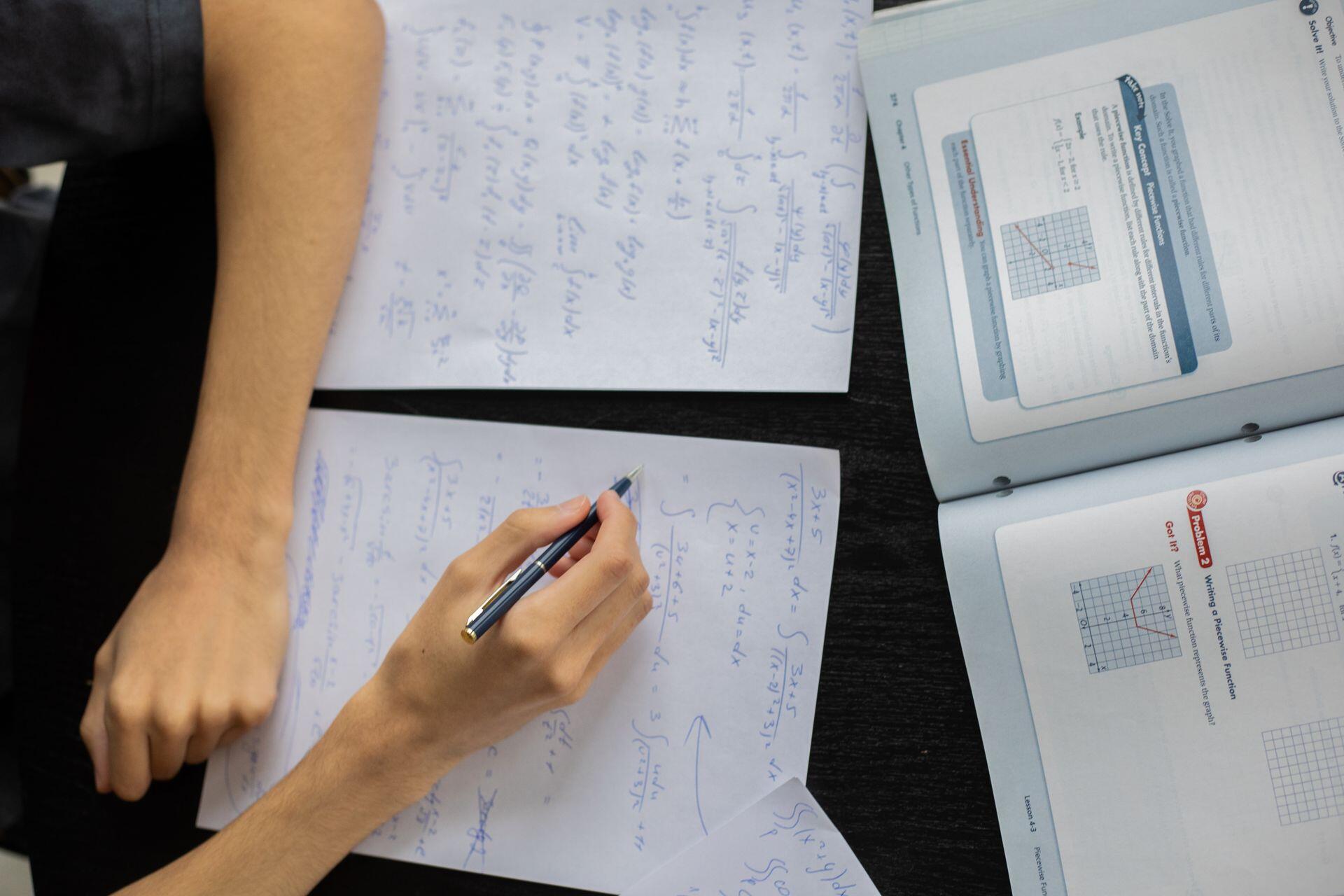
Beginning in the 2026–27 school year, the EQAO Grade 9 Mathematics assessment counts for 20% of the final MTH1W mark.
What Students and Families Should Expect From Schools
Students and families should treat school communication as the best source for a student’s exact test dates, schedule and arrangements.
Important tip: Schools can choose when to administer the sessions within EQAO’s official administration window, so families should not rely on dates from previous school years or rumours from other schools.
For the 2026–2027 school year, EQAO lists these Grade 9 mathematics administration windows.
| Administration | Dates |
|---|---|
| Winter | January 12 to February 5, 2027 |
| Spring | June 8 to June 30, 2027 |
The final two days of each window are reserved for students who missed the original dates or have extenuating circumstances.
The EQAO Grade 9 Math Test Format and Experience
Here's an overview of the EQAO Grade 9 math assessment.
📍Completed online at school.
📍It contains two sessions, Session A and Session B.
📍Each session has two stages and takes approximately 60 minutes.
📍In total, the assessment contains 54 questions: 50 operational questions used to determine the result and four field-test questions that do not count toward the outcome.
🖥️EQAO digital assessment
- Students answer single-selection, multiple-selection, drag-and-drop and drop-down questions.
- Students use an online platform with tools such as highlighting, line drawing, zoom and text-to-speech.
- Students work through adaptive stages
📝Everyday classroom math
- Classroom assignments may allow longer written solutions in their notebooks.
- Classroom work may rely more heavily on paper, notebooks or familiar software.
- Classroom tasks are generally selected by the teacher according to specific math topics
How Digital Questions Change the Way Students Work
Solving math exam questions online can be as effective and engaging when you are familiar with the assessment interface and digital tools available.
EQAO provides several sample tests and reflective questions specifically so students can become familiar with the platform and question types before the live assessment. Here are some examples:
| Habit | What to do | Example |
|---|---|---|
| Read carefully | Read the whole question before solving it. Identify what it asks for. | Decide whether a problem asks for a discount, sale price or original price. |
| Follow instructions | Check how many answers you must choose or enter. | Select two answers if the question says, “Choose TWO.” |
| Use rough work | Write calculations, draw diagrams and note important information. | Sketch a shape before using a measurement formula. |
| Check visuals | Read graph labels, table headings, scales and units carefully. | Check whether each graph interval represents 1, 5 or 10 units. |
| Use digital tools | Use the calculator, formula sheet, zoom or highlighter when helpful. | Use the formula sheet to check an area formula, then substitute the measurements. |
| Check your answer | Decide whether your answer is reasonable. | If a calculated discount is greater than the original price, review your work. |
| Organize your thinking | Use rough work to show your method, then enter the answer in the required format. | Calculate and compare the total cost of two payment options before selecting the cheaper one. |
Why Unfamiliar Questions Are Not Trick Questions
Having said that, EQAO questions may use contexts that students have not seen before, as compared to their usual math textbooks.

These questions are not "trick questions", but they require mathematical understanding to choose the right approach when it's applied in a new context or real-life situations.
For example, a student may know how to calculate a percentage in a worksheet but still need to decide whether the question is asking for a percentage increase, a discount, or a comparison to use the right calculation method.
A jacket costs $80. It is on sale for 25% off. What is the sale price?
Solution:
Find 25% of $80
Subtract the discount:
The student must recognize that a discount is subtracted from the original price. This is an example of applying percentage knowledge to a real-life financial situation, similar to the contexts used in EQAO Grade 9 mathematics.
How Destreamed Math Connects to EQAO
Ontario introduced the new Grade 9 de-streamed mathematics course, MTH1W, in September 2021. It replaced the previous Grade 9 split between academic (MPM1D) and applied (MFM1P) mathematics.
The province announced the change in June 2021, saying the new course would end Grade 9 streaming and keep pathways open for students. 3
EQAO then aligned its Grade 9 Mathematics assessment with the 2021 MTH1W curriculum. Additionally, EQAO explicitly states that students enrolled in MTH1W are assessed on the knowledge and skills defined in that curriculum. 4
87% of students think that a person can always get better at math.
Student questionnaire of 2022-2023 Provincial Results on growth mindset
Focus on Transfer Rather Than Course Labels
Under the current Grade 9 structure, the question of which pathway a student is in is no longer important. The more useful question is whether a student can apply learning beyond a rehearsed example.
EQAO groups mathematics questions into three categories of skills that students should demonstrate:
Knowledge and understanding
- Comprehension of its meaning and significance
Application
- Choose the right tool to solve a math problem
Thinking
- Demonstrate reasoning to solve a math problem
Treat Gaps as Instruction Signals
Across Ontario, the EQAO Grade 9 Mathematics assessment is one of the measures used to assess students’ mathematical knowledge and skills. 5
Source: Highlights of the Provincial Results on the Grade 9 Assessment of Mathematics (Students in English-Language Schools, 2025–2026 School Year) released by EQAO
At first glance, this figure shows a gap in mathematical skills among students. On a deeper level, it can help educators and parents to identify what the students are actually struggling with and later adapt their learning strategies and teaching methodologies.
☑️Difficulty with algebra: Practice more connecting equations, patterns and graphs.
☑️Difficulty with word problems: Learn how to identify relevant information.
☑️Difficulty with data questions: Review tables, graphs, averages and variability.
☑️Difficulty with geometry: Use diagrams to link formulas and measurements
Explore what the EQAO Grade 6 mathematics assessment entails.
What EQAO Grade 9 Math Measures
The assessment covers five main curriculum strands:
- 🔢Number
- 🔣Algebra
- 📊Data
- 📐Geometry and Measurement
- 💵Financial Literacy
It does not assess the content of the Mathematical Thinking and Making Connections strand as a separate content strand, but students are expected to apply mathematical processes while completing the assessment.
| Skill area | What the student may need to do |
|---|---|
| Number | Use operations, proportional reasoning, percentages and numerical relationships. |
| Algebra | Identify patterns, represent relationships and solve or interpret equations. |
| Data | Read graphs and tables, analyze information and make evidence-based conclusions. |
| Geometry and Measurement | Use properties, spatial reasoning, measurement relationships and formulas. |
| Financial Literacy | Apply mathematics to prices, budgets, rates, taxes, interest or other financial contexts. |
| Mathematical reasoning | Explain a method, compare strategies, justify a conclusion or check whether an answer is reasonable. |
Apply Math in Realistic Contexts
One common misconception among students is that struggling with real-life math problems means they are simply not cut out for mathematics.
What students need to realize is that real-life math problems test more than just their ability to perform routine calculations. They also require students to interpret a situation and translate it into mathematical terms.
Sample question: A school is planning a field trip for 120 students. Each bus can carry a maximum of 45 students. The school wants to use the fewest buses possible. Each bus costs $350 to rent. How many buses does the school need, and what will the total cost be?
🧠Intrepreting the problem
- At first glance, the calculations seem straightforward. A student might divide 120 by 45 and get approximately 2.67.
- However, the student must recognize that the school cannot rent 2.67 buses. (core step)
✏️Solving the problem
- Since each bus has a maximum capacity of 45 students, the number must be rounded up to 3 buses. (mathematical thinking)
- The student then needs to calculate the total cost: 3 × $350 = $1,050.
Show Thinking That Can Be Followed
Many educators encourage students to write down their steps to get to their final answer, as the steps actually reflect their mathematical thinking.
It allows them to see the relationship between the information, the method, the conclusion, and even catch their own mistakes too!

How to Read EQAO Results Without Overreacting
Remember, EQAO results should always be interpreted in context. While it has four achievement levels, these levels are descriptions of demonstrated achievement on the assessment and should not be treated as permanent labels.
Separate Assessment Results From Course Grades
The results only represent performance on one standardized assessment at one point in time (such as Grade 6 or Grade 9). EQAO reports Grade 9 mathematics outcomes using Levels 1 to 4. 6
The provincial standard is Level 3.
The student demonstrates limited achievement of the expected knowledge and skills.
The student demonstrates some achievement but has significant areas to strengthen.
The student meets the provincial standard for the expected knowledge and skills.
The student demonstrates achievement that exceeds the provincial standard in important respects
Families should consider the EQAO result alongside:
Turn Results Into One Useful Next Step
As parents, it would be good to help your child identify their strengths and weaknesses and focus on turning it into a learning priority instead of being fixated on a score. You can do so by reviewing your child's mathematical ability with their math educator.
“What level did my child get?
“Which mathematical skill should my child focus on next, and what is one activity or classroom strategy that can help strengthen it?"
Prepare Calmly for The EQAO Grade 9 Math Test
There is no need for special preparation for the EQAO Grade 9 Mathematics assessment, as it assesses knowledge and skills that are aligned with the Ontario curriculum taught in schools.
All students need is a consistent studying routine that builds familiarity, confidence and transferable mathematical habits rather than encouraging last-minute memorization.
Several weeks before
Review major Grade 9 concepts through normal classwork and identify any topics that still feel unfamiliar
One to two weeks before
Complete the official EQAO sample test and explore the digital tools
A few days before
Practise some questions, explaining why a method works and not just producing an answer
The day before
Prepare required materials, sleep normally and avoid heavy cramming
Test day
Read carefully, make a plan, use rough work, check reasonable answers and manage time calmly
Learn more about the right strategy to ace your EQAO math test.
Practise Explaining Choices
During the revision process, students should prioritize the skills to explain their reasoning and solutions instead of just memorizing a certain answer to a question.
Instead of memorizing an equation, the student should understand what its numbers represent.
For example, in this equation, y-3n+2, students should aim to explain that 3 shows how much the pattern increases each time, while 2 shows the starting amount. This understanding helps the student use the method in a different question.
Build a Recovery Plan for Difficult Questions
Of course, sometimes students might come across some challenging questions where they cannot give a final answer directly. Instead of panicking, they can always pause, move on to the next question, and then come back later with a fresh perspective.
Remember, getting stuck does not mean the assessment is going badly. The key is to have a practical recovery routine to make the next sensible mathematical choice while still staying on time throughout the test duration.
References
- Ontario Ministry of Education. “Growing Success: Assessment, Evaluation and Reporting (Kindergarten to Grade 12).” Ontario.ca, 21 Aug. 2026, https://www.ontario.ca/page/growing-success-assessment-evaluation-and-reporting-ontario-schools-kindergarten-grade-12. Accessed 7 Oct. 2026.ontario
- Education Quality and Accountability Office. “General.” EQAO, 12 June 2026, https://www.eqao.com/frequently-asked-questions/general/. Accessed 7 Oct. 2026.eqao
- Ontario Newsroom. “Modernized Math Course Prepares Students for Jobs of the Future and Life Skills.” Government of Ontario, 9 June 2021, https://news.ontario.ca/en/release/1000301/modernized-math-course-prepares-students-for-jobs-of-the-future-and-life-skills. Accessed 7 Oct. 2026.news.ontario
- Education Quality and Accountability Office. Highlights of the Provincial Results, 2022–2023. 2023, https://www.eqao.com/wp-content/uploads/2023/08/highlights-provincial-results-2023-g9.pdf. Accessed 7 Oct. 2026.
- Education Quality and Accountability Office. Grade 9 Assessment of Mathematics Framework.EQAO, n.d., https://www.eqao.com/wp-content/uploads/2025/01/Framework-grade9-assessment-of-mathematics.pdf. Accessed 7 Oct. 2026.
- Education Quality and Accountability Office. “Grade 9 Assessment of Mathematics.” EQAO, 15 Sept. 2026, https://www.eqao.com/frequently-asked-questions/faq-grade-9-assessment-of-mathematics/. Accessed 7 Oct. 2026.
Summarize with AI:
Did you like this article? Leave a rating!

 Loading...