

Every 1st of July, Canadians come together to celebrate Canada Day, the anniversary of the Canadian Confederation which took place on the 1st of July in 1867.
Through the Confederation, Canada slowly moved towards a self-governing entity from the British government. However, the process of forming a united nation from several divided territories was not an easy one.
In this article, we will be discussing one of Canada's most important historical events from these key angles:
- The division of regions before the Canadian Confederation
- The conferences leading to the Canadian Confederation
- Important figures who contributed to the confederation's success
- Significance and impacts of the Canadian Confederation


Before The Canadian Confederation: Divisions of Regions
Let's look at how Canada's various regions were divided before the confederation. Essentially, these regions were collectively known as British North American colonies and governed according to their geographical location.
The colonies include Upper Canada, Lower Canada, the Maritime Provinces (which include Nova Scotia, New Brunswick, and Prince Edward Island,) New Foundland and Labrador, Rupert’s Land and the North-Western Territory, British Columbia, and Vancouver Island.
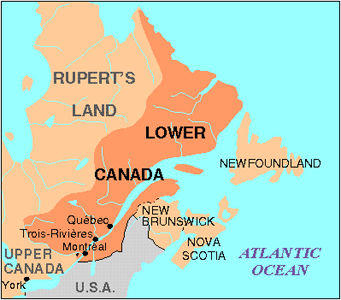
In 1841, the British government united Upper Canada and Lower Canada into one province named the Province of Canada under the Act of Union to handle the ongoing violent riots in the regions and foster assimilation among the French Canadians.
From the province of Canada, it was divided again into Canada West (modern-day Ontario) and Canada East (modern-day Quebec).
During that time, many Canadians in the Province of Canada were affected by the growing influence of the American Civil War, fearing that America would take over Canada. Furthermore, there were also growing political tensions between the English-speaking Canada West and French-speaking Canada East communities in the province.
Sensing that a political deadlock could only cause more long-term damage to the province, three key politicians from the province of Canada came together to propose a coalition, which made way to the first Canadian Confederation.
Both Canada East and Canada West have equal legislation representation but often have divisive opinions, leading to great difficulty in passing legislation effectively.
Important Figures Who Made The Confederation A Success
We can't talk about the birth of modern Canada without mentioning these three key figures. Known as the Fathers of Confederation, they are none other than John A. Macdonald, George-Étienne Cartier and George Brown.
A core Conservative politician from Canada West, John Macdonald realised that he needed to work together with his political rival, George Brown from the Liberal Party to form a stable government amid the political instabilities.
Together with his counterpart in Canada East, George-Étienne Cartier, the three of them came together to form the Great Coalition in 1864 1.
Macdonald, who would become Canada's first prime minister led the Great Coalition and conducted several discussions, to form a strong federal system for equal delegation of power among the two provinces.
Confederation is only yet in the gristle, and it will require five years more before it hardens into bone.
John A. Macdonald
The coalition would later meet up with leaders from British North American colonies (specifically the Maritime Provinces) through several conferences to discuss a union with the Province of Canada to form the initial Canadian Confederation.
The Conferences Leading To The Confederation
The Great Coalition went through a series of conferences to make the confederation a success. It took 3 years to finalise the confederation.
Charlottetown Conference (1864)
Held at the capital of Prince Edward Island, this conference was the start of something revolutionary.
It was a historical meeting between a delegation from the Province of Canada and key delegates from Nova Scotia, New Brunswick, and Prince Edward Island to discuss the terms and conditions of the Maritime Provinces to form the Canadian Federation.
After a series of discussions and negotiations, both Nova Scotia and New Brunswick decided to join the Canadian Federation.
On the other hand, the delegates from Prince Edward Island opposed the union, believing that joining the federation would shrink the province's power.

A large island known for its beautiful landscape and rich seafood, Prince Edward Island joined the Canadian Federation, nine years later in 1873.
Quebec Conference (1864)
The focus of the Quebec Conference centred around the issue of the distribution of powers.
With the participation of Nova Scotia and New Brunswick, there needs to be a balance of authority in provincial governments and also how the parliament should run.
Some of the discussions included the separation of legislation boundaries between federal and provincial powers, the decision to make Ottawa the capital of the Confederation, and the drafting of the 72 Quebec Resolutions, which eventually formed the basis of Canada's Consitution.
London Conference (1866-1867)
This marked the final conference of the Canadian Confederation. After finalising the debates around the 72 Quebec Resolutions, a final bill of the Confederation was drafted and submitted to the British government for final approval. (Quebec has other history mentions as well, check out the Quiet Revolution.)
Under the British North America Act, the Canadian Confederation finally came to fruition on the 1st of July 1867. The official union of the Province of Canada, Nova Scotia and New Brunswick is now called the Dominion of Canada.
Significance and Impacts of the Confederation
The establishment of the Dominion of Canada marked a new chapter in Canada's history as a nation.
For the first time, the provinces of Canada can benefit from a federal system with both central and provincial governments. This framework offers political and economic stability to the country in the long run while also promoting increasing self-governance from the British government.
In fact, the British supported the notion of the Confederation as it was becoming more time-consuming and costly to manage the British North American colonies.
Additionally, it also helped to balance the interests of both the English-speaking and French-speaking communities (Quebec) in the country — building a nation with a rich cultural and regional identity.

Undeniably, the most powerful impact of the Confederation is the expansion and growth of the country into the modern Canada that we know today, consisting of 10 provinces and 3 territories.
Through countless negotiations and discussions, other provinces followed suit, with new provinces and territories being created and added to join the federation.
For instance, the Manitoba province was created Under the 1870 Manitoba Act 2, while the Nunavut territory was created in 1999 after it was separated from the Northwest Territories.
From the union of the first four provinces in 1847, Nunavut eventually became the final territory to form Canada 132 years later.
Refer to the table below for the timeline of the complete Canadian Confederation.
| Provinces/ Territories | Year Joined (Confederation) |
|---|---|
| Ontario | 1867 |
| Quebec | 1867 |
| Nova Scotia | 1867 |
| New Brunswick | 1867 |
| Manitoba | 1870 |
| Northwest Territories | 1870 |
| British Columbia | 1871 |
| Prince Edward Island | 1873 |
| Yukon | 1898 |
| Alberta | 1905 |
| Sakatchewan | 1905 |
| Newfoundland and Labrador | 1949 |
| Nunavut | 1999 |
Benefits of Learning Canadian History With A Superprof Tutor
You may have noticed that the road to forming the Canadian Confederation 3 spanned over a century. In between, Canada also participated in the First World War, and Second World War.
Many key incidents and major historical events were unfolding in Canada's history.
If you are seeking to have a comprehensive and multi-angled learning experience in this subject, you can opt for private tutoring sessions.
Nothing beats the thrill of finding an experienced history tutor through a reliable tutoring platform like Superprof.

At Superprof, you can easily find a tutor who offers affordable physical or online history lessons near you (regardless of which city of Canada you're located in).
Our Superprof tutors are highly experienced and qualified to teach students of different learning levels and learning paces.
It does not matter if you are studying for your high school diploma or if you are an aspiring writer who is doing some history research for your next book, your Superprof tutor can tailor the lessons according to your needs and interests. For example, you can request specialised lessons on women's rights movements in Canada if it's something that you are passionate about.
Another benefit of learning from a Superprof tutor is the flexibility in terms of scheduling your lessons. Unlike a regular class at a tuition centre, you can easily arrange your preferred tutoring session with your tutor, even in the comfort of your home.
Additionally, one-to-one tutoring sessions allow you to have an immersive and interactive learning experience. There's no need to wait for other students when it comes to asking questions or seeking immediate clarification or feedback. The pace of the lessons will be less rigid and rushed, offering you sufficient time to understand the topic taught before moving on to the next lesson.
Now, it's time to put your passion for Canada's history into action. Head to the Superprof Canada homepage and start browsing the tutors' profiles. Go through the basic information of the tutor carefully, and pick the perfect tutor who matches your performance in terms of hourly rates, teaching methodology, and teaching experience.
Also, don't forget to read the reviews of their former/current students to have an idea of their teaching style before finalising your decision. From there, you can message them directly to arrange for your first history lesson!
Most Superprof tutors offer their first lesson for free, so be sure to seize this amazing opportunity to have the best of both worlds as you dive deep into the beauty of Canada's history!
References
- Great Coalition of 1864. The Canadian Encyclopedia. (2006, February 7). https://www.thecanadianencyclopedia.ca/en/article/great-coalition
- Manitoba Act. The Canadian Encyclopedia. (2006, February 7). https://www.thecanadianencyclopedia.ca/en/article/manitoba-act
- Confederation. The Canadian Encyclopedia. (2013, September 22). https://www.thecanadianencyclopedia.ca/en/article/confederation
Summarize with AI:
Did you like this article? Leave a rating!


 Loading...