
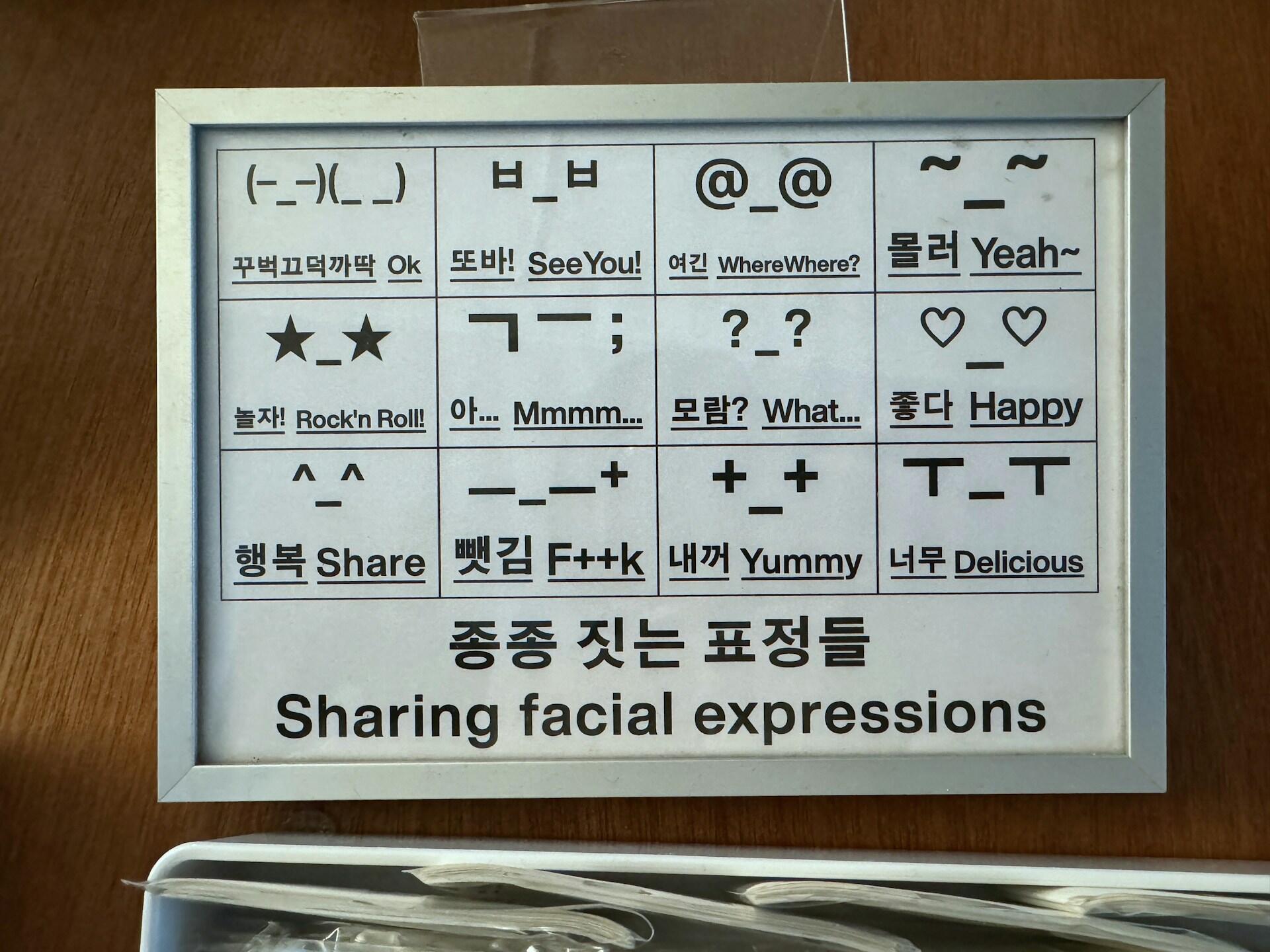

The Korean alphabet, known as Hangul, has 19 consonants and 21 vowels used in modern Korean; is a unique and logical writing system created in the 15th century by King Sejong the Great and his scholars. Before Hangul, Koreans used Classical Chinese characters. The characters needed to be better suited to Korean.
People respect Hangul for its scientific and logical design. Unlike many alphabets, Hangul's letters are made to show the sounds of spoken Korean. The consonant characters are based on the shape of the mouth and tongue when pronouncing them. At the same time, the vowels are constructed from three fundamental shapes representing the sky (a dot), the earth (a horizontal line), and a human (a vertical line).
Hangul was designed to be simple and accessible, promoting literacy among the people. The name "Hangul" combines the Korean words "han" (한), meaning "great" or "Korean," and "geul" (글), meaning "script," translating to "great script" or "Korean script."


How Many Letters Are in the Korean Alphabet?
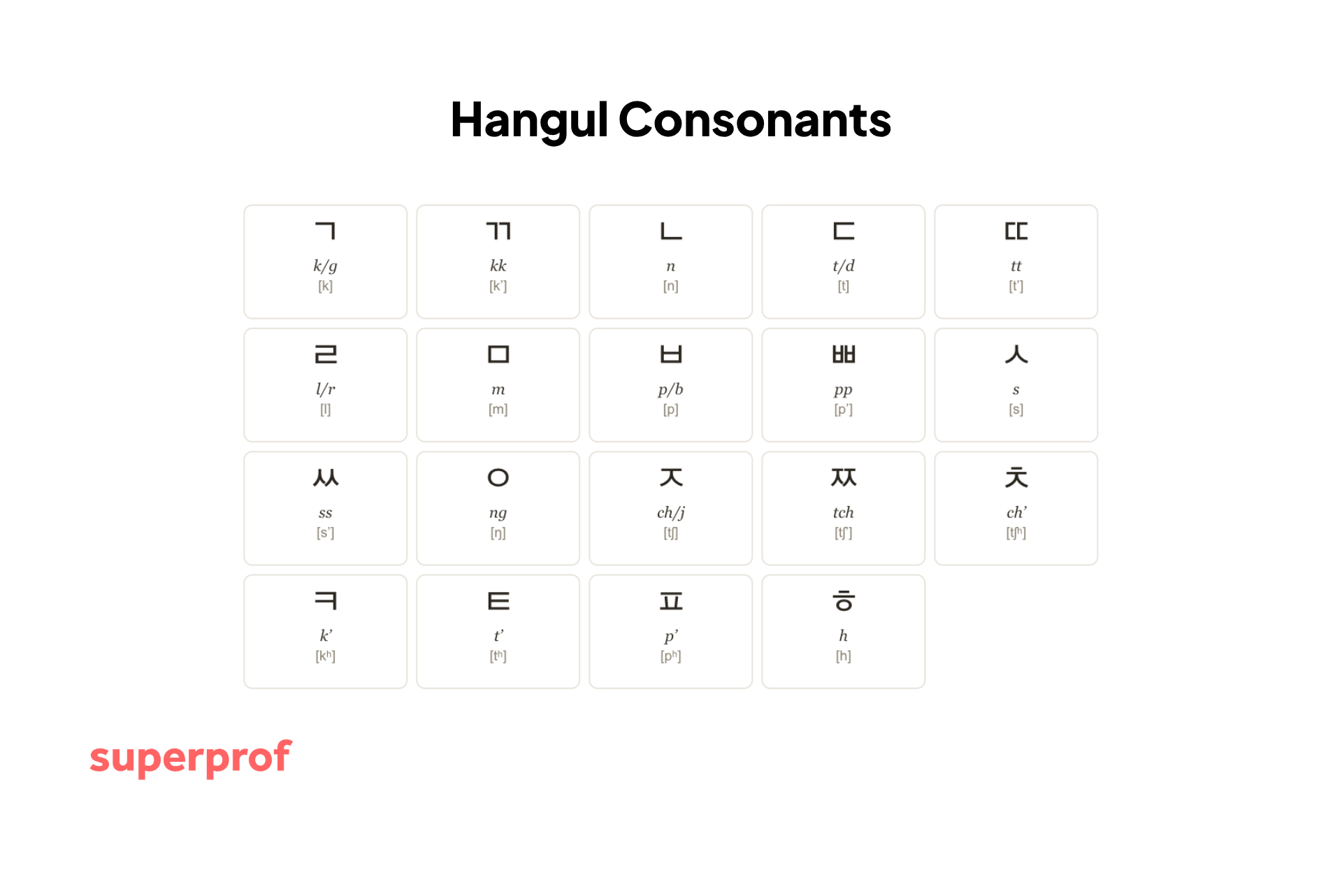
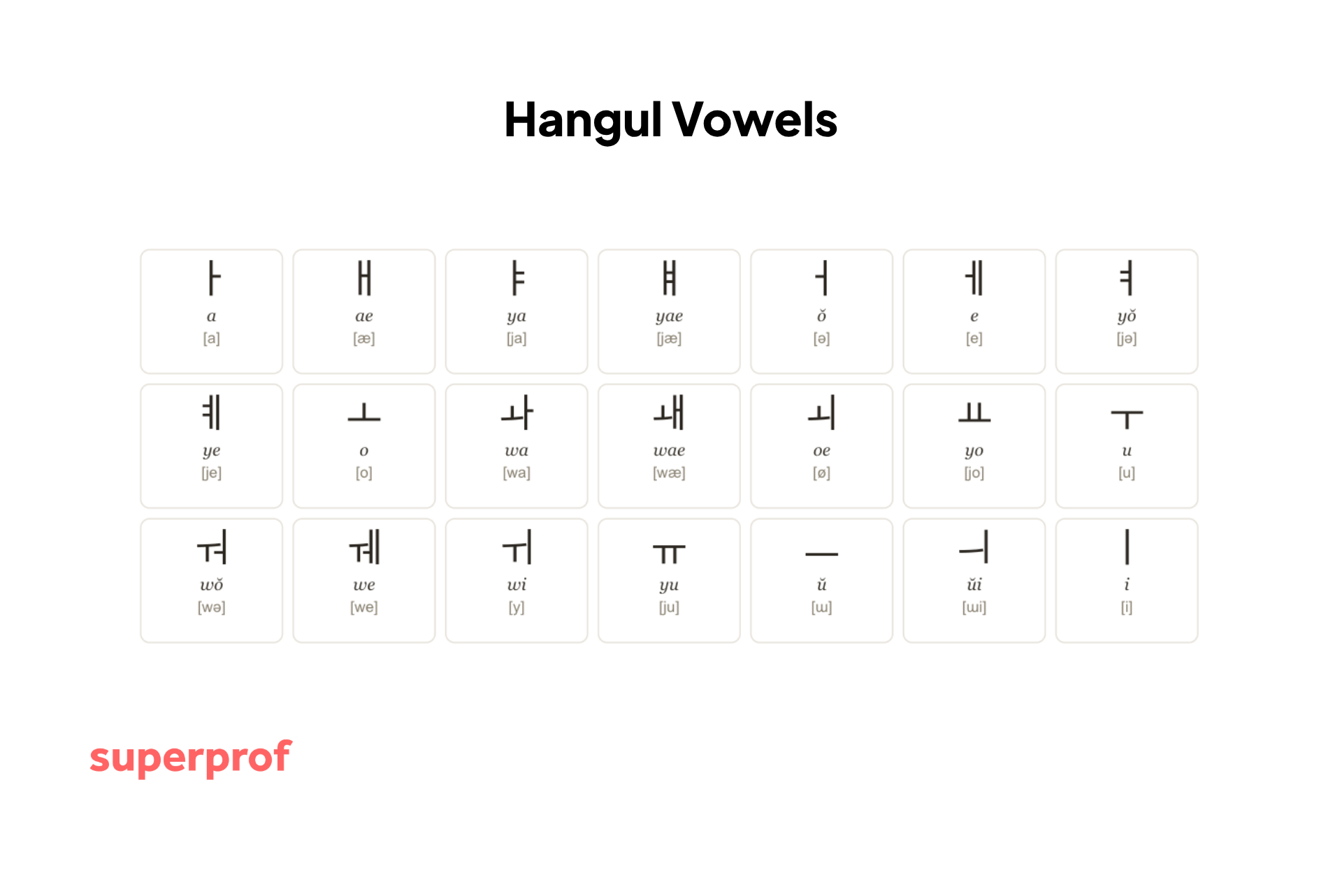
Hangul consists of 24 basic letters: 14 consonants and 10 vowels. Additionally, 16 compound letters are formed by combining these basic ones, bringing the total to 40 letters. The English alphabet has 26 letters. Hangul's structure is more modular. It allows using fewer symbols to make a vast array of sounds.
Comparing Hangul with the English Alphabet
English uses a linear arrangement of letters to form words. In contrast, Hangul's syllabic blocks create a more compact visual structure. Each block has at least one consonant and one vowel; some have extra consonants. This makes the script accessible to parse once you understand its basics.
Sound representation of the Korean Alphabet
Hangul and English differ significantly in sound representation. Hangul includes sounds that are not present in English and vice versa. For example, Hangul has distinct letters for sounds that English represents with combinations of letters, such as "ch" (ㅊ), "sh" (ㅅ), and "ng" (ㅇ).
Conversely, English has sounds like "f" and "v" which Hangul approximates using ㅍ (p) and ㅂ (b). Korean is a phonetically precise language where characters have a direct, highly predictable relationship with spoken sounds.
Writing Words
In English, words are written in a linear sequence of individual letters, while in Hangul, words are constructed from syllabic blocks. Each block has at least one consonant and one vowel, arranged in a grid pattern. For example, the English word "love" is written as four separate letters, whereas the Korean word 사랑 (sarang) is written in two syllabic blocks, 사 (sa) and 랑 (rang). Syllables give a rhythm to the Korean alphabet by using consonants and vowels logically.
Learning the alphabet is a vital step in learning the language. Understanding the principles of Korean grammar can accelerate your learning about how to write and speak Korean.
Around 1443, according to Korean historical sources, during the creation of Hangul by King Sejong and other intellectuals, the new writing system was modelled on the shapes of the vocal organs and the philosophical concepts of heaven, earth, and humanity. Therefore, Hangul's vowels would be built on three simple cosmic elements: a dot representing heaven (•), a flat line representing earth (ㅡ), and a standing line representing humanity (ㅣ).
The Structure of Hangul: Consonants and Vowels
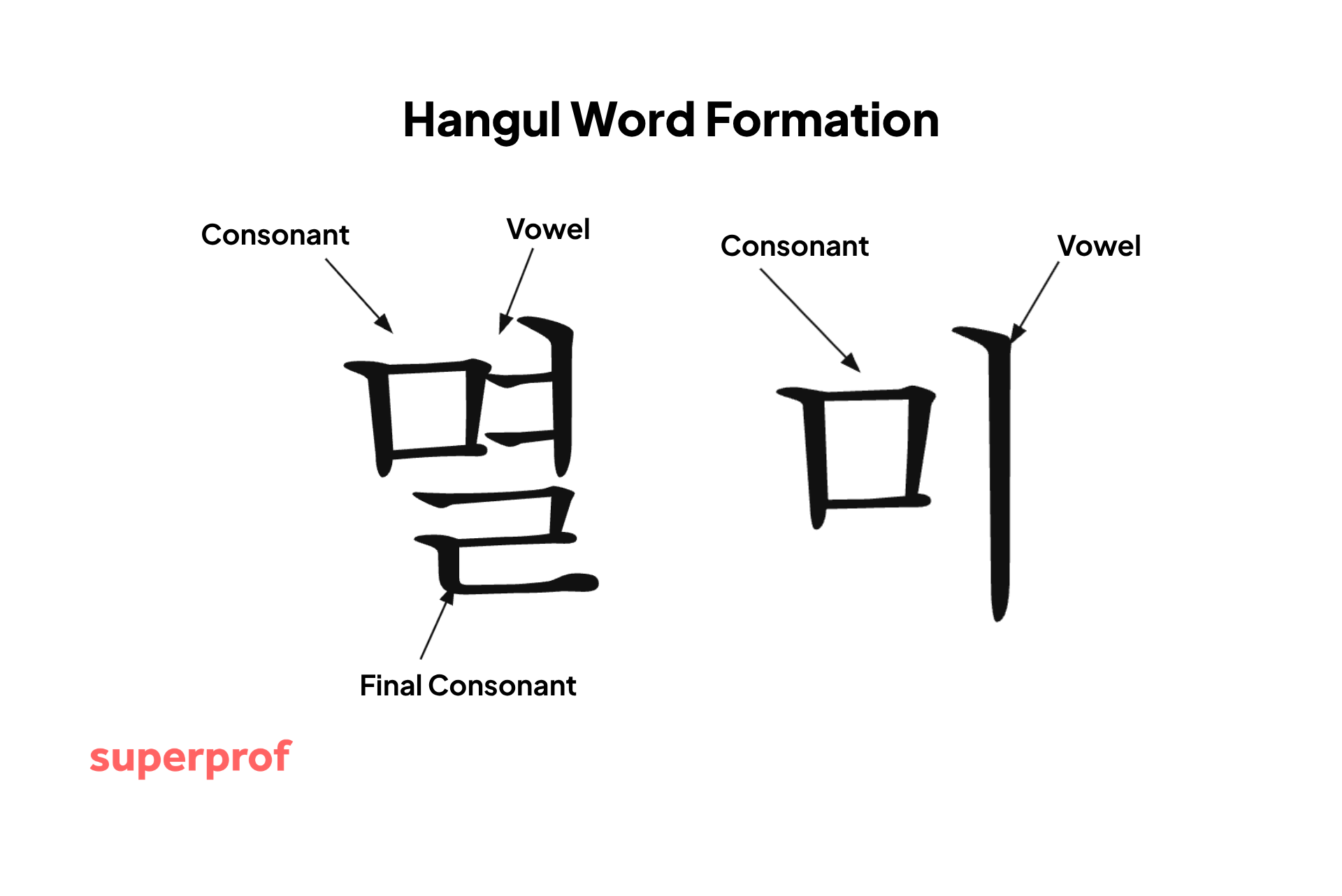
Korean pronunciation is based on syllable blocks, not on individual letters as in English, with every Hangul syllable containing at least one consonant and one vowel; every single block requires at least one vowel. Vertical vowels (like ㅏ) sit to the right of the starting consonant, while horizontal vowels (like ㅜ) sit directly beneath it.
In Korean, you have to pay special attention to consonants; it's important to note that double consonants (ㄲ, ㄸ, ㅃ, ㅆ, ㅉ) are pronounced with more tension than the basic consonants. The consonant that rests at the bottom of the syllable block is called Batchim, and its pronunciation can change or be cut short compared to when it starts a word.
Hangul's syllabic blocks are a distinctive feature that sets it apart from many other writing systems. These blocks are formed by combining consonants and vowels in a specific order.
Forming Syllabic Blocks
A typical syllabic block in Hangul can be structured in several ways:
| Korean Structure and Pattern | Example |
|---|---|
| CV (Consonant + Vowel) | 가 (ga) |
| CVC (Consonant + vowel + Final Consonant) | 집 (jip) |
| CVCC (Consonant + Vowel + Double Final Consonant) | 값 (gap), 닭 (dak), 없 (eop) |
Consonant + Vowel (CV): This is the simplest form, with a consonant followed by a vowel. For example:
- 가 (ga): The consonant ㄱ (g) combined with the vowel ㅏ (a).
| Word with Hangul | English word | Romanization |
|---|---|---|
| 가 | go (verb stem) | ga |
| 나 | me / I (informal) | na |
| 너 | you (informal) | neo |
| 비 | rain | bi |
| 소 | cow | so |
Consonant + vowel + Consonant (CVC): In this form, a final consonant, known as a "batchim," is added to the CV structure. For example:
- 각 (gak): The consonant ㄱ (g), the vowel ㅏ (a), and the final consonant ㄱ (k).
| Word with Hangul | Word in English | Romanization |
|---|---|---|
| 집 | house | jip |
| 밥 | cooked rice / meal | bap |
| 문 | door | mun |
| 손 | hand | son |
| 물 | water | mul |
Consonant + Vowel + Consonant + Consonant (CVCC): Some syllables have two final consonants. This structure is less common but still essential. For example:
- 없다 (eopda): The consonant ㅇ (silent), the vowel ㅓ (eo), and the final consonants ㅂ (b) and ㅅ (t).
| Worth with Hangul | Word in English | Romanization |
|---|---|---|
| 읽 | read (verb stem) | ik |
| 앉 | sit (verb stem) | an |
| 값 | price | gap |
| 닭 | chicken | dak |
| 없 | not exist / there isn't (verb stem) | eop |
Each block represents one syllable, and multiple blocks are combined to form words. For example, the word for "Korea" in Hangul is 한국 (hanguk), composed of two syllabic blocks: 한 (han) and 국 (guk).
Korean Alphabet Pronunciation in English
Learning to pronounce Hangul correctly is essential for mastering the Korean language. Each Hangul letter corresponds to a specific sound, which can be approximated using English phonetics.
People usually think learning Korean and Japanese is relatable because they belong to the same language family. But despite the debate, there are many similarities and differences between Korean and Japanese that can be considered for those interested in learning both languages.
Consonants
- ㄱ (g/k)
- ㄴ (n)
- ㄷ (d/t)
- ㄹ (r/l)
- ㅁ (m)
- ㅂ (b/p)
- ㅅ (s)
- ㅇ (silent/ng)
- ㅈ (j)
- ㅊ (ch)
- ㅋ (k)
- ㅌ (t)
- ㅍ (p)
- ㅎ (h)
Vowels
- ㅏ (a)
- ㅑ (ya)
- ㅓ (eo)
- ㅕ (yeo)
- ㅗ (o)
- ㅛ (yo)
- ㅜ (u)
- ㅠ (yu)
- ㅡ (eu)
- ㅣ (i)
Try to develop decent pronunciation before moving forward with the learning process. Romanization should be used only as a temporary aid, as reading Hangul directly leads to better pronunciation.
Korean grammar has a strong structure defined by an "honorific system", as its built-in levels of politeness. Korean is a language in which verbal endings change dynamically based on the speaker's social status relative to the listener.
How to write Korean words for beginners
First things first. After the consonants and vowels, the next step is the syllables. Each Korean syllable block is made up of an initial consonant, a vowel, and in some cases a final consonant. When writing a syllable, begin with the initial consonant, add the vowel next, and finish with the final consonant if one is included. Following the correct stroke order for each letter helps create clear and consistent handwriting.
👨🏻🏫 For example, the phrase “My name is John” in Korean is written as:
제 이름은 존입니다
(je ireumeun jonimnida).
✍🏻 In this example, each syllable is constructed step by step following the structure:
- 제 (je) → I / my
- 이름은 (i-reum-eun) → name + is
- 존 (John) → John
- 입니다 (im-ni-da) → is / am
🇨🇦 I’m from Canada in Korean is:
저는 캐나다에서 왔습니다
(jeoneun kaenada-eseo watseumnida)
✍🏻 Follow the structure:
- 저 (jeo) → I (polite)
- 는 (neun) → topic marker ("me")
- 캐나다 (kaenada) → Canada
- 에서 (eseo) → from / location
- 왔 (wat) → came (past form of “to come”)
- 습니다 (seumnida) → formal ending
🍜 I like Korean food
저는 한국 음식을 좋아합니다
(jeoneun hanguk eumsigeul joahamnida)
✍🏻 Syllable construction from Korean to English:
- 저 (jeo) → I
- 는 (neun) → topic marker
- 한국 (hanguk) → Korea
- 음식 (eumsik) → food
- 을 (eul) → object marker
- 좋아합니다 (joahamnida) → like (formal polite verb)
👨🏻🏫 I’m 25 years old
저는 스물다섯 살입니다
(jeoneun seumul-daseot sarimnida)
✍🏻 From English to Korean:
- 저 (jeo) → I
- 는 (neun) → topic marker
- 스물다섯 (seumul-daseot) → 25
- 살 (sal) → years old
- 입니다 (imnida) → am/is (formal polite ending)
To avoid writing mistakes in Hangul, start with the horizontal line rather than the vertical. You'll become a natural with practice. Follow the next guide step by step to write your first Korean words:
- Learning to write Korean starts with understanding the Hangul alphabet and becoming familiar with its basic consonants and vowels.
- Beginner students of Korean should first learn the correct stroke order for each letter inside the square-shaped syllable blocks that form Korean words.
- Start your Hangul writing with simple syllables before moving on to complete words.
- Focus on neat, balanced syllable blocks; it will eventually help to develop good handwriting habits from the beginning. The practice of Korean writing serves as a strong foundation for reading and vocabulary building, so it's a step you can't skip!
How to write the numbers in Korean
Like Korean words, numbers are written in Hangul syllable blocks and follow the same rules; the main difference is that they use two distinct number systems. One is commonly used for counting people, objects, ages, and hours (the native Korean numbers), and the Sino-Korean system, designed for dates, money, addresses, phone numbers, minutes, seconds, and numbers above 99.
Their logic relies on the fact that it allows Korean speakers to immediately categorize data, purely by the phonetic root of the number used.
Learning the spelling of Korean numerals is a whole different game for Canadian students. Before learning large numbers, the best advice for beginners in Korean is first to master the syllable block system (each syllable is written from left to right and top to bottom), so they can later memorize the numbers from 1 to 10 in both the native and Sino systems, and build larger numbers later more easily. The main differences between the Native Korean number system and the Sino-Korean numbers are:
🍎 Native Korean number system
- Native Korean numbers are generally used only up to 99. After that, Korean speakers normally switch to the Sino-Korean system.
- Age relies strictly on the Native Korean system
- Native Korean numbers are completely distinct phonetic words.
- When Native Korean numbers from 1-4 are attached directly to a counting-unit noun (like gae for objects or myeong for people), their spelling slightly changes. Basically, they change form when placed before counters, so learning the appropriate counter words (such as 명 for people and 개 for items) is just as important as learning the numbers themselves.
- Native Korean Numbers from 1-10: 1 (하나), 2 (둘), 3 (셋), 4 (넷), 5 (다섯), 6 (여섯), 7 (일곱), 8 (여덟), 9 (아홉), and 10 (열).
🔟 Sino-Korean system
- Sino-Korean numbers are shorter, almost entirely single-syllable blocks
- Prices always use the Sino-Korean number system, same as building numbers and floor levels.
- The numbers in the Sino-Korean system are built by combining basic number words, as in French. For example, 20 = 이십 (i-sip), literally "two-ten”. But also, like in English, 35 = 삼십오 (sam-sip-o), meaning 30 (삼십) and 5 (오).
- Sino-Korean Numbers from 1-10 are written as follows: 0 (영 or 공), 1 (일), 2 (이), 3 (삼), 4 (사), 5 (오), 6 (육), 7 (칠), 8 (팔), 9 (구), and 10 (십).
There are two words for zero in Korean: 영 (yeong) is commonly used in mathematics and temperatures, while 공 (gong) is commonly heard in phone numbers and identification numbers.
Practical Tips for Learning Hangul
Mastering Hangul can be a rewarding experience. Our coherence guide for learning Korean has already helped many students to find this journey more fun. There are several strategies to make the process smoother.
Effective Learning Strategies
Flashcards are an excellent way to memorize the characters, while mnemonics can help recall them. For instance, you might remember that ㅁ (m) looks like a mouth, which makes the "m" sound.
Writing out the characters repeatedly will help you learn their shapes and stroke orders. Start with simple syllabic blocks and gradually move to more complex ones. Trying to write every word repeatedly will also help you understand how to read. Practice daily and dedicate time to mastering complex writing habits.
Watch Korean dramas, listen to K-pop, and read simple Korean texts. This will help you see Hangul in action and improve your listening and comprehension skills.
Regularly testing your knowledge with quizzes can reinforce what you've learned and help you identify areas that need improvement.
Joining a study group can provide motivation and support. You can practice with others, share tips, and learn from each other's experiences.
Online platforms like Superprof offer access to experienced Korean language tutors who can provide personalized lessons and guidance. Engaging with a Korean tutor can significantly enhance your learning experience by providing tailored instruction and feedback.
The Role of Hangul in Korean Culture
Hangul is more than just a writing system; it symbolizes Korean identity and pride. It has played a crucial role in unifying the Korean people and preserving their language and culture.
Cultural Significance
- National Pride: Hangul Day is on October 9th in South Korea. It commemorates the creation of Hangul and its importance in Korean history.
- Literary Contributions: Hangul has created much literature, ranging from classical poetry to modern novels. It has also made Korean culture more accessible to its people.
Educational Impact
- Hangul's simplicity has made literacy more accessible in Korea, resulting in one of the highest literacy rates in the world. The script's efficiency has also contributed to the rapid spread of information and ideas, fostering a vibrant cultural and intellectual environment.
Modern Usage
- In contemporary Korea, Hangul is used daily, from official documents and literature to digital communication and street signs. Its adaptability to modern technology has further cemented its role in Korean society.
With all the tips and advice given to you, learning Korean should not seem as hard as before, and you can start your learning journey soon.
Use the provided tips and resources to enhance your learning journey, and consider engaging a tutor for personalized instruction. Embrace the challenge and enjoy the rewarding experience of learning Hangul.
References
- Hangeul Mate. How to Write Korean: The Complete Hangul Stroke Order Guide. (18-02-2026). Available at: https://www.hangeulmate.com/blog/hangul-stroke-order (Accessed: June 2026).
- Korean Cultural Center NY- The spirit and principles behind Hangeul's creation (No Date). Available at: https://www.koreanculture.org/gallery-korea/2024/04/07/hangeul (Accessed: June 2026).
- Korea Journal Central - The Journal of Translation Studies. A Study on Arabic Numeral Expressions in English-Korean Translation (No Date). Available https://journal.kci.go.kr/kats/archive/articleView?artiId=ART001458535 (Accessed: June 2026).
- Kimsooja. Contemplation on top of the Horizontal and Vertical System - Suh Young-Hee (2012). Available at: https://kimsooja.com/texts/suh-young-hee-kimsooja-contemplation-on-top-of-the-horizontal-and-vertical-system (Accessed: June 2026)
Summarize with AI:
Did you like this article? Leave a rating!


 Loading...
me ayudo demasiado a aprender, entendi la escritura y el Hangul.
Hola Isabella, nos alegramos de poder ayudarte! También puedes consultar nuestros profesores particulares aqui si quieres seguir aprendiendo :)
This article is very helpful 👍🏻
yes it is I’ve been wanting to learn Korean forever!