


Math has a language of its own. Sometimes, understanding that language can feel almost as challenging as solving the problem itself. Understanding mathematics means learning the language of maths in its own right.
You might know perfectly well how to multiply two numbers, only to see the word product on a test and suddenly wonder what the question wants. Or perhaps you understand fractions until someone starts talking about numerators, denominators, improper fractions, and equivalent fractions.
Then algebra arrives with variables, coefficients, expressions, and equations. Geometry brings along perpendicular lines, hypotenuses, and circumferences. Before long, your math lesson can start sounding like someone quietly switched languages halfway through class.
Fortunately, there is some good news: math vocabulary is much more logical than it first appears.
Most math terms belong to families. Learn the family, and the individual words become much easier to remember. Addition has its own vocabulary. So does division. Algebra terms connect to one another, geometry words describe related parts of shapes, and graphing terms work together to explain how we represent mathematical relationships visually.
| Math Term | Simple Definition | Example |
|---|---|---|
| Number | A value used to represent quantity | 7 |
| Operation | A mathematical process | Addition |
| Sum | The result of addition | 5 + 4 = 9 |
| Difference | The result of subtraction | 9 − 4 = 5 |
| Product | The result of multiplication | 3 × 5 = 15 |
| Quotient | The result of division | 20 ÷ 4 = 5 |
| Fraction | A number that can represent part of a whole | 3/4 |
| Variable | A symbol representing a value | x |
| Expression | Numbers, variables, and operations without an equals sign | 3x + 4 |
| Equation | A statement showing two expressions are equal | 3x + 4 = 10 |
| Angle | A figure formed by two rays sharing an endpoint | 90° angle |
| Coordinate | A value used to locate a point | (3, 5) |
Does your child need more help? Discover various online Math tutor on Superprof.


What Are Math Terms?
Math terms are specialized words and phrases used to describe numbers, operations, quantities, shapes, patterns, relationships, and mathematical processes.
Think of them as shortcuts. Instead of saying “the answer you get after multiplying two numbers,” mathematicians simply say product. Instead of saying “the longest side of a right triangle, opposite the right angle,” they say hypotenuse.
Mathematical vocabulary also gives everyone a common language. A student in one classroom and a mathematician on the other side of the world can both understand what a radius, variable, or equation means. That precision matters because math problems often depend on very specific instructions. A question asking you to simplify something is not necessarily asking you to solve it. A factor is not the same thing as a product, even though both are connected to multiplication.
Once you know the vocabulary, you spend less time decoding the question and more time actually doing the math.
Math terms are words used to communicate mathematical concepts and processes clearly.
Knowing them helps you understand questions, recognize relationships, choose operations, explain your reasoning, and communicate mathematical ideas accurately.
To be successful in math class, you need to understand the instructions given. While this may seem simple, sometimes important vocabulary is lacking. Find out about a good math tutor near me here.
Arithmetic Terms and Basic Operations
Arithmetic is where most people first encounter formal math vocabulary. The calculations themselves are familiar: addition, subtraction, multiplication, and division. But each operation has a collection of words describing the numbers involved and the result.
At first, this might seem unnecessarily complicated. After all, if you can calculate 8 × 4, does it really matter whether you know the word product?
It does when the question says, “Find the product of 8 and 4.” Understanding the vocabulary lets you translate that sentence instantly into 8 × 4.
Addition and Subtraction Terms
Addition begins with addends and ends with a sum.
Take:
8 + 7 = 15
The numbers 8 and 7 are the addends. The answer, 15, is the sum. That means a question asking for “the sum of 8 and 7” is simply telling you to add.
Subtraction has its own matching structure. Consider: 15 − 7 = 8
Here, 15 is the minuend, 7 is the subtrahend, and 8 is the difference.

You are likely to encounter the word difference far more frequently than minuend and subtrahend, but recognizing all three can still be useful. There is also a useful language clue hiding here. In everyday conversation, difference means how two things are unlike each other. In mathematics, it has a precise meaning: the result of subtraction.
So if a problem asks you to “find the difference between 20 and 12,” you know exactly what operation to use.
Multiplication and Division Terms
Multiplication follows a similar pattern. In: 6 × 4 = 24
6 and 4 are factors, while 24 is the product.
So when you hear the phrase “the product of 6 and 4,” think multiplication.
Division introduces three more useful terms.
24 ÷ 6 = 4
Twenty-four is the dividend, the number being divided. Six is the divisor, the number you are dividing by. Four is the quotient, or the result.
If all these terms start blending together, focus first on the four answer words:
Those four words show up constantly in math instructions and word problems, so knowing them gives you an immediate advantage.
Fraction Terms
Fractions come with their own vocabulary, but the two most important words are numerator and denominator.
Take the fraction:
3/5
The 3 is the numerator. It tells you how many parts are being considered. The 5 is the denominator. It tells you how many equal parts make up the whole.
Imagine a pizza cut into eight equal slices. If three slices remain, the fraction is 3/8. Three is the numerator because three slices are being counted. Eight is the denominator because the original pizza was divided into eight equal pieces.
Fractions can also be classified.
Consider: 1/2 = 2/4 = 4/8
Different numbers, same amount. That idea of different-looking representations having the same value will appear again and again as you move into algebra.
Algebra Terms
Then comes algebra. Suddenly, numbers have letters sitting beside them, parentheses appear everywhere, and x seems to have become the busiest letter in the alphabet. But algebra is not an entirely new kind of mathematics. It is a way of representing numbers and relationships when some quantities are unknown or changing.
The vocabulary helps explain what each piece is doing.
Core Algebra Vocabulary
Consider this expression: 3x + 5 There are several mathematical terms hiding inside those four symbols.
- The variable is x. A variable represents a number or quantity that can be unknown or can change.
- The 3 is the coefficient because it multiplies the variable.
- The 5 is a constant because it has a fixed value.
- The pieces 3x and 5 are individual terms.
- And the entire thing, 3x + 5, is an expression.
Now suppose we write:
3x + 5 = 20
That equals sign changes things. We now have an equation because we are stating that two mathematical expressions have the same value.
| term | meaning | example |
|---|---|---|
| Variable | Symbol representing a value | x |
| Coefficient | Number multiplying a variable | 4 in 4x |
| Constant | Fixed numerical value | 7 in x + 7 |
| Term | One part of an expression | 3x |
| Expression | Mathematical phrase without an equals sign | 2x + 5 |
| Equation | Statement showing two expressions are equal | 2x + 5 = 15 |
| Inequality | Comparison using symbols such as | x > 4 |
| Exponent | Indicates repeated multiplication | 3² |
One useful trick is to think of an equation as making a claim.
2x + 5 = 15
is claiming that the expression on the left has the same value as the expression on the right.
Solving the equation means figuring out which value of x makes that claim true.
Solving and Simplifying
This brings us to algebra's action words. They are particularly important because they tell you what you are supposed to do.
To solve means to determine the value that makes an equation or inequality true.
x + 3 = 8
The solution is x = 5.
To simplify, on the other hand, means rewriting an expression in an equivalent but usually easier-to-use form.
That is an important distinction. You can simplify an expression without solving for a variable.
To substitute means replacing a variable with a known value.
If x = 4, then substituting 4 into:
2x + 3
gives:
2(4) + 3
To expand usually means removing brackets by multiplying:
3(x + 2) = 3x + 6
To factor or factorize generally moves in the other direction, rewriting an expression as a product of factors
Pay attention to these verbs in questions. Sometimes the hardest part of an algebra problem is not performing the mathematics: it is recognizing what the instruction is asking you to do.
Geometry Terms
Geometry is where math vocabulary becomes much more visual. Instead of thinking only about numbers, you are now describing points, lines, angles, shapes, distances, and positions.
Lines and Angles
This is also where drawing a quick sketch can be incredibly helpful. A definition such as “two lines intersecting at a right angle” becomes much easier to remember when you can actually see perpendicular lines.
An angle is created when two rays share an endpoint called the vertex.
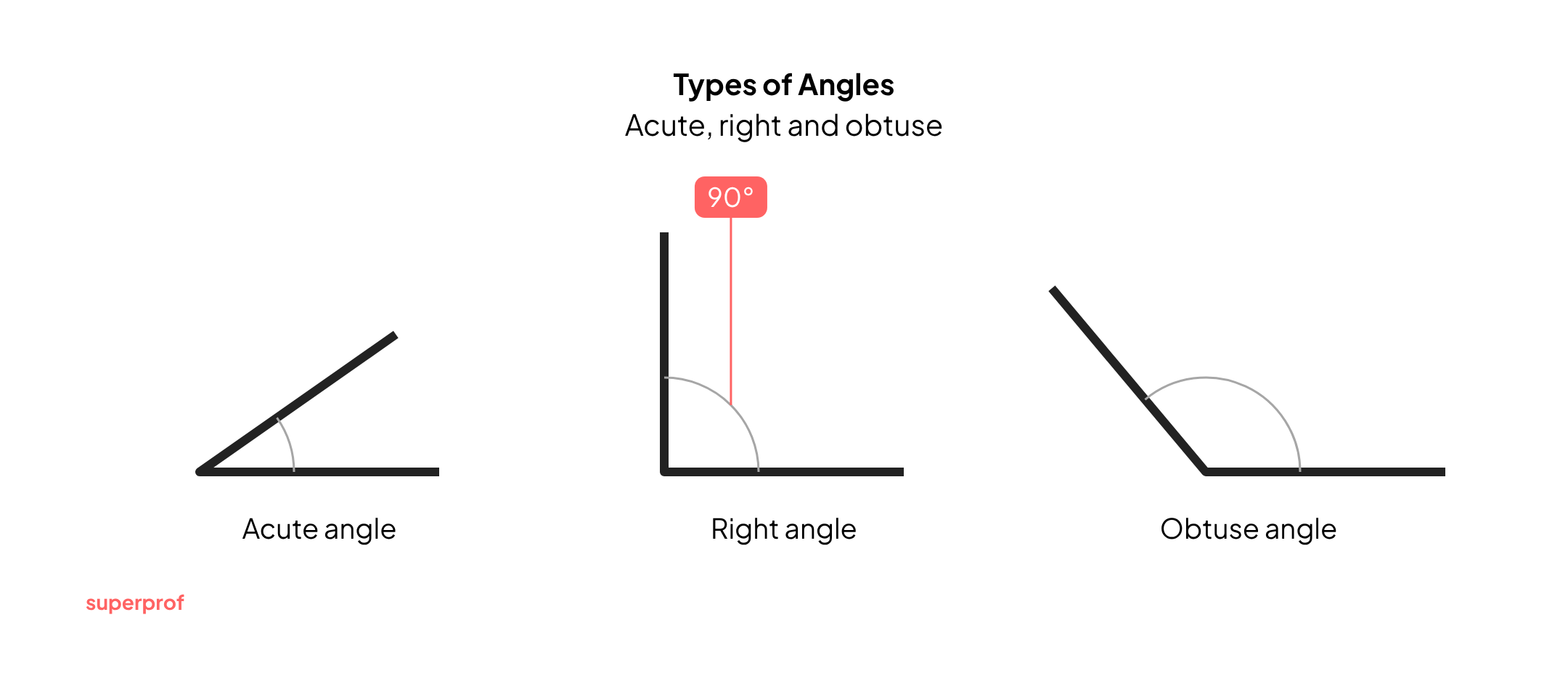
Angles are then classified according to size.
- An acute angle is less than 90°.
- A right angle is exactly 90°.
- An obtuse angle is greater than 90° but less than 180°.
A simple memory connection is that a right angle looks like the corner of a square or sheet of paper.
Polygons and Special Triangles
A polygon is a closed two-dimensional figure made from straight line segments. The number of sides often tells you the name.
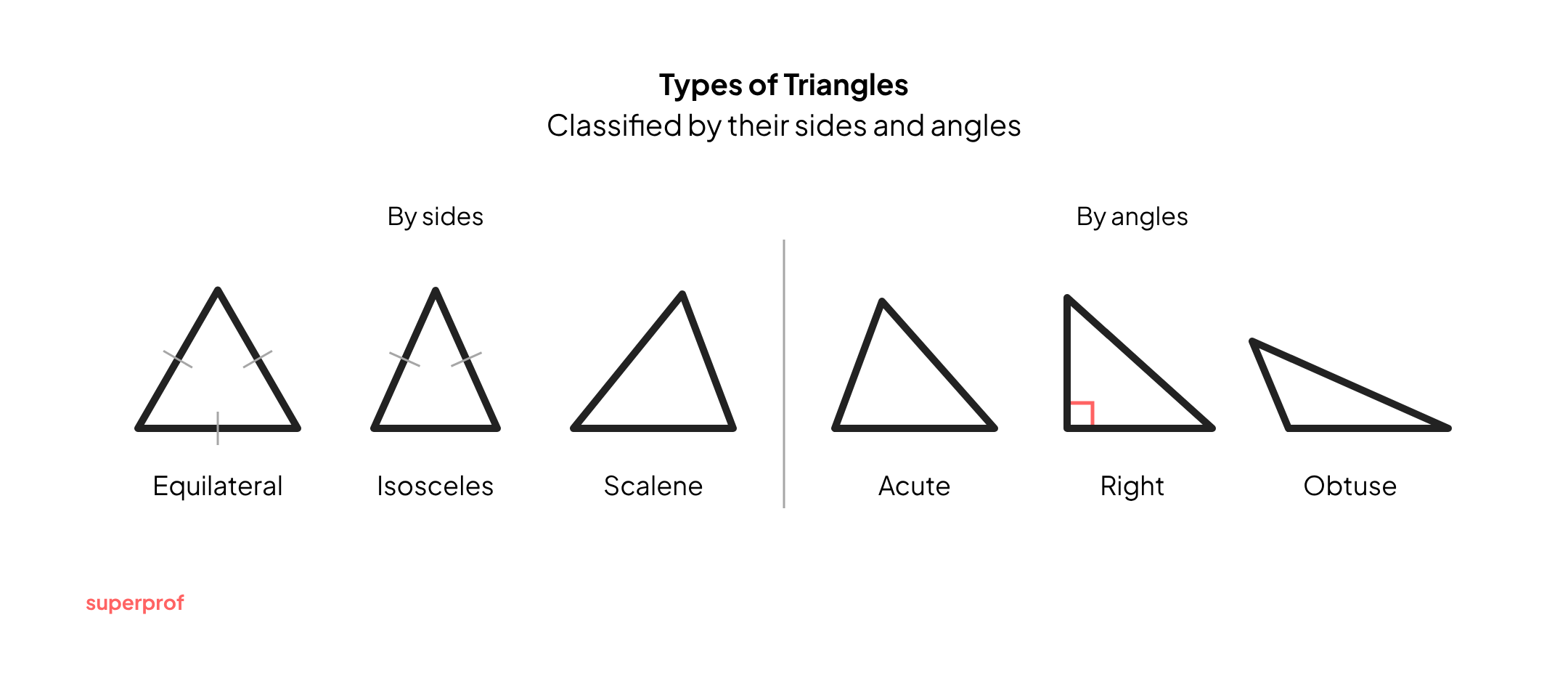
Three sides? Triangle. Four? Quadrilateral. Five? Pentagon. Six? Hexagon. Triangles then get their own set of classifications.
- An equilateral triangle has three equal sides.
- An isosceles triangle has at least two equal sides.
- A scalene triangle has no equal sides.
- A right triangle contains a 90° angle.
And right triangles introduce one especially famous piece of vocabulary: the hypotenuse. The hypotenuse is the side opposite the right angle. It is also the longest side of a right triangle. You will see that word frequently when working with the Pythagorean theorem and trigonometry, so it is worth getting comfortable with it early.
Circles and Curved Shapes
Circles play by slightly different rules. They have no straight sides and no vertices, so polygon vocabulary does not fit them very well.
- A circle consists of points that are the same distance from a fixed centre.
- The radius measures from the centre to the circle's edge.
- The diameter stretches from one side of the circle to the other while passing through its centre.
That gives us an important relationship:
Diameter = 2 × Radius
If the radius is 5 cm, the diameter is 10 cm.
The circumference is the distance around the outside of the circle. You can think of it as the circle version of perimeter. Understanding geometry also lets you understand the link between math and computer science and math and painting
Coordinate and Graphing Terms
Graphing is where algebra and geometry start working together. Numbers become positions, equations become lines or curves, and mathematical relationships suddenly become something you can see. Before plotting anything, though, you need to know your way around the coordinate plane.
Coordinate System Basics
A coordinate plane is formed by two perpendicular number lines.
- The horizontal line is the x-axis.
- The vertical line is the y-axis.
- The place where they meet is the origin, written as:
- (0, 0)
- These axes divide the plane into four sections called quadrants.
Think of the coordinate plane as a mathematical map. The axes are your reference points, and coordinates provide directions to a precise location.
Graphing Vocabulary
An ordered pair contains two coordinates written as (x, y). For example: (3, 5)
The first number tells you the horizontal position. The second tells you the vertical position.
- A point marks that location on the graph.
- To plot a point means placing it at the correct coordinates.
- A graph is a visual representation of mathematical data or relationships.
As graphing becomes more advanced, you will encounter slope, which describes the steepness and direction of a line, and intercepts, where a graph crosses an axis.
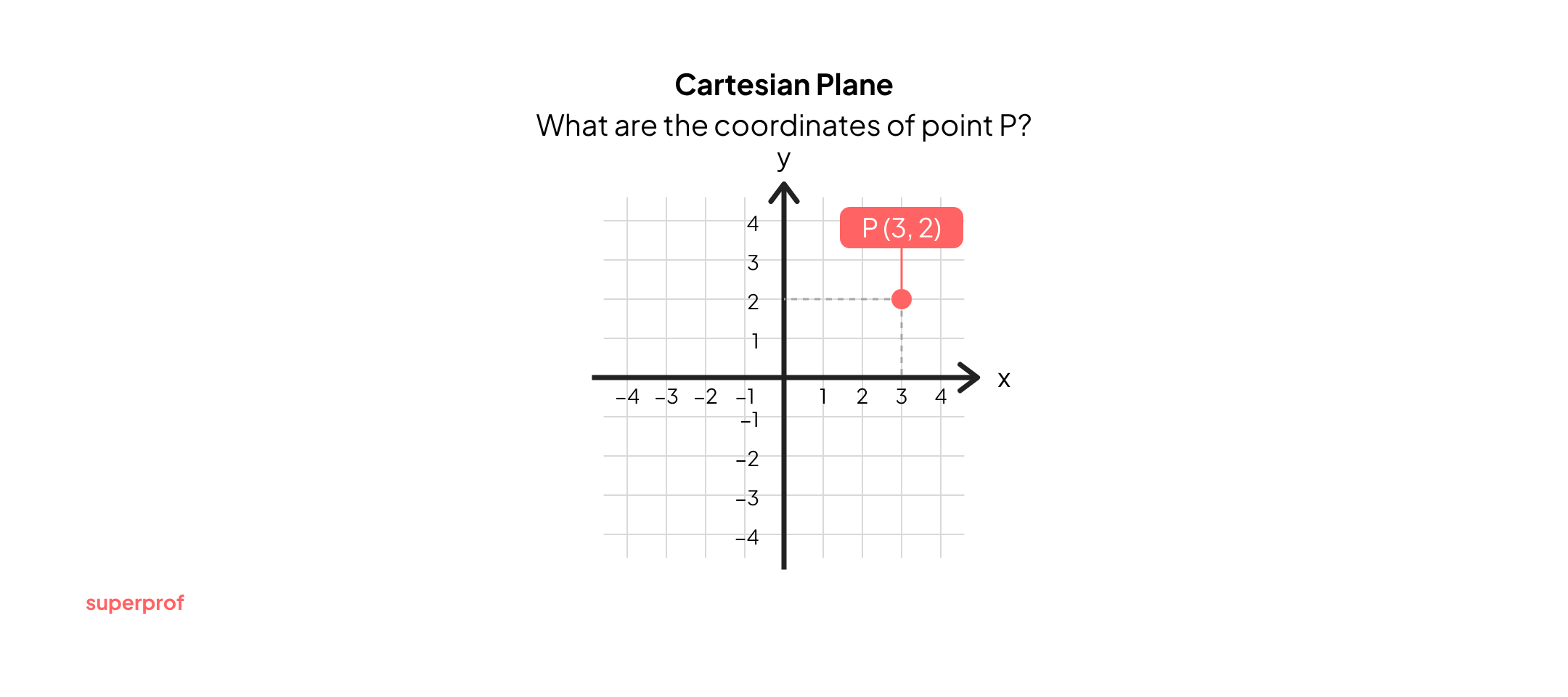
This vocabulary turns graphs from mysterious lines on grids into readable mathematical information.
An intersection is the meeting place of two objects: Groups or geometric objects. You can also read about the evolution of maths in the last centuries.
Mathematical Reasoning and Proof Terms
Not all mathematics is about calculating an answer. Sometimes the challenge is showing why something must be true. That brings us to mathematical reasoning.
A conjecture is a mathematical statement believed to be true based on a pattern or observation, but which has not yet been proven.
- A proof is a logical argument demonstrating that a statement must be true.
- Once a mathematical statement has been proven, it may be called a theorem.
- An axiom is different. It is a foundational statement accepted as true and used as a starting point for further reasoning.
- Then there is the counterexample, which is the mathematical equivalent of saying, “Well, what about this?”
Suppose someone claims:
"Every even number is divisible by 4." Six immediately causes trouble. Six is even, but 6 ÷ 4 is not a whole number. Therefore, 6 is a counterexample that proves the original statement false.
This vocabulary matters because advanced mathematics is not simply about getting answers. It is about making claims, testing ideas, spotting patterns, and building logical arguments.
If you have any questions about the origins of math or mathematical misconceptions, make sure to ask for help in your private maths lessons.
Math Terms Frequently Confused by Students
Some math terms are confusing because they live so close together. A factor and a product, for example, both belong to multiplication. A radius and a diameter both measure parts of a circle. An expression and an equation can look almost identical.
| Terms | The Difference |
|---|---|
| Factor vs. Product | A factor is multiplied; a product is the result of multiplication. |
| Sum vs. Difference | A sum results from addition; a difference results from subtraction. |
| Numerator vs. Denominator | The numerator is above the fraction bar; the denominator is below it. |
| Parallel vs. Perpendicular | Parallel lines do not meet; perpendicular lines meet at 90°. |
| Equation vs. Expression | An equation states that two expressions are equal; an expression does not. |
| Radius vs. Diameter | A radius runs from centre to edge; a diameter crosses the circle through its centre. |
| Coefficient vs. Constant | A coefficient multiplies a variable; a constant has a fixed value. |
| Solve vs. Simplify | Solving finds an unknown value; simplifying rewrites something equivalently. |
The trick is to focus on the one feature that separates them.
Try learning these as pairs instead of separate definitions.
“Parallel means this, perpendicular means that” is often much easier to remember than memorizing two disconnected dictionary entries.
Complete Glossary of Math Terms
Need to check a definition quickly? Here is the speedy A-to-Z section.
| Term | Definition |
|---|---|
| Acute angle | An angle measuring less than 90°. |
| Addend | A number being added to another number. |
| Angle | A figure formed by two rays sharing an endpoint. |
| Axis | A reference line used in a coordinate system. |
| Circumference | The distance around a circle. |
| Coefficient | A number multiplying a variable. |
| Constant | A fixed numerical value. |
| Coordinate | A value used to identify a position. |
| Denominator | The bottom number in a fraction. |
| Diameter | A line segment crossing a circle through its centre. |
| Difference | The result of subtraction. |
| Dividend | The number being divided. |
| Divisor | The number by which another number is divided. |
| Equation | A mathematical statement showing two expressions are equal. |
| Equilateral triangle | A triangle with three equal sides. |
| Equivalent | Having the same mathematical value. |
| Exponent | A number indicating repeated multiplication of a base. |
| Expression | A combination of numbers, variables, and operations without an equality. |
| Factor | A number or expression multiplied by another. |
| Fraction | A number that can represent part of a whole or a ratio. |
| Graph | A visual representation of mathematical information or relationships. |
| Hypotenuse | The side opposite the right angle in a right triangle. |
| Inequality | A comparison using symbols such as <, >, ≤, or ≥. |
| Isosceles triangle | A triangle with at least two equal sides. |
| Line | A straight path extending indefinitely in both directions. |
| Line segment | Part of a line with two endpoints. |
| Mixed number | A whole number combined with a fraction. |
| Numerator | The top number in a fraction. |
| Obtuse angle | An angle greater than 90° but less than 180°. |
| Ordered pair | Two coordinates written in a specific order, usually (x, y). |
| Origin | The point (0, 0) on a coordinate plane. |
| Parallel | Lines in the same plane that remain the same distance apart and do not intersect. |
| Perpendicular | Lines that intersect at right angles. |
| Point | An exact mathematical location. |
| Polygon | A closed two-dimensional figure made from straight line segments. |
| Product | The result of multiplication. |
| Proof | A logical argument demonstrating that a mathematical statement is true. |
| Quadrant | One of the four regions formed by the axes of a coordinate plane. |
| Quotient | The result of division. |
| Radius | The distance from the centre of a circle to its edge. |
| Ray | Part of a line beginning at an endpoint and extending indefinitely in one direction. |
| Right angle | An angle measuring exactly 90°. |
| Scalene triangle | A triangle with no equal sides. |
| Slope | A measure of the steepness and direction of a line. |
| Subtrahend | The number being subtracted. |
| Sum | The result of addition. |
| Term | A single mathematical number, variable, or product within an expression. |
| Theorem | A mathematical statement established through proof. |
| Variable | A symbol representing a quantity or value. |
| Vertex | A point where lines, rays, or edges meet. |
Why Learning Mathematical Terms and Definitions Matters
It is tempting to treat math vocabulary as something separate from “doing math.” It isn't. Imagine that you know exactly how to multiply but do not know what product means. A test question asks you to “find the product of 12 and 8.” The multiplication itself is easy. Understanding the instruction becomes the obstacle.
The same thing happens at more advanced levels. A question may ask you to factor an expression, solve an equation, plot an ordered pair, identify perpendicular lines, or justify a conjecture. Each instruction contains clues about the mathematics you are expected to perform.
Good mathematical vocabulary also helps you explain your thinking. Instead of saying, “I moved this number over there,” you can explain which operation you performed on both sides of an equation. Instead of referring to “that long side of the triangle,” you can identify the hypotenuse. Instead of saying that two lines “go the same way,” you can describe them precisely as parallel.
And that precision becomes increasingly useful as the math gets more complicated.
References
- Cambridge University Press & Assessment. “Mathematics.” Cambridge Dictionary, Cambridge University Press & Assessment, https://dictionary.cambridge.org/dictionary/english/mathematics. Accessed 3 Oct. 2026.
- “Basic Math Definitions.” Math Is Fun, MathsIsFun.com, https://www.mathsisfun.com/basic-math-definitions.html. Accessed 3 Oct. 2026.
- “Algebra – Basic Definitions.” Math Is Fun, MathsIsFun.com, https://www.mathsisfun.com/algebra/definitions.html. Accessed 3 Oct. 2026.
Summarize with AI:
Did you like this article? Leave a rating!

 Loading...

