
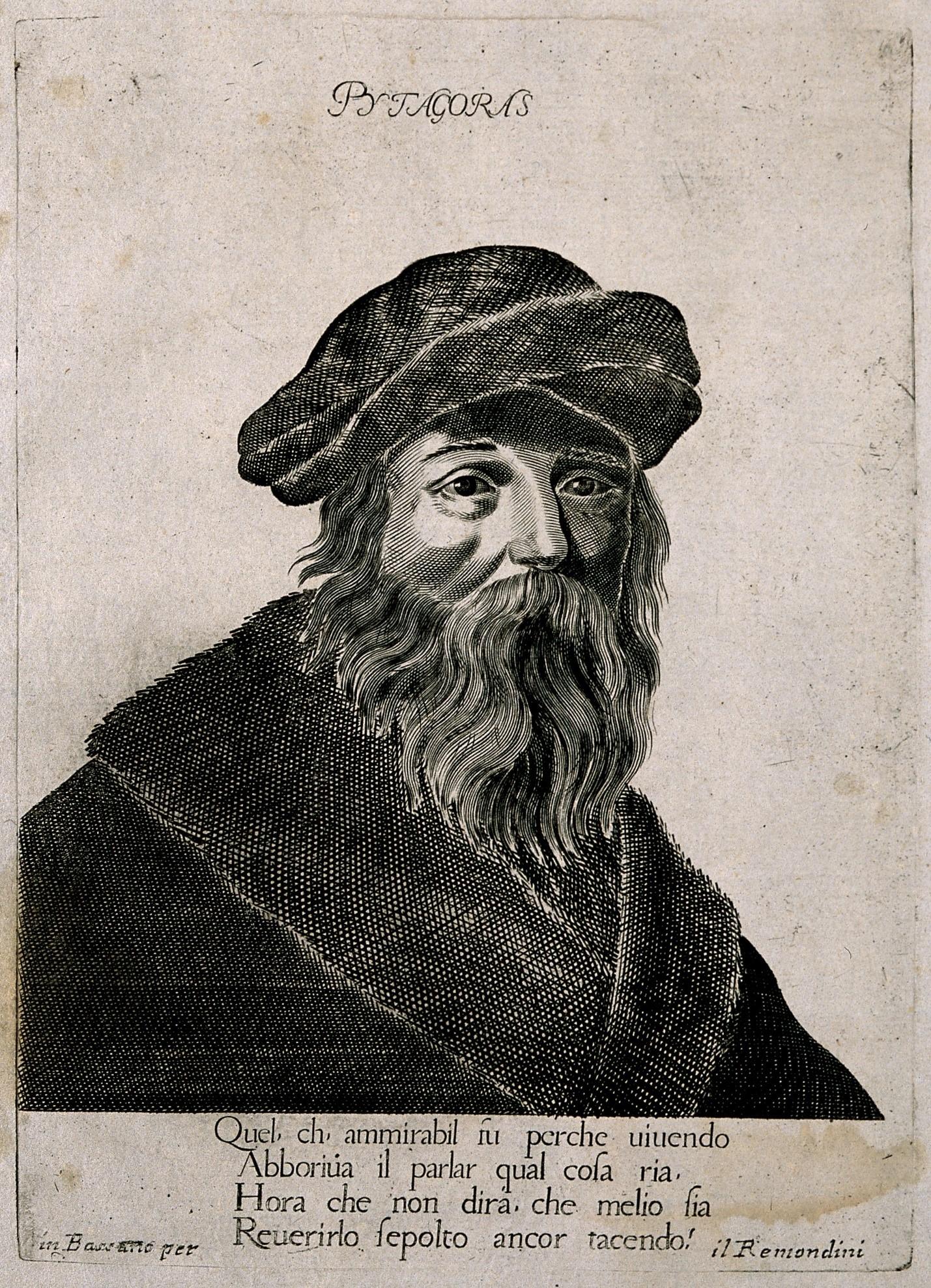

The Impact of Pythagoras
- Pythagoras transformed mathematics by linking numbers to the natural world, introducing ideas such as numerical harmony, geometric proof, and the belief that mathematical relationships form the structure of reality.
- Pythagoras and the Pythagoreans contributed major advances in irrational numbers, musical ratios, geometric solids, and number theory, laying some of the earliest foundations for modern math.
- The Pythagorean school influenced major thinkers like Plato and Aristotle and continues to impact modern mathematics, physics, music theory, and philosophy.
Pythagoras is known mainly for the famous Pythagorean Theorem, but his influence reaches far deeper into the history of mathematics and Greek philosophy. More than a mathematician, Pythagoras was a philosopher, teacher, and founder of a community whose ideas reshaped Western intellectualism. His belief that numbers govern reality helped establish math as a tool for interpreting the nature of existence.
The Pythagorean school blended scientific investigation with spiritual inquiry. For the Pythagoreans, mathematics was a path toward understanding the soul, harmony, and cosmic order. Through their study of geometry, musical ratios, astronomy, and number theory, they left behind teachings that shaped thinkers from Plato to Kepler, influencing mathematics for more than two thousand years.
Pythagoras' thinking remains central in today's math curriculum. Cosines, trigonometry, reciprocals, square roots, fractions, geometry, arithmetic, tangent, and symmetry are all concepts connected to the Pythagorean school. Let's take a deeper dive in to Pythagoras' contributions to mathematics.
Discover the influence of Pythagoras in the history of math.


Early Life and Background
Although Pythagoras’ life is surrounded by myth, historians like the ancient biographer Iamblichus offer key details that illuminate Pythagoras' development.
Birth and Early Education in Samos
Pythagoras was born around 570 BCE on the island of Samos, a vibrant center of Greek culture and trade. Legend has it that some months before his birth, an oracle predicted the birth of a gifted being to Pythagoras’ father. This is how Pythagoras’ name was chosen, signifying “announced by Pythian.” Just as the oracle predicted, Pythagoras proved to be a very gifted child. His early education exposed him to geometry, music, and astronomy.
Born: c. 570 BCE, Samos
Died: c. 495 BCE
Known for: Pythagorean Theorem, study of numbers, music ratios, cosmology
Philosophy: “All is number”
Influence: Plato, Euclid, ancient astronomy, number theory, Western mathematics
Influences and Travels
At just eighteen years of age, Pythagoras not only participated in the Olympic games of combat, but he won all of the competitions.
Athletic and intellectual, the young Pythagoras was interested as a scholar in Greek philosophy, history and the sciences. He traveled extensively to Egypt and Babylon, where he encountered advanced mathematical ideas, temple geometry, and astronomical observations. These experiences profoundly shaped his intellectual foundation.
If you're interested in other famous Greek philosophers and mathematicians, check out Archimedes of Syracuse!
Geometry is knowledge of the eternally existent.
Pythagoras
The Pythagorean Theorem
Pythagoras has been the bane of many middle and high-schoolers' existence, with many struggling understand Pythagoras’ most seminal concept, the Pythagorean theorem.

It must come as surprise, then, to learn that it was not actually discovered by Pythagoras. Engraved tablets of clay, dating back to 1800 BCE, illustrate that the length of triangles and their properties were already well known to the Babylonians, way before the arrival of Pythagoras.
The Pythagorean Theorem is one of the most famous equations in math, stating that:
In a right-angled triangle, the square of the hypotenuse equals the sum of the squares of the other two sides.
This relationship, written as a² + b² = c², is the foundation of geometry and trigonometry.
This formula permits for the calculation of the length of one side of a right triangle, and simultaneously to prove that the triangle is a right triangle. In fact, if the square of the longest side is equal to the sum of the squares of the two other sides, the triangle is a right triangle.

The theorem of Pythagoras, still taught today, led to the advancement of a particular type of geometry, known as “Euclidean geometry.”
Historical Context in Greek Mathematics
While earlier civilizations such as the Babylonians knew specific cases of the theorem, Pythagoras is credited with transforming it into a universal mathematical proof. This approach reflected a key Pythagorean belief: that numbers reveal truths about the structure of the world. Through this theorem, mathematics became not just practical, but philosophical.
Looking to improve your work in math? Find a private math tutor online.
Proof and Applications
A classic Pythagorean proof arranges four right triangles around a square, demonstrating visually that the areas align with the equation. The theorem applies today in:
- Architecture and engineering
- Space science and astronomy
- Computer graphics
- Physics and navigation
This single result embodies the power of mathematical reasoning that Pythagoras championed.
Theorizing this law led Pythagoras to be forever remembered in the annals of history. To thank the gods for having helped him in his discovery, certain accounts hold Pythagoras to have sacrificed a hundred oxen. However, it was not enough to simply form the law into existence, Pythagoras had to prove his theory.

The school founded by Pythagoras was in charge of this task, performing many experiments and calculations towards prove this theorem.
Some historians have also noted that Pythagoras was the student of another celebrated mathematicians: Thales.
Other Mathematical Contributions
Pythagoras was a veritable genius in many respects, and not just mathematics. According to him, mathematicians should strive to learn other subjects like music, philosophy, astronomy, mysticism. During the course of his life, he and his disciples adopted this mentality and managed to bring to light many mathematical discoveries. Though best known for the theorem, Pythagoras’ ideas reshaped entire fields of mathematics.
Discovery of Irrational Numbers
The Pythagoreans believed that all quantities could be expressed as ratios of whole numbers. Yet their own geometric investigations, particularly the diagonal of a unit square, √2—revealed numbers that could not be written as fractions.
This shocking discovery of irrational numbers challenged their worldview and changed the direction of mathematical history. It demonstrated that numbers were more complex than previously imagined, leading to new foundations for geometry and algebra.
The work done by the Pythagorean School inspired countless other scientists, including even the infamous Leonardo de Vinci and Sir Isaac Newton.
Theory of Proportions
Pythagoras explored numerical ratios not only in geometry but also in nature, music, and cosmology. These ratios expressed:
- Balance
- Harmony
- Mathematical relationships in shapes and sound
His study of proportions laid groundwork later used by Plato and Euclid, linking Greek philosophy to mathematical structure.
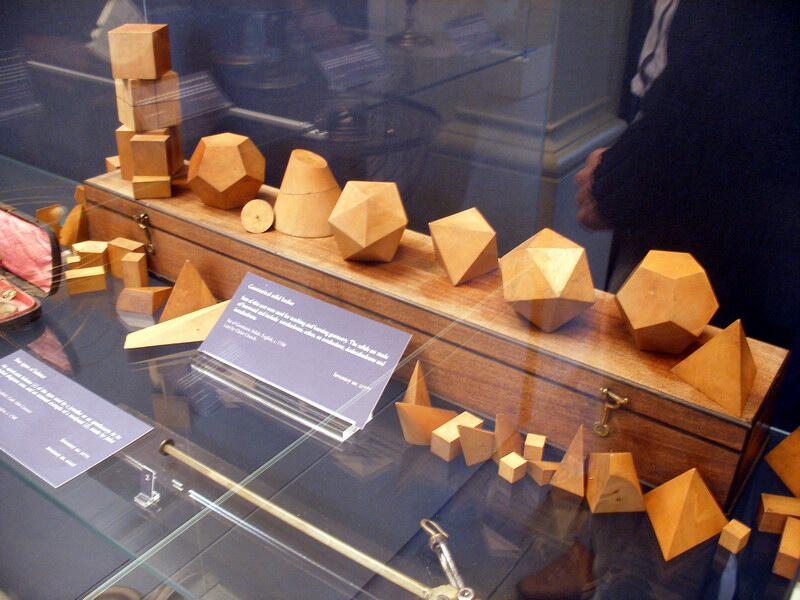
The Five Regular Solids
The Pythagoreans recognized and studied the five regular polyhedra, known today as the Platonic solids:
- Tetrahedron
- Cube
- Octahedron
- Dodecahedron
- Icosahedron
These shapes symbolized elements and cosmic harmony, merging mathematics with metaphysical ideas about the soul and the universe.
Number rules the universe.
Pythagoras
Pythagoras and Music
Pythagoras’ contributions to music theory emerged from his belief that numbers govern all forms of harmony. Pythagoras discovered the link between the length of a vibrating string and the pitch of the note played on that string. His investigations in to music didn’t stop there, he also played with glasses containing different levels of water and found that each level of water represented a distinct musical note.
These works were the basis of research of many other scientists and mathematicians, including Rene Descartes.
Mathematical Basis of Musical Intervals
He discovered that pleasing musical intervals correspond to simple ratios:
- Octave → 2:1
- Fifth → 3:2
- Fourth → 4:3
This breakthrough linked math, physics, and art, showing that sound itself followed numerical laws.
Pythagorean Tuning System
Using perfect fifths, he created a tuning system foundational to Greek and medieval music. Though later replaced, it represents one of the earliest applications of mathematics to acoustics.
Pythagorean Tuning System
- Based on pure numerical ratios, especially the perfect fifth (3:2).
- Rooted in Pythagoras’ philosophy that numbers create cosmic harmony.
- Produces perfect fifths and perfect fourths, but uneven whole tones and semitones.
- Works best for music that stays within one or two closely related keys.
- Used in ancient Greek music and early medieval music traditions.
- Ideal for demonstrating musical ratios used in Pythagorean mathematics.
Modern Temperament Tuning System
- Based on dividing the octave into 12 equal logarithmic steps.
- Designed for practical performance, allowing instruments to play in every key evenly.
- Produces slightly adjusted (tempered) intervals so all keys sound equally in tune.
- Works well for music that modulates across many keys (e.g., classical, jazz, pop).
- The global standard for Western instruments today (piano, guitar, orchestral instruments).
- Ideal for performance, recording, composition, and ensemble tuning.
Find a math tutor Mississauga on Superprof.
The Pythagorean School and Its Influence
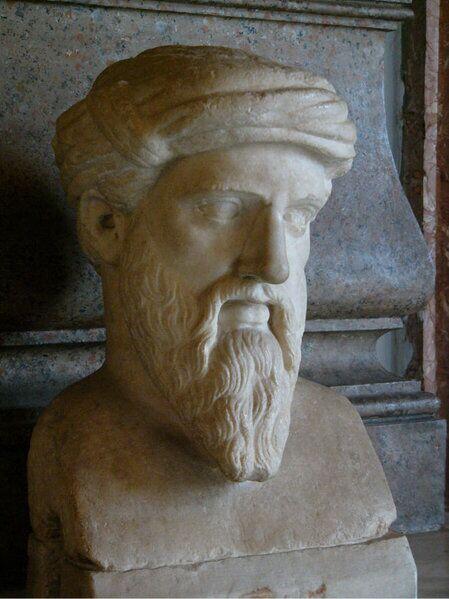
Pythagoras’ life goal was to teach math and to always have a group of people around him to help him in his scientific inquiries. This is why he found in Cortona, in the south of Italy, a school known as the School of Pythagoras. Likened to a sect, the members of this school discussed not only science but also aimed to be astute philosophers, politicians, and even involved in religion.
n general, all of Pythagoras’ life centered around mathematics - but the Pythagorean school was more than a math academy, it was a philosophical community.
A Unique Way of Life
Founded in Croton around 530 BCE, the school blended:
- Mathematics
- Music
- Ethical teachings
- Ritual practices
- Beliefs about the soul and reincarnation
Students lived communally, shared property, and followed a disciplined lifestyle structured around self-improvement and intellectual study.
Pythagoras and his disciples continued to interest themselves in the divisibility of numbers and led to the famous proclamation: “numbers rule the universe.” The school lasted for 150 years and is totalled to have had about 218 members, members who were known as Pythagoreans. Because much of the work was executed as a team, it is impossible to know the exact identities of the real inventors of various formulas and principles we attribute to the Pythagorean school.
Find Waterloo math courses with a private tutor.
Pythagorean Philosophy
Central beliefs included:
- Numbers are the essence of reality
- The soul is immortal
- Harmony reflects cosmic order
- Mathematics is a sacred pathway to knowledge
These teachings elevated math from a practical tool to a philosophical system.
Influence on Future Thinkers
The school’s ideas influenced major figures in Greek philosophy, especially Plato, who adopted Pythagorean views about geometry and cosmic harmony in works like the Timaeus.
Their impact also shaped:
- Euclid’s Elements
- Ancient and medieval astronomy
- Early scientific method
- Western education in mathematics
The Pythagorean emphasis on rational inquiry set the foundations for modern science.
530–525 BCE
Formulation of the Concept ‘All Is Number’
Pythagoras introduces the revolutionary idea that everything, from music to geometry to the soul, follows numerical patterns. This marks the birth of Western mathematical philosophy.
520 BCE
Foundational Work in Geometry
Pythagoras and the emerging Pythagorean school begin formal studies of geometric relationships, laying groundwork for Euclid’s later work.
510–500 BCE
The Pythagorean Theorem
The Pythagoreans provide the first formal proof of what becomes the Pythagorean Theorem.
500–495 BCE
Development of the Pythagorean Tuning System
Building on musical ratios, Pythagoras creates a tuning system based on perfect fifths. This becomes the standard in Greek music and influences centuries of musical theory.
500 BCE
Discovery of Irrational Numbers (Attributed to the Pythagoreans)
When examining the diagonal of a square (√2), the Pythagoreans discover the existence of irrational numbers, a groundbreaking moment in the history of mathematics.
490 BCE
Introduction of the Five Regular Solids
The Pythagoreans study the five regular polyhedra (later called Platonic solids) as symbols of the elements and cosmic harmony. Their geometric properties become central to later Greek mathematics.
Legacy and Modern Relevance
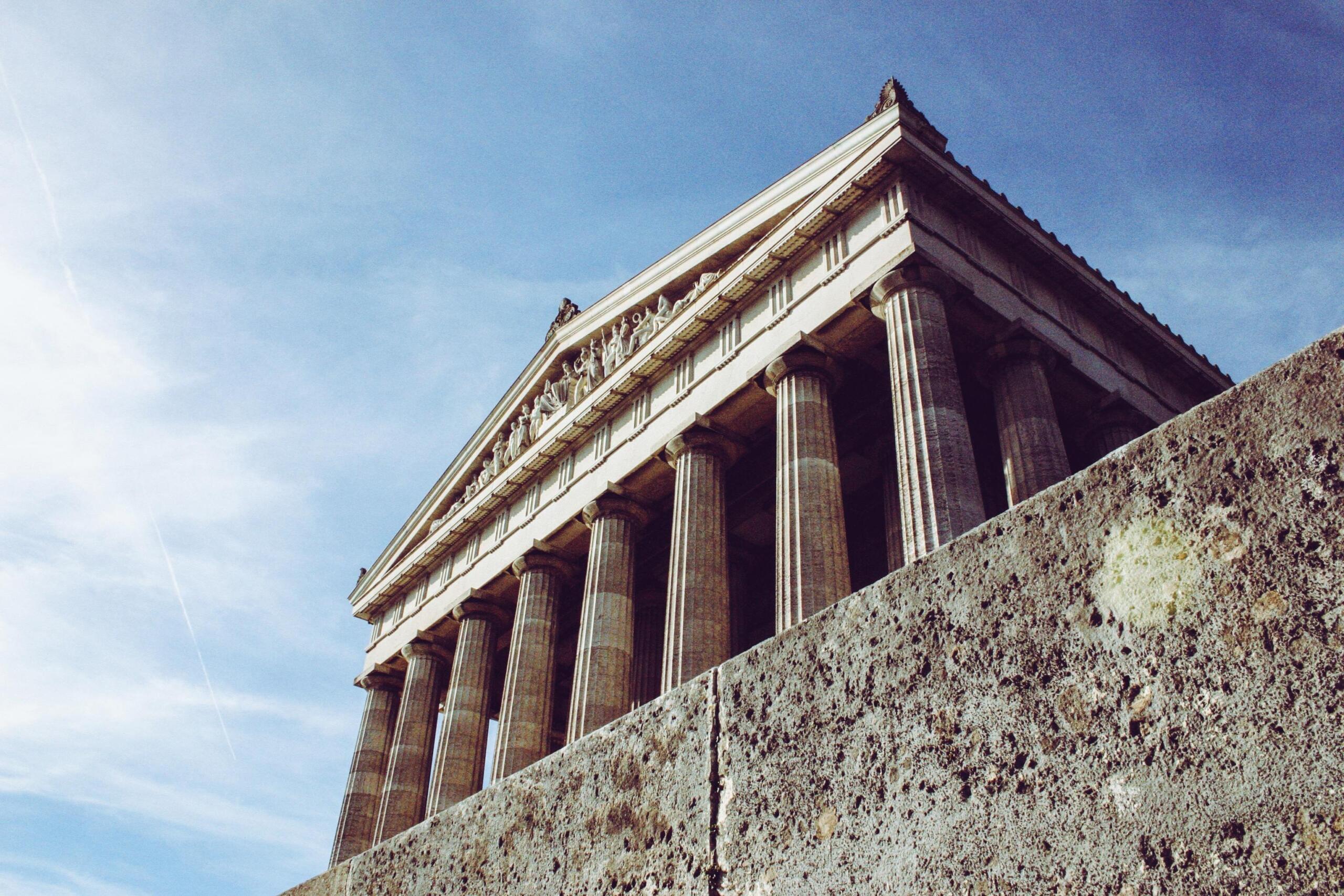
Pythagoras and his school played a vital role in the evolution of mathematics. Whole numbers, circumferences, quadrilaterals, perpendicular, relative numbers, addition, parallelogram, decimals, sine, conjecture, scale products, fragment, diamond – all aspects of the math we learn today passed through the hand of the great mathematician.
Pythagoras’ ideas remain deeply embedded in mathematics, science, and culture.
Influence on Mathematics
His insights shaped:
- Geometry
- Trigonometry
- Number theory
- Mathematical harmonics
- Formal mathematical proof
The belief that reality can be described through numbers continues to guide physics, computing, and engineering.
Cultural Impact
From the use of the Pythagorean Theorem in school curricula to the idea of numerical harmony in design and music, Pythagoras’ influence is everywhere. His teachings helped establish mathematics as the language of the universe. His advancements in mathematics continued to permeate into many different disciplines and took on many different forms.
References
- MacTutor History of Mathematics Archive. https://mathshistory.st-andrews.ac.uk/
- Stanford Encyclopedia of Philosophy, “Pythagoras”. https://plato.stanford.edu/entries/pythagoras/
- Encyclopaedia Britannica, “Pythagoras”. https://www.britannica.com/biography/Pythagoras
Summarize with AI:
Did you like this article? Leave a rating!


 Loading...
The pythagorean table of opposites is not as you described. First of all, “of opposites” should be dropped because this is something completely different. Secondly, a pythagorean table does not have 2 columns – it has n rows and n columns, forming a grid. I can infer that this is what you meant, but it’s not what you’ve said (columns are vertical and rows are horizontal). What you’ve described is a t-chart where the intersection of two values is a section of the vertical line that separates the two (vertical) columns.
Hi Sam! We are currently refreshing this article, thanks for your feedback. Come back in a few weeks and let us know how if it looks good!