
Are you curious about ancient maths and what these have to do with Einstein and algebra? To understand how we got here, we need to follow the long journey from antiquity, from the time of ancient Greek and Arab philosophers. The origins of mathematics and its history throughout different civilizations reveal the evolution of mathematical thought over the centuries.
c. 44,000–20,000 BCE
Prehistoric Counting Systems
Artifacts like the Lebombo Bone and Ishango Bone show early tally marks, likely used for counting and tracking lunar cycles.
c. 3000–1650 BCE
Egyptian Mathematics
Use of arithmetic and geometry for construction and administration. The Rhind Papyrus (c. 1650 BCE) documents fractions, area and volume calculations.
c. 2000–300 BCE
Babylonian Mathematics
Development of the base-60 system. Advanced algebra and geometry are evident in tablets such as Plimpton 322.
c. 600–300 BCE
Greek Innovations
Thales, Pythagoras and Euclid formalized geometry and logical mathematical proof, laying the foundations for theoretical mathematics.
c. 200 BCE–700 CE
Chinese & Indian Advances
China’s Nine Chapters on the Mathematical Art compiles practical math problems. Indian mathematicians (e.g., Brahmagupta) formalized the concept of zero and negative numbers.
8th–13th Centuries
Islamic Golden Age
Scholars preserve and expand knowledge from Greece and India. Al-Khwarizmi develops algebra; Hindu-Arabic numerals spread to Europe.
14th–17th Centuries
European Renaissance
Descartes develops analytic geometry. Newton and Leibniz independently invented calculus.
16th–17th Centuries
Scientific Revolution
Mathematics becomes central to physics and astronomy. Logarithms and calculus revolutionized science.
19th–20th Centuries
Rise of Abstract Mathematics
Set theory (Cantor), abstract algebra (Noether), and mathematical logic (Russell) expand the field into abstraction.
20th–21st Centuries
Digital Age
Mathematics powers computing, encryption (RSA), algorithms, AI and big data.
Present & Future
Unsolved Problems
Open challenges like the Riemann Hypothesis and the P vs NP problem continue to shape modern research.






Prehistoric Foundations of Mathematics
Did you know that the first counting systems emerged long before formal writing? Through various archaeological findings, it is now possible to see how these early forms of mathematical thinking laid the foundation for the development of arithmetic and mathematics as a discipline.
Early Counting Systems
Various archaeological finds have been discovered, such as the Ishango bone, which is perhaps the oldest mathematical artifact in existence, dating to approximately 20,000 to 25,000 years ago.
Unearthed in 1950 in what is now the Democratic Republic of Congo, the Ishango bone features a series of notches that, for many observers, identify it as a counting stick. Today, it is housed in the Natural Sciences Museum in Brussels, Belgium. 1
Another well-known ancient math artifact is the Lebombo Bone, discovered in 1970 in Border Cave on the border between South Africa and Swaziland (now Eswatini).
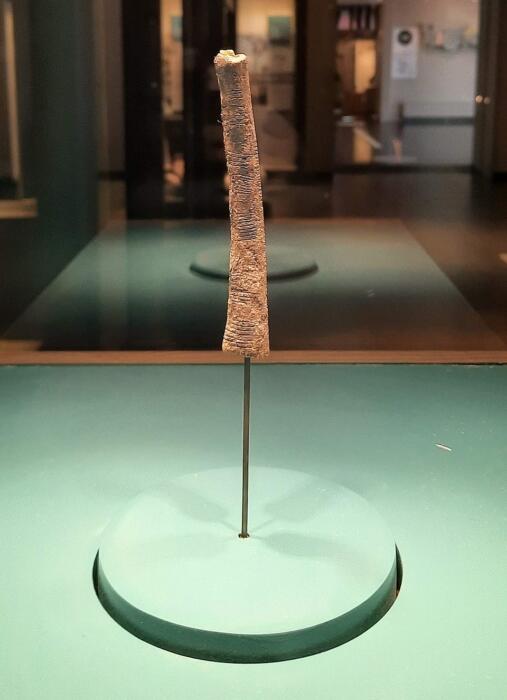
The Lebombo Bone is between 44,200 and 43,000 years old (making it older than the Ishango bone), and consists of 29 notches carved into the fibula of a baboon. According to several studies, the 29 notches on the bone may have been used as a lunar phase counter. In this case, African women may have been the first to keep track of menstrual cycles using a lunar calendar. 2
Development of Basic Arithmetic
With the emergence of early civilizations, arithmetic began to formalize as societies needed more effective systems to manage harvests, record trade, calculate taxes and measure land. All of this shows that basic arithmetic arose primarily out of necessity, before becoming an abstract discipline.
Are you ready for some mental math classes? Discover the best math tutor here.
Mathematics in Ancient Civilizations
With the emergence of the first civilizations, mathematics began to develop more systematically. Ancient cultures applied mathematics to everyday life and introduced concepts and methods that laid the foundations for its further development.
Egyptian Mathematics
Mathematics in Ancient Egypt took on extreme importance, as it became the cornerstone of a functional society. Mathematics supported everyday needs, from ensuring sufficient resources to architectural design.
But the ancient Egyptians did not only use simple arithmetic operations. In fact, the Rhind Papyrus (c. 1650 BC) contains arithmetic and geometric problems, including unit fractions, area calculations and volume calculations, making it one of the most important documents in the history of mathematics. 3
Babylonian Contributions
Babylonian mathematics (c. 2000–300 BC) went far beyond arithmetic, as it is notable for the introduction of a sexagesimal (base-60) number system. This system is the origin of the modern division of time (60 seconds, 60 minutes) and the measurement of angles (360 degrees).
Babylonian mathematicians also devoted themselves to arithmetic, algebra and geometry, using tables for calculations, including multiplication and square roots. For example, the Plimpton 322 tablet is a clay tablet that demonstrates an advanced knowledge of geometric relationships centuries before classical Greece. 4
Discover various online Math tutors to learn more about science.
Greek Innovations
Greek mathematics studied the numbers and their properties, patterns, structures and space. It originated with Thales of Miletus (c. 585 BCE) and Pythagoras (c. 571 to c. 497 BCE), who considered it a means of learning the truth. Thales is considered the first mathematician in Greece for introducing and applying geometry. And Pythagoras, who was possibly one of his students, made mathematics the central axis of his philosophy. And, another prominent Greek mathematician of the time, Euclid (300 BCE), is known as the “father of geometry.” 5
These thinkers laid the foundations that were later developed by other mathematicians, enabling mathematical progress into the modern era.
Chinese and Indian Mathematics
However, fundamental innovations also existed in other parts of the world, which would later give rise to the development of Islamic and European algebra and mathematics.
For example, in China, the Jiuzhang suanshu, or Nine Chapters on the Mathematical Art, was developed as a practical mathematics manual that evolved over several centuries and comprises 246 problems in engineering, surveying, commerce and taxation. In India, mathematicians such as Brahmagupta (598-668 AD) revolutionized mathematics by fully developing zero as a number and providing the first rules for negative numbers. 6 7
Did you know that to study maths, it's important to know the essential math concepts and definitions?
The Islamic Golden Age and Medieval Europe
The development of mathematics continued thanks to the transmission and expansion of knowledge among different cultures. The intellectual exchange led to important advances that laid the foundations for many modern related branches, such as algebra and analytical geometry.
Preservation and Expansion of Knowledge
Mathematical sciences flourished in the Islamic world between the 8th and 13th centuries, drawing on Greek, Indian, Babylonian and Persian traditions, as well as revolutionary innovations of their own. Muslim scholars perfected arithmetic by adopting Hindu numbers, negative numbers and the invention of zero, which revolutionized calculation and spread to Europe via Spain, Italy and Portugal. 8
Introduction of Algebra
Some of the most influential thinkers of the time, such as al-Khwarizmi, better known as the “father of algebra,” laid the foundations of modern algebra and wrote the first book on algebra. In the second half of the 12th century, the first part of Al-Khwarizmi's work Kitab al-Jabr wa al-Muqabalah was translated and published in Europe. Other pivotal figures, such as Umar Khayyam, advanced the study of cubic equations, and al-Battani developed trigonometry. 8
European Renaissance
During the European Renaissance (14th-17th centuries), two major advances in mathematics emerged. On the one hand, René Descartes developed analytical geometry, which connected algebra and geometry through a coordinate system.

On the other hand, Isaac Newton and Gottfried Wilhelm Leibniz independently developed calculus in the 17th century, one of the most influential branches of mathematics of all time.
This new branch of mathematics made it possible to study phenomena related to motion, continuous change and rates of change.
In fact, calculus made it possible to mathematically describe the motion of planets, the behavior of falling objects and numerous phenomena in mechanics.
Calculus soon became an essential tool for the development of physics and many other sciences. Over time, its applications spread to areas such as engineering, economics, computer science and biology.
Interesting, right? But did you know what maths teaching will be like in the future?
Modern Mathematics and Its Applications
Starting in the Modern Age, scientific advances drove the development of new tools that allowed for a more accurate understanding of natural phenomena. Over time, this gave rise to new areas of scientific and technological study.
The Scientific Revolution
The Scientific Revolution (16th–17th centuries) transformed mathematics into a central tool for understanding the natural world.
Some of the most significant advances were undoubtedly the development of analytical geometry by René Descartes, the invention of calculus by Newton and Leibniz, and the introduction of logarithms by Napier. These advances revolutionized mathematics, simplifying calculations and laying the foundations for contemporary science and engineering, but they also revolutionized physics, astronomy and engineering. 9
19th and 20th Century Advances
The 19th and 20th centuries marked a shift from applied mathematics to abstraction. For example, the German mathematician Georg Cantor (1845–1918) was the inventor of set theory, which introduced the concept of infinite sets and different sizes of infinity.
Emmy Noether (1882–1935), a German mathematician, made major contributions to abstract algebra. Formal structures such as groups, rings and fields were also developed, laying the foundation for modern algebra and physics. And last but not least, figures such as Bertrand Russell (1872–1970) contributed to the formalization of mathematical logic.
Einstein's Mathematical theories have transformed our view of the world, from simplistic notions such as mental arithmetic, multiplication and geometry. Discover all about them!
Mathematics in the Digital Age
In the 20th and 21st centuries, the theoretical foundations established by logicians and mathematicians shaped algorithms, computer theory and programming languages. For example, modern encryption methods, such as RSA, are largely based on number theory and modular arithmetic. Thanks to this, public key cryptography enables secure information transmission over the Internet.
Of course, one cannot talk about modern mathematics without mentioning the fundamental role of data analysis and artificial intelligence. Disciplines such as statistical modeling, linear algebra and probability theory form the mathematical basis for all of these modern technologies.
In fact, many machine learning algorithms rely on mathematical models that enable the analysis of patterns in large data sets and the making of predictions. Thanks to these mathematical tools, artificial intelligence can now be applied in fields as diverse as medicine, finance and digital technology.

In addition, did you also know about the strong links between mathematics and art? Discover more about this fascinating science and more about its applications.
The Future of Mathematics
Today, mathematics continues to evolve and pose new challenges. In fact, many fundamental problems remain unsolved, presenting challenges for science, technology and our understanding of the world around us.
Unsolved Problems and Emerging Fields
But did you know that, after so many centuries of evolution, mathematics is still constantly changing? As you might expect, there will always be profound questions and unsolved mysteries.
In fact, one of the most famous open problems is the Riemann hypothesis, posed in 1859. In fact, we can say that most mathematicians agree that it is the most difficult mathematical problem in history. It concerns the distribution of prime numbers and is fundamental to number theory.
Did you know that the Riemann Hypothesis and the P vs NP problems are both part of the Millennium Problems established by the Clay Mathematics Institute each carrying a $1 million prize for a correct solution? 11
However, it is not the only mystery to be solved. The P versus NP problem is perhaps the most difficult mathematical problem in theoretical computer science. It asks whether all problems whose solution can be verified quickly can also be solved quickly, and its resolution would have enormous implications for cryptography, optimization and computer science. 10
Feeling inspired? Read on about mathematics and 3D art.
Interdisciplinary Applications
As expected, mathematics is increasingly interconnected with other modern scientific disciplines, such as artificial intelligence. In fact, did you know that AI systems are based on linear algebra, probability theory and statistics? Another relevant field we need to discuss is quantum computing, whose algorithms rely on advanced linear algebra, complex numbers and probability amplitudes.
And of course, we cannot talk about mathematical advances without mentioning data science and modeling. Mathematical models allow researchers to analyze patterns and predict results that are of utmost importance in climate science and epidemiology, thereby enabling better decision-making.
Many schools allow you to combine maths and computer science to explore all the advances in science.
Did you know that mathematics is one of the most unpopular core subjects? Discover the biggest stereotypes of math.
References
- Mathematical Treasure: Ishango Bone | Mathematical Association of America. (n.d.). https://old.maa.org/press/periodicals/convergence/mathematical-treasure-ishango-bone
- Y. (2019, August 5). The Lebombo Bone: the oldest mathematical artifact in the world. African Heritage. https://afrolegends.com/2019/05/17/the-lebombo-bone-the-oldest-mathematical-artifact-in-the-world/
- Christina Geisen. (2025, September 1). Learn maths like an Egyptian: the secrets of the Rhind Mathematical Papyrus. The British Museum. https://www.britishmuseum.org/blog/learn-maths-egyptian-secrets-rhind-mathematical-papyrus
- Babylonian mathematics | Mathematics | Research Starters | EBSCO Research. (n.d.). EBSCO. https://www.ebsco.com/research-starters/mathematics/babylonian-mathematics
- Mark, J. J. (2023). Greek Mathematics. World History Encyclopedia. https://www.worldhistory.org/article/606/greek-mathematics/
- Nine chapters. (n.d.). Maths History. https://mathshistory.st-andrews.ac.uk/HistTopics/Nine_chapters/
- The zero that balanced the universe: Brahmagupta and the invention of “Nothing.” (2025, April 7). Beautiful Minds. https://beautifulmindsofmath.com/2025/04/07/the-zero-that-balanced-the-universe-brahmagupta-and-the-invention-of-nothing/
- Nizamoglu, C., & Nizamoglu, C. (2025, September 22). Mathematical Science – Contributions of Islamic scholars to the scientific enterprise. Muslim Heritage. https://muslimheritage.com/mathematical-science/
- A history of the mathematics during the Scientific Revolution. (2025, November). Research Gate; International Journal of Scientific Research in Science and Technology. https://www.researchgate.net/publication/397877509_A_History_of_the_Mathematics_during_the_Scientific_Revolution
- Cooper, M. (2025, September 16). What is the hardest math problem? Mindko. https://www.mindko.com/blog/what-is-the-hardest-math-problem
- The Millennium Prize Problems - Clay Mathematics Institute. (2022, May 27). Clay Mathematics Institute. https://www.claymath.org/millennium-problems/
Summarize with AI:
Did you like this article? Leave a rating!


 Loading...