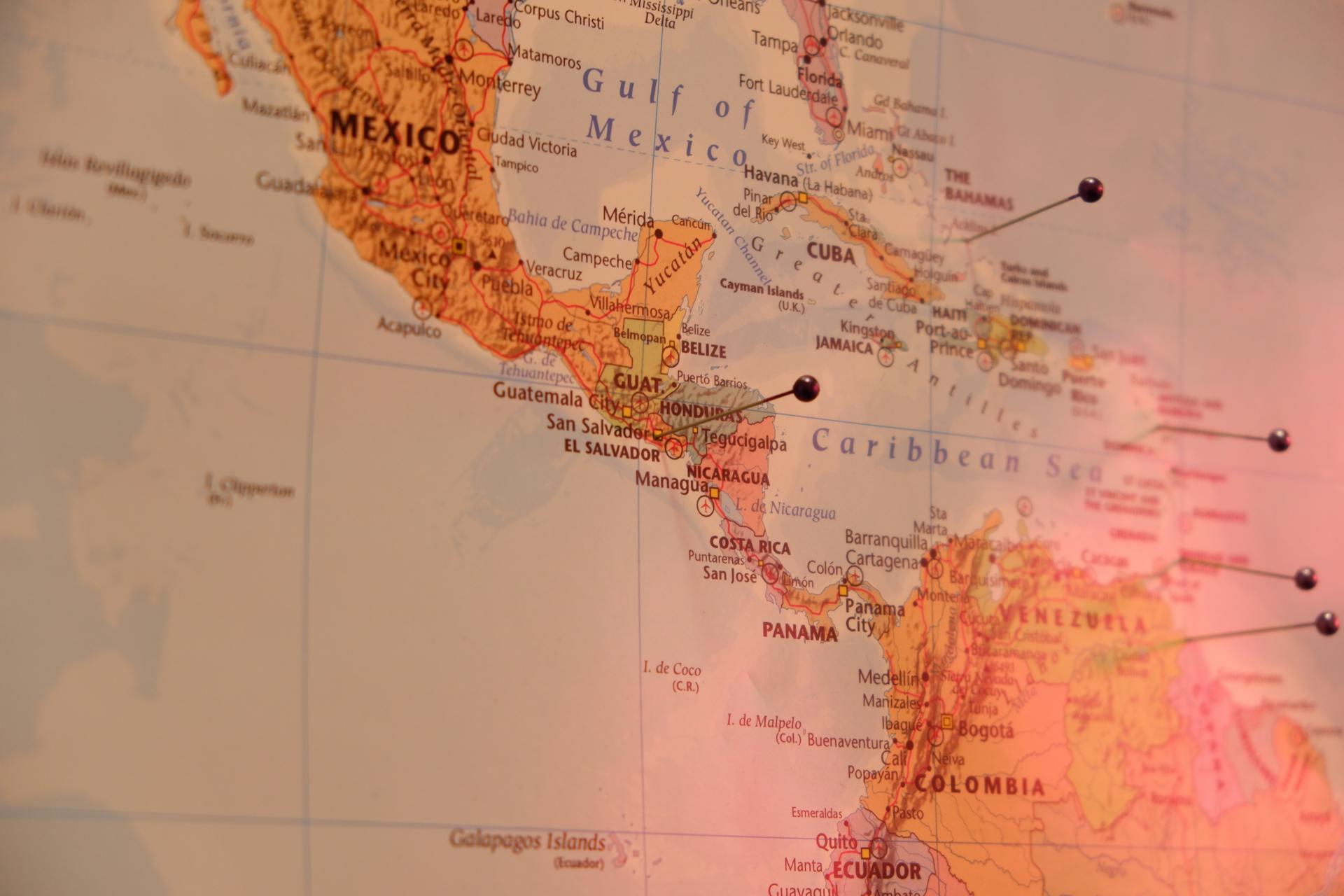

With millions of speakers worldwide, Spanish has become one of the most popular languages to learn. In fact, the Spanish language is the second most widely spoken, and it is the official language in 20 countries across Europe, Latin America and beyond. Its global reach and cultural impact are among the reasons so many people choose to learn Spanish today.
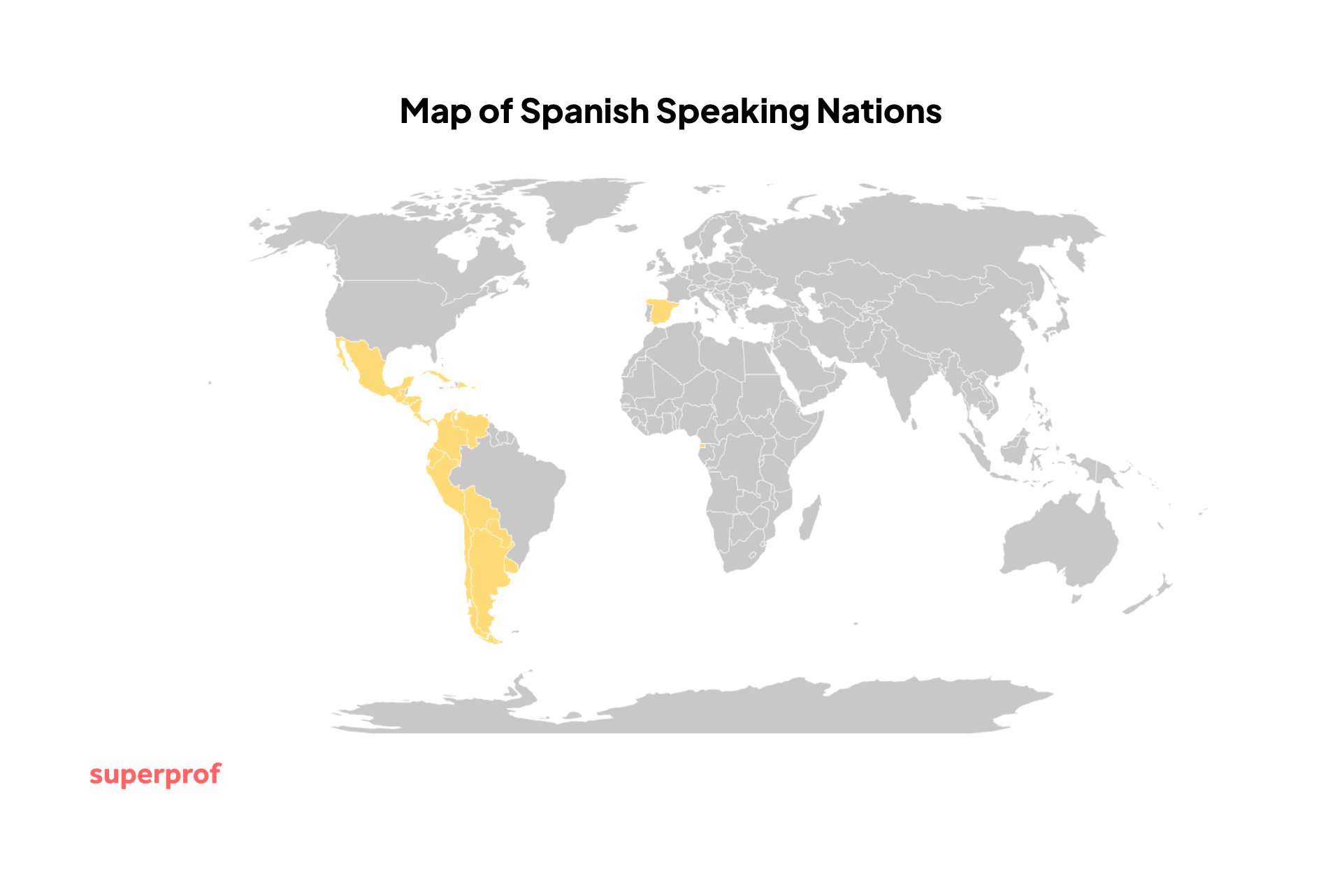
Spanish is one of the most widely spoken languages in the world, with approximately 561 million speakers worldwide, behind English, Mandarin Chinese and Hindi. 1 It is the official language of 20 sovereign countries, primarily in Latin America and Europe, as well as other places that speak Spanish, such as Puerto Rico.
Countries with Spanish as the Official Language
Spanish is an official language in 21 territories and countries around the world. Most of these are located in Latin America, but did you know Spanish is also an official language in Europe and Africa? Together, these Spanish-speaking countries highlight the wide variety of accents and regional differences that extend across continents.
| # | Country | 2025 Population Estimate | Native Proficiency Group (NPG) | Native Speakers (%) | Characteristics of Spanish Spoken |
|---|---|---|---|---|---|
| 1 | Mexico | 138,070,271 | 130,034,675 | 94.18 | The country with the largest number of Spanish speakers in the world |
| 2 | Colombia | 53,110,609 | 52,090,983 | 98.08 | Known for its wide variety of regional accents and strong Spanish-language media influence |
| 3 | Spain | 49,270,000 | 47,250,026 | 95.90 | The birthplace of the Spanish language |
| 4 | Argentina | 47,473,760 | 46,866,195 | 98.72 | Known for Rioplatense Spanish and its Italian-influenced accent |
| 5 | Peru | 34,412,393 | 29,601,626 | 86.02 | Home to strong Indigenous linguistic influences, especially Quechua |
| 6 | Venezuela | 29,395,334 | 28,631,153 | 97.40 | Caribbean-influenced Spanish with strong regional diversity |
| 7 | Chile | 20,206,953 | 19,315,922 | 95.59 | Known for its distinctive pronunciation and regional slang |
| 8 | Ecuador | 18,103,660 | 16,963,223 | 93.70 | Spanish varies significantly between coastal and Andean regions |
| 9 | Guatemala | 18,079,810 | 13,722,652 | 75.90 | Spanish strongly influenced by Mayan languages and culture |
| 10 | Bolivia | 11,425,746 | 9,197,806 | 80.50 | A multilingual country where Spanish coexists with several Indigenous languages |
| 11 | Dominican Republic | 10,878,267 | 10,323,570 | 94.90 | Features a fast Caribbean Spanish accent and rich local slang |
| 12 | Cuba | 10,055,968 | 9,970,591 | 99.15 | Caribbean Spanish with strong African and Canarian influences |
| 13 | Honduras | 10,038,054 | 9,548,292 | 95.12 | Central American Spanish with regional Indigenous influences |
| 14 | Paraguay | 7,758,263 | 5,222,154 | 67.31 | Spanish is co-official with Guaraní |
| 15 | Nicaragua | 7,218,143 | 7,001,696 | 97.00 | Spanish influenced by Caribbean and Central American speech patterns |
| 16 | El Salvador | 6,366,086 | 6,358,547 | 99.88 | Central American Spanish with distinctive regional vocabulary |
| 17 | Costa Rica | 5,567,811 | 5,510,005 | 98.96 | Costa Rican Spanish is known for its clear pronunciation and use of local expressions |
| 18 | Panama | 4,544,816 | 3,925,898 | 86.38 | Panamanian Spanish combines Caribbean and Central American linguistic influences |
| 19 | Uruguay | 3,588,937 | 3,557,812 | 99.13 | Uruguayan Spanish shares many features with Rioplatense Spanish spoken in Argentina |
| 20 | Puerto Rico | 2,980,532 | 2,834,581 | 95.10 | Spanish and English are both official languages |
| 21 | Equatorial Guinea | 1,682,611 | 1,245,206 | 74.00 | The only Spanish-speaking country in Africa |
Table 1: Where do people speak Spanish? Population and Native Speakers in Spanish-Speaking Countries2
These figures highlight the global importance of the Spanish language. With hundreds of millions of native speakers and the number of countries where it is spoken, Spanish is one of the most influential languages in the world to learn.
Countries with Significant Spanish-Speaking Populations
It is highly likely that there are Spanish speakers in every country and territory worldwide. Although Spanish is the official language of the 21 countries and territories mentioned above, it is also widely spoken in various parts of the world where it is not considered an official language. Factors such as migration, history, international trade and cultural influence have undoubtedly contributed to the expansion of the Spanish-speaking population far beyond.
For example, the U.S. has the second-largest Spanish-speaking population in the world after Mexico. Because of this, Spanish plays a fundamental role in the media, culture, education, business and everyday communication.
The U.S. has more than 65 million people who can speak or understand Spanish to some degree, and nearly 20% of the U.S. population was expected to be Hispanic in 2025.
Although English is its official language, Belize is another country with a significant Spanish-speaking population due to its geographic location and its close cultural ties to Mexico, Guatemala and neighboring countries. In addition, Spanish is also spoken in Brazil, Canada and Morocco, where migration, tourism and international business have contributed to the language’s growing presence. 2
Why is Spanish so common in the Americas? The history of Spanish has made it widespread. It all started with the voyages of Christopher Columbus and the colonization of the Americas at the end of the 15th century. During the Spanish Empire, much of the territory in this part of the world came under the control of the Spanish monarchy.


Historical Spread of the Spanish Language
The history of Spanish dates back many centuries, evolving from a regional language spoken on the Iberian Peninsula into one of the most widely spoken languages in the world.
Origins and Evolution
Spanish is a Romance language belonging to the Indo-European family that originated on the Iberian Peninsula, specifically in the Kingdom of Castile during the Middle Ages. Spanish developed from Vulgar Latin, which was introduced during the Roman conquest, and evolved under Germanic and Arabic influences following the Muslim occupation of the peninsula in 711.
Over time, Castilian established itself as one of the region’s major Romance languages. The first texts written in Castilian appeared in the 10th century, and later the School of Translators in Toledo contributed to its cultural and linguistic expansion. 3
Colonial Expansion and Language Dissemination
During the 15th century, Spain and Portugal undertook expeditions to find trade routes to Asia. However, the explorer Christopher Columbus landed on the Caribbean islands in 1492 without intending to. The arrival of European in the Americas soon led to their exploration and colonization.
The first European countries to colonize the Americas were Spain and Portugal. Spain claimed and colonized Mexico, most of Central and South America, and several Caribbean islands. Meanwhile, Portugal gained control of Brazil. Due to its colonial history, the majority of the Latin American population speaks Spanish.
As the Spanish empire expanded, the language became the dominant language in many regions, blending with indigenous languages and local cultures and contributing to a wide variety of accents and regional variants. 4
Chronological timeline of the Spanish language's evolution
3rd Century BCE – 5th Century CE
The Roman roots of Spanish
The Romans conquered the Iberian Peninsula and introduced Vulgar Latin, the foundation of the Spanish language.
5th–8th Centuries
The influence of Germanics
Germanic invasions influenced the development of early Romance languages across the peninsula.
711 CE
Arabic influence on Spanish
Muslims occupied the Iberian Peninsula, influencing and shaping Spanish vocabulary and culture.
10th Century
The first written Castilian texts
The first written texts in Castilian appeared, including the Glosas Emilianenses and Glosas Silenses.
15th Century
Castilian becomes dominant in Spain
Castilian became increasingly dominant following the political unification of Spain.
1492
Spanish reaches the Americas
Christopher Columbus arrived in the Americas, marking the beginning of Spanish expansion beyond Europe.
16th–19th Centuries
Colonization spreads the Spanish language
During Spanish colonization, the language spread across Latin America and the Caribbean, blending with Indigenous languages.
Modern Era
Spanish becomes a global language
Spanish became one of the world’s most widely spoken languages, with hundreds of millions of speakers across multiple continents.
From its origins to its expansion, today millions of people choose to learn Spanish for work, travel, cultural connection and education. Join this global community and book personalized Spanish lessons.
Cultural Significance of Spanish
Through literature, art, music, film and the media, Spanish-speaking countries have had a major influence on global culture, reaching audiences across multiple continents. As a result, Spanish has also gained an important role in international communication and global organizations.
Influence on Art, Literature, and Music
Spanish-speaking cultures have contributed to the development of art, literature, and music, influencing cultural movements, artistic styles, and musical trends worldwide. For example, in literature, some of the greatest writers in history, such as Miguel de Cervantes for Don Quixote, Gabriel García Márquez for One Hundred Years of Solitude, and Isabel Allende for The House of the Spirits, are widely recognized.
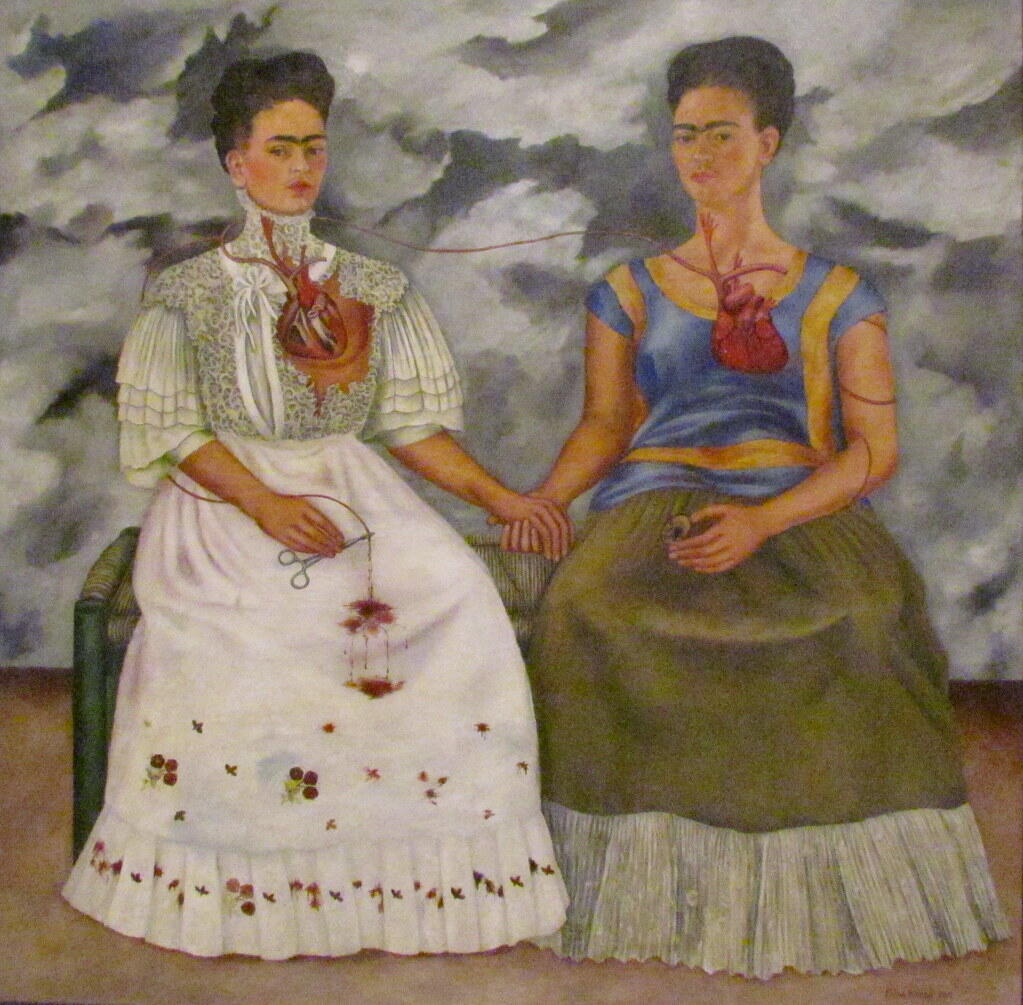
In the visual arts, Spanish-speaking artists such as Frida Kahlo and Remedios Varo have had a major influence on modern art and continue to inspire artists around the world. And of course, genres such as reggaeton, flamenco, salsa and Latin pop have reached an international audience through artists like Shakira, Ricky Martin and Daddy Yankee.
Spanish in International Organizations
The importance of Spanish on the world stage extends far beyond its native speakers. Due to its major role in communication, diplomacy and global cooperation, Spanish has become one of the main working languages in many international organizations.
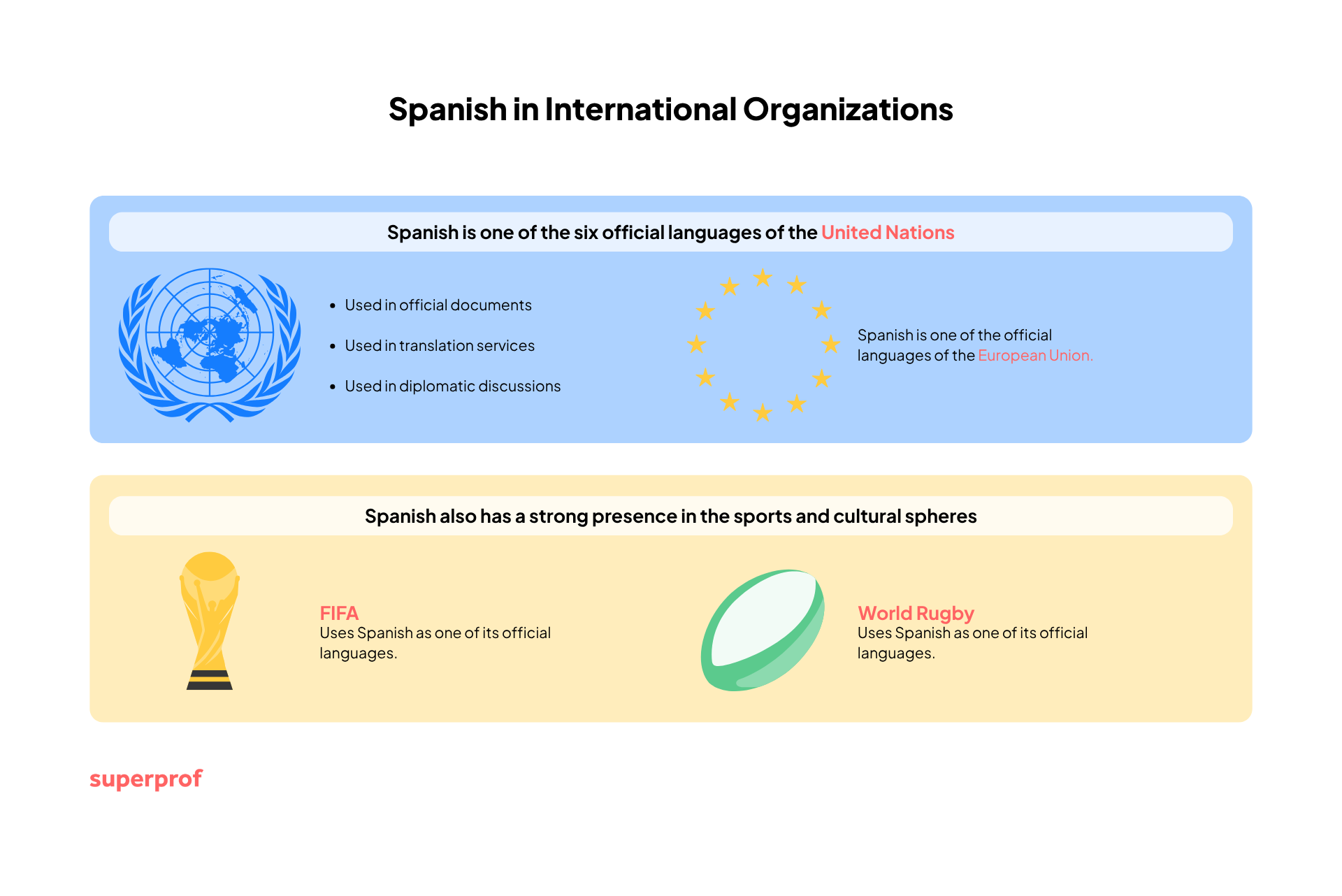
Spanish is one of the six official languages of the United Nations, and one of the official languages of the European Union. In addition, Spanish also has a strong presence in the sports and cultural spheres, as sports organizations such as FIFA and World Rugby use the language as one of their official languages.
The widespread use of Spanish in such organizations means that learning business Spanish could open up new professional opportunities.
Spanish Language Variations Across Regions
Due to history and factors such as migration, Spanish is spoken in different parts of the world. However, it has various regional, local, and indigenous variants, making it one of the richest languages in terms of pronunciation, vocabulary, grammar and expressions.
Dialects and Regional Differences
Although Spanish speakers usually understand each other, did you know that accents and vocabulary can differ considerably from one country to another? In fact, the Spanish spoken in Spain is very different from the Spanish of Latin America.
| Spanish Accent / Dialect | Main Regions | Most Notable Characteristics |
|---|---|---|
| Castilian Spanish | Spain | Pronounces “z” and soft “c” with a “th” sound; uses “vosotros” |
| Caribbean Spanish | Cuba, Puerto Rico, Dominican Republic | Fast speech, softer or omitted final “s” sounds, strong African and Caribbean influences |
| Rioplatense Spanish | Argentina, Uruguay | Uses “vos” instead of “tú”; Italian-influenced intonation and pronunciation |
| Andean Spanish | Peru, Bolivia | Clear consonant pronunciation and strong Indigenous linguistic influences, especially Quechua |
| Mexican Spanish | Mexico | Clear pronunciation and globally recognised vocabulary due to media and entertainment |
| Central American Spanish | Guatemala, Costa Rica | Distinct local slang, regional vocabulary, and varying Indigenous influences |
| Chilean Spanish | Chile | Fast-paced speech, unique slang, and distinctive pronunciation |
| Canarian Spanish | Canary Islands, Spain | Shares similarities with Caribbean Spanish, including softer consonants and seseo pronunciation |
For example, the Spanish spoken in Spain is known for pronouncing the “z” and the soft “c” with a “th” sound, whereas in most Latin American countries these letters are pronounced as “s.” On the other hand, Caribbean Spanish, spoken in countries such as Cuba, the Dominican Republic and Puerto Rico, is often characterized by a faster pronunciation and the omission of certain consonants.
Unique Linguistic Features
Across the different regions where Spanish is spoken, we find a wide variety of local expressions and pronunciations that reflect regional diversity and traditions. For example, in Spain, “vosotros” is used to address groups informally, while most Latin American countries use “ustedes” for both contexts. Furthermore, vocabulary and pronunciation can also widely vary.
And of course, we can’t forget to mention that slang and local expressions also contribute to the diversity of Spanish. In fact, words that are commonly used in one place may have completely different meanings in another.
Whether you’re interested in Latin American dialects or colloquial Spanish for travel and communication, learning the language will help you connect with millions of speakers around the world. Find available Spanish classes in Calgary.
Learning Spanish: Opportunities and Challenges
As one of the most widely spoken languages in the world, Spanish can help students connect with millions of people across continents and offer a wide range of personal, academic and professional possibilities.
Benefits of Learning Spanish
Learning Spanish can be very beneficial for traveling, studying, and working. Since Spanish is spoken in many countries, learning the language will make traveling through Latin America and Spain a much more immersive experience.
Connecting through travel
More immersive cultural and travel experiences, and the ability to communicate with millions.
Studying opportunities
Valuable skills for studying and international education opportunities.
Career and business
Increased job opportunities in tourism, healthcare, education, marketing and business.
Furthermore, Spanish is increasingly valuable in the job market. Many international companies and organizations seek bilingual employees in tourism, healthcare, education, customer service, marketing, and international business. Moreover, learning Spanish can help you better understand Hispanic cultures, literature, music, film and traditions by broadening your cultural perspective.
Resources for Spanish Learners
Today, there are many resources available for learning Spanish, ranging from traditional classes to digital learning platforms and immersion experiences. Language-learning apps like Duolingo offer interactive lessons focused on vocabulary, grammar, and pronunciation. Online platforms like Superprof and their private tutors also offer flexible learning options for both beginners and advanced students, no matter where they are in Canada.
Many students also opt for immersion-based methods, such as studying abroad in Spanish-speaking countries, joining conversation groups, watching movies and series, or listening to music and podcasts in Spanish. Combining structured lessons with regular exposure to the language is often one of the most effective ways to improve fluency and confidence in Spanish.
In 2025, approximately 24.6 million people learned Spanish as a foreign language in different educational contexts.
Whether it's for travel, career opportunities, or building cultural connections, Spanish can open the door to many opportunities. Check out Spanish classes in Toronto.
References
- Statista. (2026, April 15). The most spoken languages worldwide 2026. https://www.statista.com/statistics/266808/the-most-spoken-languages-worldwide/?srsltid=AfmBOopA-EyaI_TJjbdHOtP0grg5phWd5_MNwbwodxwY2GfwAtmDhuCZ
- Observatorio Global del Español Official Website. (2025). Spanish: A Language to the World 2025. https://observatoriodelespanol.cervantes.org/wp-content/uploads/2025/10/Spanish_a_language_to_the_world_2025.pdf?
- A Brief History of the Spanish Language in 10 Milestones - Google Arts & Culture. (n.d.). https://artsandculture.google.com/story/breve-historia-de-la-lengua-espa%C3%B1ola-en-10-hitos-fundacion-antonio-de-nebrija/pAVRk_Dyi4cHTw?hl=es
- Colonization of the Americas. (2026). Kids Britannica. https://kids.britannica.com/students/article/colonization-of-the-Americas/272832
Summarize with AI:
Did you like this article? Leave a rating!


 Loading...