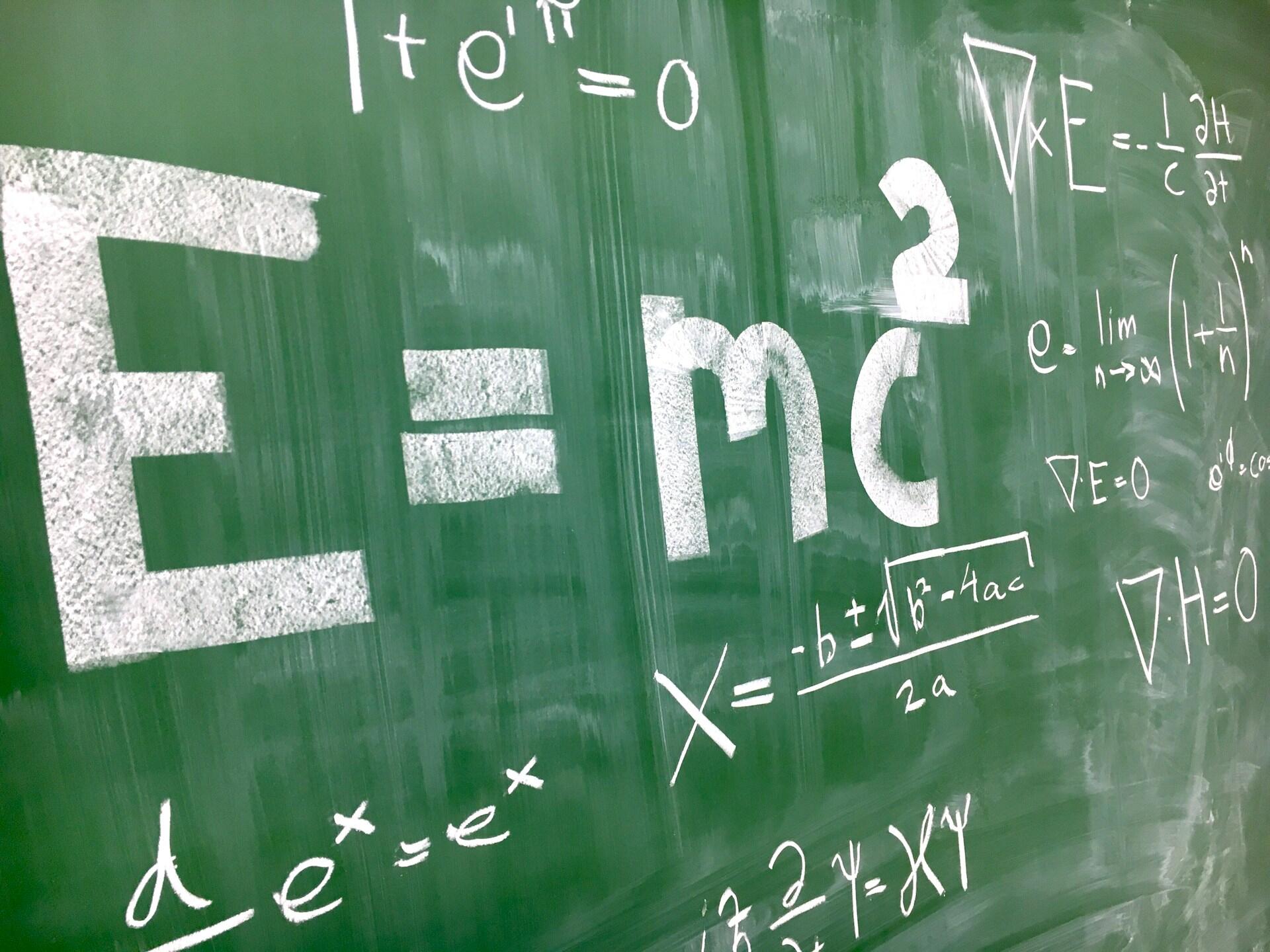

One of the most difficult classes for students is physics. There are many keywords and definitions, symbols and equations, and concepts that build on one another.
Physics terminology is useful for communicating ideas. Since each word has a precise definition within the scientific community, teachers, scientists, and students can talk about the information consistently.
In everyday conversation, a word like work can mean effort, the result of an effort; a production, a job, or even as slang for cosmetic surgery. In physics, it has a specific meaning: energy transferred when a force moves an object through a distance.
Physics itself is the study of fundamental features of the universe including what objects are, what properties they have, and how they change or interact. Major areas of physics include mechanics, thermodynamics, electricity and magnetism, optics, quantum physics, and cosmology.
Knowing the precise definition allows you to understand and communicate effectively about the science, since the word only has one meaning. It also refers to a specific equation: W = Fd
Where W means work,F is force, and d is displacement in the direction of the force.


Physics Terms A–Z Glossary
A–E
- Acceleration: The rate at which an object’s velocity changes over time. An object accelerates when it speeds up, slows down, or changes direction.
- Atom: The smallest unit of an element that still has the properties of that element. Atoms contain protons, neutrons, and electrons.
- Circuit: A complete path through which electric charge can flow. A simple circuit may include a battery, wires, a switch, and a bulb.
- Conduction: The transfer of thermal energy through direct contact between particles or objects. Metals are usually good conductors.
- Convection: The transfer of thermal energy by the movement of a liquid or gas. Warm fluid rises because it is less dense, while cooler fluid sinks.
- Current: The rate at which electric charge flows through a conductor or circuit. Current is measured in amperes, or amps (A).
- Dark matter: Matter that cannot be seen directly because it does not emit, absorb, or reflect light, but whose presence is inferred from its gravitational effects on visible matter.
- Diffraction: The spreading or bending of a wave when it passes around an obstacle or through an opening.
- Displacement: The straight-line change in an object’s position from its starting point to its ending point, including direction.
- Electron: A negatively charged subatomic particle found outside an atom’s nucleus.
- Energy: The ability to do work or cause change. Energy may exist in forms such as kinetic, thermal, chemical, electrical, and gravitational potential energy.
- Enthalpy: A quantity used to describe the total thermal energy of a system, especially when pressure is constant. Changes in enthalpy often show heat absorbed or released in a process.
- Entropy: A measure of how spread out energy is in a system, often linked to the number of possible arrangements of its particles. In an isolated system, entropy tends to increase.
- Equilibrium: A state in which all forces on an object are balanced, so there is no acceleration. Rotational equilibrium also requires balanced torques.
F–M
- Flux: The amount of a field passing through a given area. Magnetic flux describes how much magnetic field passes through a surface.
- Force: A push or pull on an object that can change its motion, shape, or direction. Force is measured in newtons (N).
- Frequency: The number of complete wave cycles or vibrations that occur each second. Frequency is measured in hertz (Hz).
- Friction: A force that opposes motion between surfaces in contact, or through a fluid such as air or water.
- Gravity: The attractive force between objects with mass. Near Earth’s surface, gravity pulls objects toward Earth’s centre.
- Inertia: The tendency of an object to resist a change in its motion. Greater mass means greater inertia.
- Ion: An atom or group of atoms with an electric charge because it has gained or lost electrons.
- Isotope: A form of an element with the same number of protons but a different number of neutrons.
- Lens: A transparent object with curved surfaces that refracts light to focus it or spread it out.
- Light-year: A unit of distance equal to the distance light travels through a vacuum in one year. It is about 9.46 trillion kilometres.
- Magnetism: The effects produced by magnetic fields, which are associated with moving electric charges and certain materials, such as iron.
- Mass: A measure of the amount of matter in an object and its resistance to acceleration. Mass is measured in kilograms (kg).
- Momentum: The quantity of motion an object has, equal to its mass multiplied by its velocity: p=mv
Reinforce your learning with a tutor for physics on Superprof!
SI stands for “Le Système International d'Unités,” which translates from French to the “International System of Units.” SI units are standard measurement units used universally in science and finance. So, for example, the SI unit for kilogram is kg. So, the standard label “kg” will be used when communicating between international people, even if they might refer to kilograms by a different word in their local language.
N–R
- Neutron: A subatomic particle with no electric charge, found in an atom’s nucleus.
- Nucleus: The small, dense central region of an atom that contains protons and neutrons.
- Orbit: The curved path followed by an object as it moves around another object because of gravity.
- Photon: A discrete packet, or quantum, of electromagnetic energy. Light can be described as a stream of photons.
- Proton: A positively charged subatomic particle found in an atom’s nucleus. The number of protons determines the element.
- Quantum: The smallest discrete amount of a physical quantity involved in an interaction. A photon is one quantum of light.
- Radiation: Energy transmitted through space or matter as waves or particles. Examples include visible light, radio waves, X-rays, and particles released during radioactive decay.
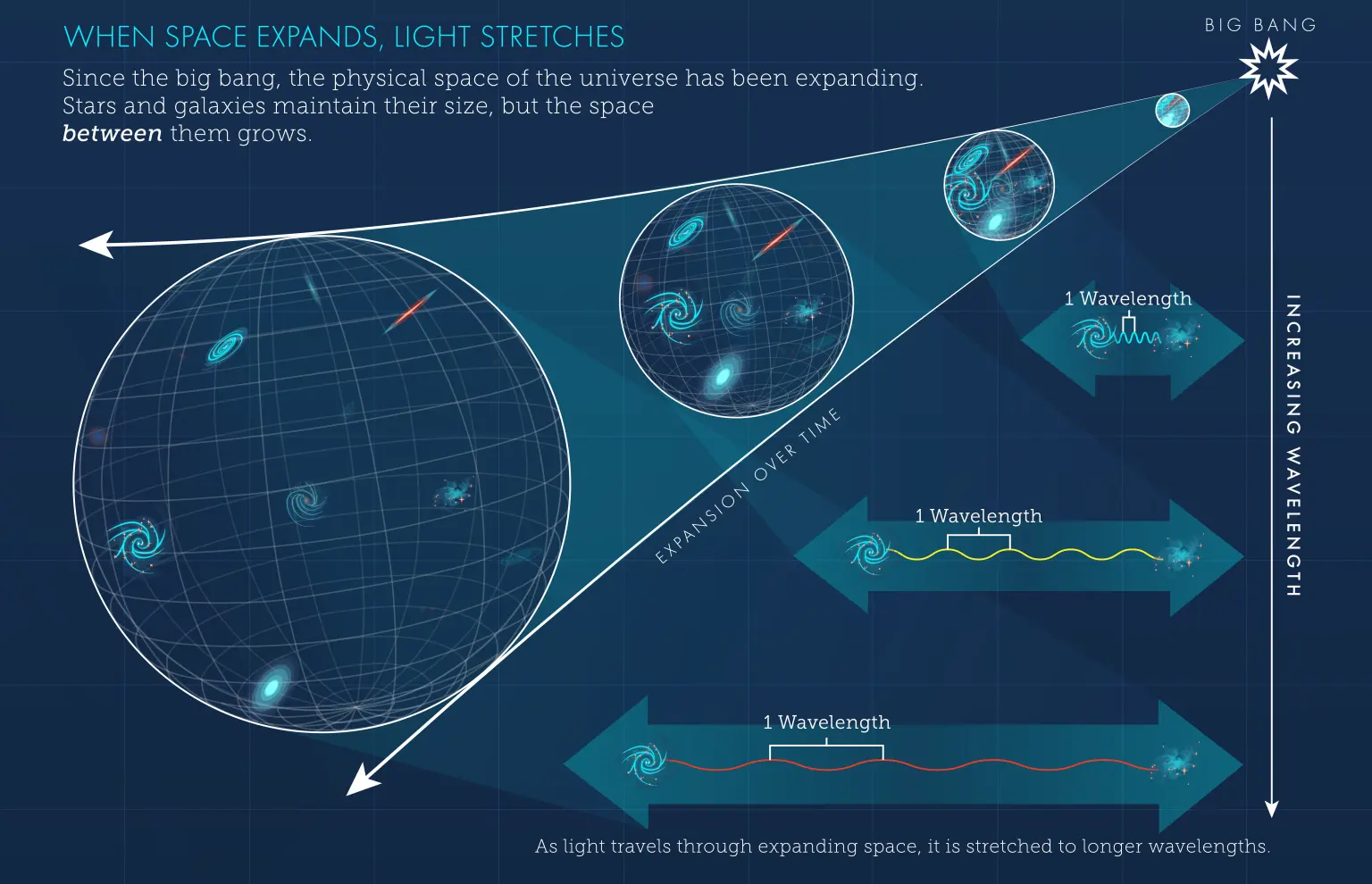
- Redshift: An increase in the wavelength of light, causing it to shift toward the red end of the spectrum. It commonly occurs when a light source is moving away or when expanding space stretches the light.
- Reflection: The bouncing of a wave off a surface. A mirror reflects visible light.
- Refraction: The change in direction of a wave as it moves from one medium into another because its speed changes.
- Relativity: Einstein’s theories explaining how measurements of space, time, motion, and gravity depend on speed and gravitational conditions.
- Resistance: The opposition a material or component provides to the flow of electric current. Resistance is measured in ohms (Ω).
Learn more about physics with a tutor for physics.
S–Z
- Singularity: A point or region in a physics model where quantities such as density or spacetime curvature become infinite, meaning the current theory cannot fully describe what happens there. It is often associated with the centre of a black hole.
- Spectrum: The full range of wavelengths or frequencies of electromagnetic radiation. The visible spectrum is the small part of this range seen as colours.
- Spin: An intrinsic quantum property of particles that gives them angular momentum. It is not simply a particle physically spinning like a small ball.
- Superposition: The principle that waves can overlap and combine, producing a resulting wave equal to the sum of their individual effects. In quantum physics, a system can also exist in a combination of possible states until measured.
- Thermodynamics: The branch of physics that studies heat, temperature, work, energy, and how energy moves or changes form.
- Torque: The turning effect of a force around a pivot point or axis. Torque depends on the force and its distance from the pivot.
- Trajectory: The path an object follows as it moves through space. A thrown ball follows a curved trajectory because of gravity.
- Velocity: Speed in a specified direction. For example, 15 m/s east is a velocity.
- Voltage: The electric potential difference between two points. It represents the energy transferred per unit charge and is measured in volts (V).
- Wave: A disturbance that transfers energy from one place to another without permanently transferring matter overall.
- Wave function: A mathematical description of a quantum system that can be used to calculate the probability of finding a particle in a particular state or location.
- Wavelength: The distance between identical points on consecutive waves, such as crest to crest or trough to trough. Wavelength is commonly represented by λ (lambda).
Still confused? Find a tutor for physics to help you learn.
Simple Definitions List
View all these definitions in a simple list, perfect for studying and reviewing concepts.
| Term | Simplest definition | Simplest example |
|---|---|---|
| Acceleration | Change in velocity per unit of time | A bicycle speeds up after the rider pedals harder |
| Atom | Smallest unit of an element that keeps its chemical identity | A carbon atom in pencil graphite |
| Circuit | A complete path for electric current | A battery, wires, and bulb connected in a loop |
| Conduction | Heat transfer through direct contact | A metal spoon warms in soup |
| Convection | Heat transfer by moving fluids | Warm air rises above a radiator |
| Current | Flow of electric charge | Charge moving through a phone charger cable |
| Dark matter | Unseen matter inferred from its gravitational effects | Galaxy motion suggests more mass than visible stars provide |
| Diffraction | Spreading of waves around an edge or through a gap | Sound bends through an open doorway |
| Displacement | Straight-line change in position, including direction | Walking 3 m east from a starting point |
| Electron | Negatively charged particle in an atom | Electrons moving in a wire create current |
| Energy | Capacity to cause change or transfer heat | A raised book has gravitational potential energy |
| Enthalpy | A measure used to track heat energy in a system at constant pressure | Heat released in a chemical reaction |
| Entropy | A measure related to energy spreading and the number of possible arrangements | Ice melting into liquid water |
| Equilibrium | A state in which net force and net torque are zero | A book resting on a table |
| Flux | The amount of a field passing through an area | Magnetic field passing through a coil |
| Force | A push or pull that can change motion | Kicking a soccer ball |
| Frequency | Number of wave cycles each second | A 440 Hz musical note vibrates 440 times per second |
| Friction | Force that resists sliding or rolling motion | Shoes gripping the floor |
| Gravity | Attraction between objects with mass | Earth pulling an apple downward |
| Inertia | Resistance to a change in motion | A heavy cart is harder to start moving |
| Ion | Atom or molecule with a net electric charge | Sodium becomes a positive ion after losing an electron |
| Isotope | Version of an element with the same protons but different neutrons | Carbon-12 and carbon-14 |
| Lens | Transparent object that bends light | Eyeglasses focusing light on the eye |
| Light-year | Distance light travels in one year | Proxima Centauri is about 4.24 light-years away |
| Magnetism | Effects caused by moving charges and magnetic fields | A magnet attracting iron filings |
| Mass | Measure of matter and inertia | A 2 kg textbook has more mass than a 500 g notebook |
| Momentum | Mass multiplied by velocity | A moving truck has more momentum than a moving skateboard |
| Neutron | Neutral particle in an atomic nucleus | Carbon-12 has six neutrons |
| Nucleus | Dense centre of an atom containing protons and neutrons | The centre of a helium atom |
| Orbit | Curved path of an object moving under gravity | The Moon’s path around Earth |
| Photon | A packet, or quantum, of electromagnetic energy | A photon of visible light reaches your eye |
| Proton | Positively charged particle in an atom’s nucleus | Hydrogen has one proton |
| Quantum | Smallest discrete amount of a physical quantity in a given interaction | A photon is a quantum of light |
| Radiation | Energy transferred by electromagnetic waves or particles | Sunlight warming your skin |
| Redshift | Shift of light toward longer wavelengths | Light from a receding galaxy appears redder |
| Reflection | Bouncing of a wave off a surface | Seeing your face in a mirror |
| Refraction | Bending of a wave as it enters a different medium | A straw looks bent in water |
| Relativity | Einstein’s theories of space, time, gravity, and motion | GPS systems account for relativity corrections |
| Resistance | Opposition to electric current | A thin wire limits current more than a thick wire |
| Singularity | A point where a model predicts extremely high density or curvature | The centre described by a simple black-hole model |
| Spectrum | Range of wavelengths or frequencies | A rainbow is part of the visible spectrum |
| Spin | An intrinsic quantum property of particles | Electrons have spin, but do not act like tiny spinning balls |
| Superposition | A situation in which wave effects or quantum states combine | Two water waves overlap in a pool |
| Thermodynamics | Study of heat, work, temperature, and energy transfer | How a refrigerator moves thermal energy |
| Torque | Turning effect of a force | Pushing a door near its handle creates torque |
| Trajectory | Path followed by a moving object | The curved path of a thrown baseball |
| Velocity | Speed in a stated direction | 20 m/s north |
| Voltage | Energy transferred per unit charge | A 9 V battery provides 9 joules per coulomb |
| Wave | A disturbance that transfers energy | Ripples moving across water |
| Wave function | Mathematical description of a quantum system | It can be used to predict where an electron may be found |
| Wavelength | Distance between matching points on neighbouring waves | Distance from one crest to the next |
Acceleration, force, mass, energy, momentum, velocity, current, voltage, resistance, wavelength, frequency, atom, and photon. They are foundational in understanding more complex concepts later on.
Core Physics Concepts Explained
Knowing the definition doesn't necessarily mean you understand a concept. Here, we’ll cover some of the essentials for different areas of physics beyond just the short definition.
Matter, Mass and Energy
Matter, mass and energy are closely-connected concepts.
- Matter is anything that has mass and takes up space. All solids, liquids, gases and plasmas are all matter.
- Mass measures how much matter an object contains and how strongly it resists changes in motion.
- Energy comes in several forms. The most common are kinetic (energy caused from motion), gravitational potential (energy acquired by doing work against gravity), thermal (internal kinetic energy; energy of the moving atoms and molecules in an object), electrical (energy from the flow of electrons), chemical (energy stored in the bonds of atoms and molecules that is released through chemical reactions), and nuclear (energy released the nucleus of an atom during fission or fusion).
Force, Motion and Acceleration
Newton’s laws describe how forces affect motion:
- Newton’s first law: An object stays at rest or keeps moving at a constant velocity unless an external force acts on it, also called inertia. Example: A shopping cart takes extra effort to start pushing, less effort to keep in motion, and more effort to make it come to a stop prematurely.
- Newton’s second law: An object’s acceleration depends on the mass of the object and the amount of force applied. Example: An empty shopping cart is easier to move, while a full one with more mass is harder to accelerate.
- Newton’s third law: Objects exert equal and opposite forces on one another. Example: When you push a shopping cart, it’s also pushing you back, but because you have greater mass, you overcome the resistance.
Quantum: Derives from Latin, meaning “how much.” In modern physics, it refers to a specific amount, such as one photon of light.
Plasma: Borrowed from biology. Physicist Irving Langmuir was reminded of blood cells carrying plasma when observing ionized gas. In modern physics, it refers to the state of matter made of charged particles.
Inertia, acceleration and force depend on mass. These concepts about motion often cause confusion:
- Displacement is a straight-line change in position, whereas distance is the total length travelled.
- Velocity includes direction. A car travelling 60 km/h east and one travelling 60 km/h west have two different velocities.
- Acceleration includes slowing down and turning, not just speeding up.
- Friction acts against motion between surfaces.
- Equilibrium means there is no acceleration and forces are balanced.
Ensure you really understand all the concepts with help from a tutor for physics.
Work, Power, And Momentum
These concepts are related to force, motion and acceleration, but have distinct connotations.
- Work takes place when a force causes displacement.
Example: Holding a heavy backpack is tiring over time, but in physics there is no mechanical work being exerted because the backpack does not move. - Power is how quickly work is done or energy is transferred.
Example: If two people both carry the same box up a flight of stairs, they do the same work. However, the student who does it faster uses more power. - Momentum is how much effort it takes to stop an object’s movement. It is similar in concept to inertia, which confuses many students. It depends on mass and velocity. A force is what changes momentum.
Fields, Waves, And Radiation
A field is a region where each point within has an associated physical quantity. For example, Earth has a gravitational field; each point within the gravitational field has newtons per kilogram measurement exerted on them. Other types of fields include magnetic and electric.
A wave transfers energy without permanently moving matter. Waves are described by wavelength, frequency, amplitude and speed. Electromagnetic waves are very common; the spectrum contains radio waves, microwaves, infrared, visible, and ultraviolet light, X-rays, and gamma rays.
Radiation is energy that is carried by waves or particles, rather than only through matter touching. Sunlight is electromagnetic radiation; the heat and light can travel through the vacuum of space.
Delta (Δ): “change in”
Lambda (λ): wavelength
Theta (θ): angle
Rho (ρ): may mean density
Mu (μ): may mean a coefficient
Heat, Temperature, And Thermodynamics
These concepts are closely related to energy.
- Temperature measures the average kinetic energy of particles in a substance.
- Heat is thermal energy moving from a warmer object to a cooler one.
- Thermodynamics is the study of heat, work, energy and temperature together.
(degrees Kelvin)
Is the same as 0 K.
There are four main laws of thermodynamics:
- The zeroth law (added after laws one and two were discovered, resulting in the name) is the most fundamental law and explains thermal equilibrium. If two objects are each in equilibrium with a third, they are in equilibrium with each other.
- The first law states that energy is not destroyed or created, only conserved and converted into different forms.
- The second law explains that heat tends to move from hot to cold. This also tends to cause an increase in entropy in natural systems.
- The third law states that absolute zero (and therefore no molecular movement and 0 entropy) cannot be reached.

Electricity And Magnetism
Electricity originates at the smallest level from the positive and negative particles in atoms, protons and electrons, respectively. Protons repel other protons and electrons repel other electrons because the same electric charge repels. Conversely, opposite charges attract. This intertwines electric and magnetic forces, though they are slightly different. Magnetic fields naturally arise around moving electric charges. That’s why the field is often called electromagnetism.
- Ohm’s law examines the relationship between voltage, current and resistance. It’s denoted with V = IR, where V is voltage, I is current, and R is resistance.
- Voltage is the energy available to move an electric charge.
- Current is the flow of the charge.
- Resistance limits or impedes the flow.
- Circuits are complete paths that allow current to flow.
Need more explanations about electricity or another physics concept? Find physics courses online on Superprof!
Light And Optics
Light travels in straight lines (though, it behaves as a wave on the electromagnetic level) through a uniform medium. When it interacts with a medium, its behaviour can change:
- Reflection is when light bounces off a surface.
- Refraction is when light changes speed and/or direction between different materials or different densities of the same material. A lens uses this concept to focus or spread light, creating a zoomed-in or zoomed-out effect.
- Diffraction is when a light wave spreads around a gap or corner.
This is "c" in E=mc^2
Atomic And Quantum
Atoms contain three particles: neutrons, protons, and electrons. The number of protons determines the element (also the atomic number). Different neutron counts create different isotopes, and different numbers of electrons than normal can result in positive or negative ions (atoms with an electric charge).
Quantum physics describes how things (in this instance, particles, atoms, and molecules) behave differently than the mechanics we observe on an everyday scale because they are so small. Modern physics includes quantum mechanics and relativity because classical physics doesn’t fully describe the conditions at the atomic level.
Looking at the root word can help you form an idea about what the term is referring to. For example, thermo is related to heat, photo relates to light, and chrono relates to time.
Space And Cosmology
Important concepts in this realm of physics include:
- Light-years, which are a unit of distance, not time. It describes the distance light travels in one year in a vacuum.
- Redshift occurs when the wavelength of light from a distant object is stretched, making its colour appear redder than it would actually appear if it were able to be seen without the distortion. This happens in astronomy, since light travels over immense distances and the stars are usually moving in a different direction than Earth.
- Dark matter cannot be seen directly because it does not emit or reflect enough electromagnetic radiation (light or heat). Scientists can infer its presence from gravitational effects on visible matter.
kilometers
| Concept | Symbol | SI Unit | Formula | Meaning |
|---|---|---|---|---|
| Acceleration | a | m/s² | a = Δv / Δt | How quickly an object’s velocity changes |
| Force | F | N | F = ma | A push or pull; net force causes acceleration |
| Momentum | p | kg·m/s | p = mv | Mass in motion |
| Work | W | J | W = Fd cos(θ) | Energy transferred when a force moves an object |
| Power | P | W | P = W / t | How quickly work is done or energy is transferred |
| Kinetic energy | Eₖ | J | Eₖ = ½mv² | Energy an object has because it is moving |
| Gravitational potential energy | Eₚ | J | Eₚ = mgh | Stored energy due to an object’s height in a gravitational field |
| Current | I | A | I = Q / t | Rate at which electric charge flows |
| Voltage | V | V | V = IR | Energy transferred per unit of electric charge |
| Resistance | R | Ω | R = V / I | Opposition to electric current |
| Frequency | f | Hz | f = 1 / T | Number of complete wave cycles each second |
| Wave speed | v | m/s | v = fλ | How fast a wave travels |
| Wavelength | λ | m | λ = v / f | Distance between matching points on consecutive waves |
| Photon energy | E | J | E = hf | Energy carried by one photon |
| Weight | Fg | N | Fg = mg | Gravitational force acting on an object |
| Density | ρ | kg/m³ | ρ = m / V | Mass contained in a given volume |
| Pressure | P | Pa | P = F / A | Force applied over an area |
| Electric charge | Q | C | Q = It | Amount of electric charge |
| Gravitational field strength | g | N/kg or m/s² | g = Fg / m | Gravitational force per kilogram of mass |
| Torque | τ | N·m | τ = rF sin(θ) | Turning effect of a force about a pivot |
| Efficiency | η | % | η = (useful energy output / total energy input) × 100 | Percentage of input energy converted into useful output |
Learning Physics Terminology For Students
Now you know of more than 50 concepts you should learn in physics class. How can you remember it all? Here are some techniques for learning physics vocabulary.
How To Memorize Physics Words
Memorizing physics words is achievable with spaced-repetition and active recall techniques. Connecting the definition and accompanying concepts (like SI units, equations, and closely-related topics) along with an example and simple diagram you have a firm understanding of helps. Grouping words by topic this way helps create a strong schema in your mind, making it easier to remember what you’ve already learned and pick up new concepts more quickly.
Here are some ideas for flashcards you can use in your own set of study resources! You can also study with physics courses on Superprof!
Common Physics Terms Mistakes And Confusions
When learning and studying physics, be sure to avoid these common pitfalls. Having a fundamental misunderstanding will make it so much harder to learn more concepts later on.
Mass is measured in kilograms. Weight is a force caused by gravity and is measured in newtons.
Speed tells you how fast something moves. Velocity tells you how fast and in what direction it moves.
Heat is energy transferred because of a temperature difference. Temperature measures the average kinetic energy of particles.
Energy is the capacity to do work. Work is what happens when force is applied to move an object/system over a certain distance. Energy is transferred to the object which results in movement.
Force changes momentum. Momentum describes an object’s motion based on mass and velocity.
Learning physics terms is one of the cornerstones of learning physics overall. It helps you parse out difficult concepts in your mind, which helps you understand more complex topics later on. Having a strong physics vocabulary allows you to properly name what you’re observing. Using correct terminology is essential in the scientific and academic setting; using incorrect terms causes confusion and can render your statements completely wrong. Once these words are familiar, comprehending questions becomes a lot easier.
⚛ Which physics topic do you find hardest?
References
- Hall, Nancy. “Newton’s Laws of Motion.” Glenn Research Center | NASA, 27 June 2024, www1.grc.nasa.gov/beginners-guide-to-aeronautics/newtons-laws-of-motion. Accessed 12 Sept. 2026.
- “The Stephen Hawking Centre for Theoretical Cosmology: Glossary.” University of Cambridge, www.ctc.cam.ac.uk/footer/glossary.php. Accessed 12 Sept. 2026.
- Urone, Paul Peter, and Roger Hinrichs. 1.1 Physics: Definitions and Applications - Physics | OpenStax. 26 Mar. 2020, openstax.org/books/physics/pages/1-1-physics-definitions-and-applications. Accessed 12 Sept. 2026.
Summarize with AI:
Did you like this article? Leave a rating!


 Loading...