


French slang is colorful, expressive, and ever-changing — giving you a glimpse into everyday life that textbooks often miss. Whether you're visiting France, chatting with native speakers, or simply want to sound more authentic, understanding slang in French is your ticket to sounding like a local.





French Slang: A Short History
When you start learning French, you're typically introduced to the polished, proper version of the language. It’s the kind you’d use at school, in a business meeting, or ordering a croissant in a quiet café.

But the moment you step into everyday French life — on the metro, in bars, or scrolling social media—you’ll notice something different. That’s where French slang takes over.
Slang in French, or “argot,“ isn’t just a fun addition — it’s essential for understanding how people really talk. From casual phrases like "ça roule?" (how’s it going?) to more niche expressions found in music and movies, French slang words reflect how culture and conversation constantly evolve.
Just like in English, slang can express emotions, identity, and group belonging. If you want to sound less like a textbook and more like a local, understanding French slang expressions will level up your fluency. In fact, mastering them is a major step in improving your ability to hold natural conversations and speak french like a native. It will overall make the experience for you and whoever you are talking to seem much more natural.
What’s even more fascinating is how French slang has been shaped by other cultures — especially Arabic. This influence stems largely from France’s colonial history and waves of immigration from North Africa, particularly Algeria, Morocco, and Tunisia. Over the years, many everyday slang words have made their way into French through immigration and cultural exchange. Words like kiffer (to love), seum (frustration or bitterness), and toubib (doctor) are all words with Arabic origins. These borrowed terms add richness and depth to the way modern French is spoken.
French is one of the only languages spoken on every continent — thanks to France’s colonial past.
Verlan: What is It?
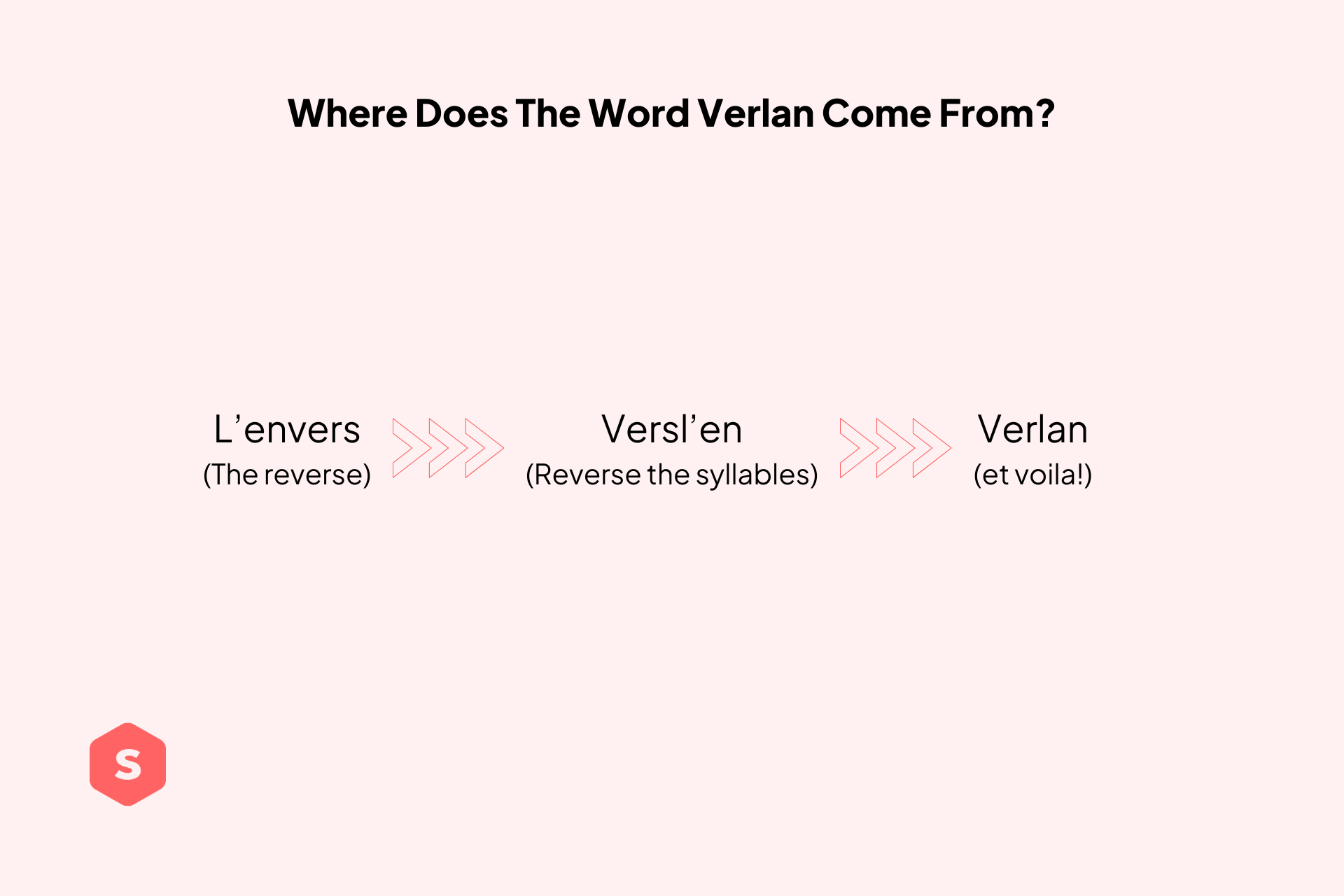
Verlan is a form of French slang where syllables are reversed — think of it like the French version of Pig Latin. It's also a fascinating case study of how language evolves through youth culture, music, and regional identity.
For students who want to sharpen both comprehension and speaking skills, playing with slang like verlan can seriously boost your listening practice. But unlike Pig Latin, Verlan isn’t just a joke. It’s used seriously, especially among younger speakers, in pop culture, music, and everyday chat.
If you want to learn French jargon, you can’t escape verlan. In this wordplay technique, you break a word into syllables, swap them around, and sometimes even modify the pronunciation to make it sound smoother or more natural. The result? A fresh new slang term that often carries a sense of belonging, rebellion, or fun.
This style of speaking originated in the Paris suburbs, especially among working-class and immigrant youth. Over time, it spread into mainstream culture through rap music, films, and everyday conversation. It’s now common to hear verlan in casual speech, especially among teens and young adults across France.
One of the most commonly cited examples of cheum French slang (from moche, meaning ugly) is “Cette voiture est trop cheum !” — a phrase you’ll hear in casual convos and memes alike.
What makes Verlan fascinating is how dynamic it is. New words are created all the time, and some older ones fall out of use. Some terms become so widely used that they lose their underground feel and become part of general slang — only to be re-verlaned in response. A perfect example is meuf (from femme, meaning woman), which later got flipped again to become feum.
| Verlan Word | Original Word | Meaning in English | Example Sentence |
|---|---|---|---|
| Meuf | Femme | Woman / Girl | C’est une meuf super cool. |
| Keum | Mec | Guy / Dude | T’as vu ce keum avec le blouson rouge? |
| Ouf | Fou | Crazy (in a fun way) | Le concert était ouf hier soir! |
| Cimer | Merci | Thanks (cool/slangy) | Cimer pour ton aide, frérot. |
| Zikmu | Musique | Music | Tu connais cette zikmu? Elle est trop bien! |
| Teuf | Fête | Party | Tu viens à la teuf ce soir? |
| Kiffer | Aimer | To really like / love/ enjoy | Je kiffe ce film, il est génial. |
| Nickel | Parfait | Perfect / Spot on | Ton exposé était nickel. |
| Reum | Mère | Mom / Mum | Je vais chez ma reum ce week-end. |
| Chanmé | Méchant | Wicked / Awesome | Ton skate trick était chanmé! |
As I am sure you’ve found, none of these are in your textbook. And while you can buy a slang dictionary or a thesaurus, there is nothing like spending time among native speakers for free French slang lessons - which have the added benefit of the French accent. As you immerse yourself in the French language, you will discover a great number of words that weren’t covered in your last French lesson.
Express Yourself Like a Local
What’s considered basic in French slang today might be totally outdated next year — that’s how fast it evolves. Still, learning the essentials helps you follow along and join in.
When you first start learning French, you're usually focused on getting the basics right: building your vocabulary, mastering grammar, memorizing your verbs, and making sure your adjectives agree. You work on pronunciation and maybe even get confident enough to say bonjour with flair.

But when you finally set foot in a French-speaking city like Paris or Montreal (don't worry you can find french courses there as well) or listen to locals chatting on the metro, you quickly realize something — real-life French doesn't always sound like the version you learned in class.
That’s because what you’ve been taught is often formal French. It’s the version used in professional environments, exams, or polite conversation. But once you're on the street, hanging out at cafés, watching French films, or scrolling through social media, you'll notice a whole other layer to the language— colloquial French.
And it’s not just slang. It’s rhythm, tone, compound expressions, shortened words, and idioms that make conversations feel fluid and real.
For example, instead of saying bonjour, someone might greet you with salut — a word that also means bye. Or they might say ça roule? instead of comment ça va? These aren’t things you typically find in textbooks, but they’re everywhere in real life.
Find the best of French classes Toronto here.
Everyday Phrases, Fillers & Contractions
To truly sound like a native speaker, it’s not enough to just know the vocabulary — you also need to get a feel for how French is spoken in casual, everyday settings. Sometimes it can help to get a private French tutor to help you out. Whether you need tutoring in Regina or elsewhere in Canada, there's a tutor for you! As native speakers often pepper their conversations with filler words, interjections, and expressions that don’t always translate directly but carry a lot of meaning and tone, it gives French its natural rhythm and flair.
Beyond slang, French is rich with filler words, contractions, and everyday phrases like:
Meh, not sure
Totally, for sure.
Like / kind of (used similarly to "like" in English).
Let it go / forget it.
That’s annoying / I’ve had enough.
Expressions like these might not be grammatically "perfect," but they’re what give modern French its character. They also reflect how native speakers express emotions, set the tone, and relate to one another. Mastering these subtleties is one of the best ways to improve your French conversation and listening practice, especially if you’re working toward fluency in social settings.

Another key element of sounding local is knowing how compound words and phrases evolve in speech. French speakers often link words, drop letters, and use rhythm to guide their flow:
- T’es où ? instead of Tu es où ?
- J’sais pas instead of Je ne sais pas
- Y’a du monde instead of Il y a du monde
This is where listening and speaking practice really come into play. If you’re looking to polish your pronunciation and get comfortable with how native French sounds, you might want to learn how to pronounce French words correctly through one-on-one practice.
With time, you’ll also become familiar with regional accents and expressions. The slang used in Paris may differ from what you hear in Marseille, Montreal, or Dakar. French is a global language with rich diversity, and understanding those differences helps you connect more deeply with people across cultures, especially when you start noticing how accents and dialects shift from region to region. It doesn't matter whether you are in Quebec, Marseille, or Dakar, local variations matter.
accents & dialects
accents & dialects
accents & dialects
Every region has its own way of speaking French — not just in words and pronunciation but also in tone, rhythm, and everyday expressions. In the south of France, the accent tends to be more musical and drawn out. In Quebec, you’ll hear unique phrases influenced by English and local history. And in parts of West Africa, French often mixes with local languages, creating super vibrant and expressive slang.
And if you're hoping to apply this knowledge in real life, whether you're traveling, moving abroad, or simply want to deepen your immersion, consider booking a private lesson. It’s never been easier to locate a French teacher in Canada or connect with a tutor who fits your goals.
So if you want to learn French in Canada see if you can find a tutor on Superprof to help you out.
French Slang Words for Food
Let’s be honest—talking about food is practically a national sport in France. Mealtime isn’t just about eating — it’s about connection, culture, and conversation. So, it’s no surprise that there’s a whole slang vocabulary built around it.
Some common French slang for eating and drinking includes:
| French Slang | Meaning in English |
|---|---|
| J’ai la dalle | I'm starving |
| La bouffe | Grub/food |
| Te goinfrer | To stuff yourself |
| Être bourré | To be drunk |
| Malbouffe | Junkfood |
| Le grignotage | Snacking |
| Un pain au chocolat | Chocolate croissant |
| Les bonbons | Candy |
| Les pâtes | Pasta |
| Le café | Coffee |
| Les légumes | Vegetables |
| La glace | Ice cream |
| L’eau | Water |
| Délicieux / Délicieuse | Delicious |
Let’s unpack a few of these. Saying j’ai la dalle isn’t just a casual way to say you’re hungry — it actually has roots in Old French, where dalle referred to a gutter or gully. It was short for expressions like avoir la dalle vide (to have an empty gullet). You might also hear je crève la dalle to say you're absolutely starving.
Then there’s la bouffe, which means grub. It’s not used for gourmet cuisine — think more along the lines of everyday eats or something you'd grab at Macdo (McDonald’s). In fact, malbouffe (literally “bad grub”) is how French media often refer to fast food and unhealthy eating.
If you’re based in Ottawa, practicing with a local tutor can help you pick up these phrases faster.
And if you’ve overindulged — especially in wine — you might find yourself bourré (drunk). But there are tons of ways to say that too: être pompette, être pété, être noir, or even être beurré comme un petit LU (drunk as a buttered biscuit). You’ll hear these terms in bars, family kitchens, on TV shows, and even in school cafeterias. Some are playful, others a bit cheeky, but they’re all part of how French speakers express their love of food and drink.
Whether you're learning French to study abroad, travel, or just impress your foodie friends, picking up these slang terms will help you blend right in. Food is an important part of any culture and since French is so widely spoken it would make sense to know just how to share your thoughts, cravings, interest and so on with your friends.
Want to go deeper? Maybe it’s time to book a French teacher in Vancouver and start practicing these in real time.
French Slang Expressions to Use Among Friends
When you’re hanging out with French-speaking friends, the way people talk shifts — it’s more relaxed, more expressive, and often way more fun. That’s where slang really comes to life. These aren’t the phrases you’ll learn in your average French class, but they’re essential if you want to sound natural in everyday conversations.
Instead of saying salut, comment vas-tu ?, your friends might greet you with:
- Wesh ? – What’s up? (very casual)
- Ça roule ? – How’s it going?
- T’as la pêche ? – Feeling good?
The same goes for reacting to things. If someone tells a surprising story, you might hear C’est ouf ! (That’s crazy!), or T’es sérieux ?! (Are you serious?!). And when someone’s being annoying, you’ll probably hear Il est relou…, a slangy way to say someone is being a pain. (Relou is Verlan, by the way—reversed from lourd, meaning heavy.)
Not sure how to pronounce or use these naturally? You can always find an online French tutor to practice with someone in real time.
This type of slang is also where emotional tone plays a huge role. When something’s exciting or impressive, phrases like Ça déchire ! (That rocks!) or C’est chanmé ! (That’s wicked!) bring the energy.
If someone’s super strong or impressive, you might say they’re balaise. The balaise meaning is close to “tough” or “solid” — great for describing a friend who nailed an exam or crushed it at the gym.
You might also hear C’est dar ! — a popular Gen Z expression. The c’est dar meaning is pretty close to “that’s awesome” or “so cool,” and it’s one of those phrases that instantly makes you sound in the loop.
The magic of these expressions is that they carry social meaning. They let you relate to people your own age, join in on jokes, and show you’re comfortable in casual settings. They also help you move past textbook French and into the rhythm of everyday life.
These expressions are great for casual chats with friends — but definitely not for formal situations like work, school presentations, or polite company.
If you’re ready to practice this kind of French in a real-world setting — especially if you want help with the French pronunciation and using it naturally - you can consider booking classes with a tutor.
Summarize with AI:
Did you like this article? Leave a rating!


 Loading...
