

There’s something fascinating about complex piano songs.
Whether it’s the thrill of pushing your limits or the satisfaction of finally nailing that impossible passage, difficult pieces are a badge of honour for many pianists.
But difficulty isn’t always about speed. Some pieces challenge your coordination, memory, or emotional control, while others do all three at once.
In this guide, we’ve rounded up ten of the hardest piano songs across genres, from classical masterpieces to film scores and iconic ballads. You’ll find out what makes them so demanding and why they’ve earned a place in the elite tier of piano repertoire.






Symphony No. 5 by Beethoven (1804-1808)
Beethoven’s Symphony No. 5 is one of the most famous pieces in classical music but also one of the hardest to play on piano.
The well-known four-note theme has been used in movies like The Longest Day and Saturday Night Fever, but the full 40-minute piece is complex and challenging. It pushes a pianist’s energy, expression, and control.
Written during the Napoleonic wars, while Beethoven was losing his hearing, the piece captures both chaos and triumph. It remains a favourite among advanced pianists who explore the historical roots of the instrument and deepen their understanding of the piano world.
Comptine d'un autre été by Yann Tiersen (2001)
This haunting piano-accordion melody from Amélie remains one of the most iconic soundtracks of the early 2000s. And this melody, composed by one of the best pianists of the world Yann Tiersen is very difficult for a particular reason: it is a piece for a left-handed person.
Known for its emotional depth and minimalist charm, the piece is deceptively challenging — not due to complex harmonies, but because it heavily favors the left hand. It's a beautiful piano-accordion melody of one of the most popular french films of the early 2000s : Amélie.
This makes it uniquely demanding for most players, requiring strong finger independence and non-dominant hand control. Add to that its flowing tempo and subtle dynamic shifts, and it becomes clear why this piece is a benchmark for intermediate pianists seeking to build expressive range and control.
of pianists are right-handed
Piano Sonata No. 18 in D major by W.A Mozart
Mozart is often seen as one of the greatest piano composers in history, not just for his genius, but for the technical challenges hidden in his works.
While many know him for his operas, like The Magic Flute, his piano sonatas are just as iconic and far more difficult to master than they may sound.
Sonata No. 18 in D Major stands out for its fast fingering, shifting rhythms, and constant changes in tempo. It demands precision, expression, and a deep understanding of classical phrasing. Playing this sonata well is often seen as a mark of true pianistic skill.
Mozart composed 18 piano sonatas, all between the ages of 18 and 31, showcasing his transition from prodigy to mature composer.
The Toccata in D Minor by J.S Bach (1703-1707)
Everyone has already heard this music, the reference music written for the organs by Bach. Built in three episodes, it took four years to be written. Controversies ran around it at the beginning, the sulfurous composer Ringck and then Kelliner claiming its origin, but it is ultimately attributed to Bach when he was young.
Very quickly returned to popular culture, the XXth gives a timeless aspect to this piece. He is taken to the cinema in Fantasia, Twenty Thousands Leagues under the Sea, The Godfather or even Aviator and Pirates of the Caribbean.
The first notes entered history, and a melody as beautiful as that is difficult with accelerations and piano adaptation.
The Bolero by Maurice Ravel (1928)
Undoubtedly one of the most beautiful ballets of the XXth Century. Again, you probably heard this music from the AGF Insurance ad in the early 2000s. A beautiful and catchy melody, lasting about 15 minutes.
Originally composed as a ballet, Boléro has become one of the most performed orchestral works worldwide, featured in everything from Olympic ceremonies to concert halls. Playing it on the piano requires a high level of focus and control, even though the notes themselves appear deceptively simple.
It’s the kind of challenge advanced students often take on after completing foundational training for example, through piano lessons in Vancouver, where access to experienced teachers can help unlock the musical depth behind repetitive phrasing.
Boléro was originally considered a musical experiment — Ravel once described it as “17 minutes of orchestral crescendo with no development!”
Diego by Michel Berger (1983)
In France, Michel Berger is a reference in piano and musical creation. We owe him a very large number of great hits. He wrote songs for himself, but also for the other musicians.
And if we had to come out with a song that represents the composer's genius, Diego is the perfect example.
While it’s not the most technically complex piece, Diego is a challenge in its own right. The beauty of the song lies in its subtle shifts in rhythm and emotional phrasing, making it surprisingly difficult to recreate the expressive depth of Berger’s original performance.
Advanced players often tackle pieces like Diego when working to refine their musicality and expression. It’s the kind of song that fits naturally into a more interpretive learning journey, especially for students exploring piano lessons in Winnipeg where many teachers focus on developing both technique and feeling.
Life on Mars by David Bowie (1971)
Life on Mars? is one of David Bowie’s most iconic and theatrical ballads and a powerful example of how pop music can be just as emotionally demanding as classical repertoire. After Bowie’s passing in 2016, the song took on new life, cementing its place in music history as a timeless anthem.
At first listen, the piano part may seem simple or repetitive. But playing it well is a true challenge. The song relies heavily on dynamics, emotional build-up, and perfectly timed chord progressions. It slowly rises in intensity without ever rushing — something that’s deceptively hard to master.
Like Michel Berger’s Diego, this piece requires deep sensitivity and control rather than speed or complexity. It takes focused practice to capture the emotion behind each note — and to make it feel effortless.
Check out for more piano teachers here on Superprof.
Georgia On My Mind by Ray Charles (1960)
Jazz is in a league of its own — rich in improvisation, soul, and complexity. And when it comes to jazz piano, few names carry as much weight as Ray Charles. A musical genius, Charles combined gospel, jazz, and blues into something uniquely his own, and Georgia On My Mind remains one of his most iconic romantic ballads.
While the tempo is slow and the structure is relatively straightforward, the difficulty lies in the phrasing, emotion, and subtle timing that define the piece.
The melody isn’t just played — it’s interpreted. To perform this piece well, a pianist must understand the relationship between voice and piano, and how to create space, weight, and feeling between the notes.
This is why Georgia On My Mind is so often reserved for advanced players: not because it’s technically overwhelming, but because it requires complete emotional control and expressive depth, skills that only come with experience and patience.
Check out for more piano lessons Calgary here on Superprof.
Fly by Ludovico Einaudi (2011)
Few modern piano pieces have touched audiences the way Fly has.
Featured in the emotional climax of The Intouchables, this composition by Ludovico Einaudi is simple in harmony but powerful in execution. Many listeners have shed a tear while hearing it, and many pianists have struggled to master its unique balance of speed and softness.
At its core, Fly is built around flowing arpeggios, repeated chord patterns, and a steady rhythmic pulse. But what makes it difficult isn’t just the technical dexterity it demands — it’s the control required to play each phrase with softness and precision, even as the tempo moves forward.
The challenge is maintaining that light touch while conveying the cinematic emotion the piece is known for. This contrast between momentum and tenderness is what makes Fly so unforgettable, and why it has become a modern classic among pianists drawn to expressive film music.
Interstellar soundtrack by Hans Zimmer (2014)
Ah, the master Hans Zimmer. Worthy successor to John Williams, this German is THE reference in movie music.
And the least that can be said is that with the soundtrack of Interstellar, he gave it all he had. A lengthly song, with rhythmic and melodic accelerations.
It is an all-powerful and all-crescendo piece.
As in a lot of music by Hans Zimmer, the song's basis is not technically very hard. It is the rhythmic changes and variations of sound that make this piece a model of movie scores.
The piano is a prestigious instrument so honor it!
Hans Zimmer composed the Interstellar soundtrack without knowing the film was about space. Christopher Nolan gave him only a single page of emotional context about a father and child — no script, no visuals. Zimmer wrote the main theme on organ and piano based solely on that.
Practice Strategies for Difficult Pieces in Private Lessons
When learning hard songs to play on piano, YouTube tutorials and sheet music can be great starting points — but they’re often not enough. With so much online content, it’s easy to get stuck in a loop of trial and error without making real progress. That’s why pieces like La Campanella, Rachmaninoff’s Piano Concerto No. 3, or even Comptine d’un autre été are best tackled with a teacher by your side.
This is especially true when the piece demands more than just finger speed, like emotional depth, advanced phrasing, or complex rhythms.
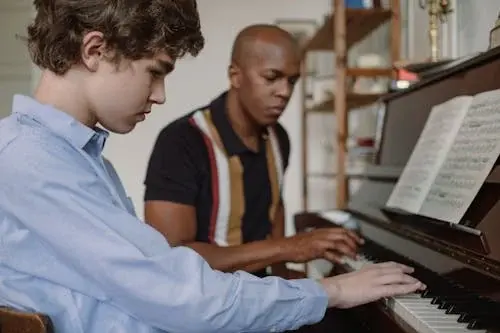
A personal piano teacher online or physical, will help you avoid trial-and-error overload. They can identify what’s holding you back and show you exactly how to fix it, whether that’s improving hand coordination, adjusting posture, or breaking down the piece into manageable chunks.
Whether you’re aiming to learn what is the hardest song to play on piano or simply want to level up your technique, a private teacher can guide you through smart, effective practice methods like:
On tough days, your teacher can be the push you need.
With expert guidance, even hard songs to play on piano can become manageable, and more enjoyable.
Curious how to apply this to your next piece? Our guide to piano tutorials that help you learn piano breaks down how structured learning can make even the most intimidating compositions feel more approachable.
Easy Songs for Beginners
If you’re new to the piano, diving straight into hard songs to play on piano like Chopin’s Études or Stravinsky’s Trois Mouvements de Petrouchka might feel exciting — but let’s be real, it’s also a fast track to burnout. Even if your end goal is tackling what is the hardest piano song in the world, building a solid foundation first is essential.
These beginner pieces are also a great way to explore the instrument’s expressive potential. While the melodies may be simple, they still require control and musicality — skills that connect back to the long and fascinating evolution of the instrument itself.
In fact, many of these pieces date back to the early development of piano education, which you can learn more about in our guide to the history of the piano.
Here are some easy songs to learn with the piano:
- Twinkle star. The famous poem "Twinkle Twinkle Little Star" is one of the easiest plays. Its key is all located around the same area, except its highest key.
- Happy Birthday, Song - The happy birthday song is another famously easy piece a beginner pianist can learn to play.
- Alphabet song
- Fur Elise
- Jingle Bell
These classics offer a way to focus on timing, key familiarity, and musicality — all while keeping it enjoyable. Don’t underestimate the power of repetition and simplicity when you’re just getting started.
While they may seem basic, these songs are amazing tools. They help you become comfortable moving between keys, recognizing patterns, and building the coordination needed to play with both hands.
Even a piece like Für Elise — which sounds impressive — is often broken down into manageable sections that beginners can gradually master. Learning these familiar tunes builds confidence and provides quick wins early on, which is crucial for maintaining motivation.
The beauty of learning these songs is that you can start personalizing them early. Try changing the dynamics, experimenting with tempo, or adding simple left-hand chords to develop your musical instincts. Once these easy songs feel natural, you’ll find yourself ready to explore more complex pieces with confidence.
Start piano lessons Toronto here on Superprof.
Summarize with AI:
Did you like this article? Leave a rating!


 Loading...
