
Every true star begins inside a cloud of gas and dust coalescing together in space. Eventually, the matter becomes dense and hot enough to give life to a giant, glowing, hydrogen-fusing entity. As the fuel runs out, the star begins to die in one of three ways. Find out more about this fascinating and incredible process.
Stars are not solid objects, and they don’t burn like fire. Instead, they are made of gases condensed so closely together by gravity that the friction causes them to ignite and emit massive amounts of light and heat. But, the gravity is so strong, that the particles do not escape, and are instead reused over and over again.
A star is a ball of plasma, mostly made of hydrogen and helium, that is held together by gravity. Its light and heat come from chemical reactions deep inside its core, making it self-luminous and self-fuelling.
Why Stars Shine
Plasma is a hot state of matter in which atoms are broken into charged particles. Gravity pulls the star’s gas inward, while pressure from the hot interior pushes outward. The hydrogen atoms in the star undergo fusion in the core (nuclear fusion).
In a main-sequence star, hydrogen nuclei join together to form helium, which changes a small amount of mass into energy. But, since there are uncountable atoms all performing this process at the same time every millisecond, that translates into massive amounts of energy and heat. This process is relatively stable during the main-sequence phase; when it becomes unstable, the star begins to die.
This light and heat energy moves outward from the core, eventually escaping gravity and radiating outward through space. Other types of radiation, like UV and infrared rays, radio and microwaves, and X-rays and gamma radiation, also emit.
Learn more about stars, planets and more with an online physics course on Superprof.
Stars Vs. Planets Vs. Brown Dwarfs
How does a mass in space become a planet or star, and what differentiates them? All large space objects form when matter, like dust and gas, begin to condense and form a centre of gravity. When they get large enough, they can become planets. When they amass enough material, they can begin to undergo and sustain nuclear fusion and become stars. In between these two phases, we find brown dwarfs: objects more dense than planets, but not large or dense enough to become stars. They can have some nuclear fusion in their cores, but not enough to shine bright like a typical star.
Star
- Produces visible light
- Produces massive amounts of heat
- Sustains hydrogen fusion
- Stellar object classification
- Minimum size: roughly 80 Jupiter masses
Brown Dwarf
- Can sometimes glow faintly and produce a little heat
- Most emitted light is infrared (not visible to humans)
- Does not have sustained hydrogen fusion
- Has limited deuterium fusion (unique to brown dwarfs)
- Substellar object classification
- Minimum size: 3-13 Jupiter masses
Planet
- Does not produce light or exceptional heat
- Does not have sustained hydrogen fusion
- Planetary object classification
- Minimum size: about 1/13th of Earth’s mass (but no strict definition exists)
Stars
As we will cover more in-depth, stars are made of large amounts of gas and dust. It all comes together to create a core with enough mass and density for nuclear fusion to occur. Stars are well-studied in astronomy, astrophysics and cosmology.
Brown Dwarf
Brown dwarfs are substellar objects: too massive to be ordinary planets, but not massive enough to host steady hydrogen fusion. They are formed the same way as stars, but don’t collect enough mass to actually become a protostar. Though, they can produce some heat and light through friction forces, and sometimes fuse deuterium briefly. But that limited reaction doesn’t provide the long-term energy required for a star.
They usually fade and cool after formation and release their stored heat. Their emitted light becomes more infrared over time before fading out.
They are commonly 13 to 80 times the size of Jupiter. The mass threshold to become a star is greater than 80 Jupiter masses, or roughly 0.08 times the Sun’s mass.
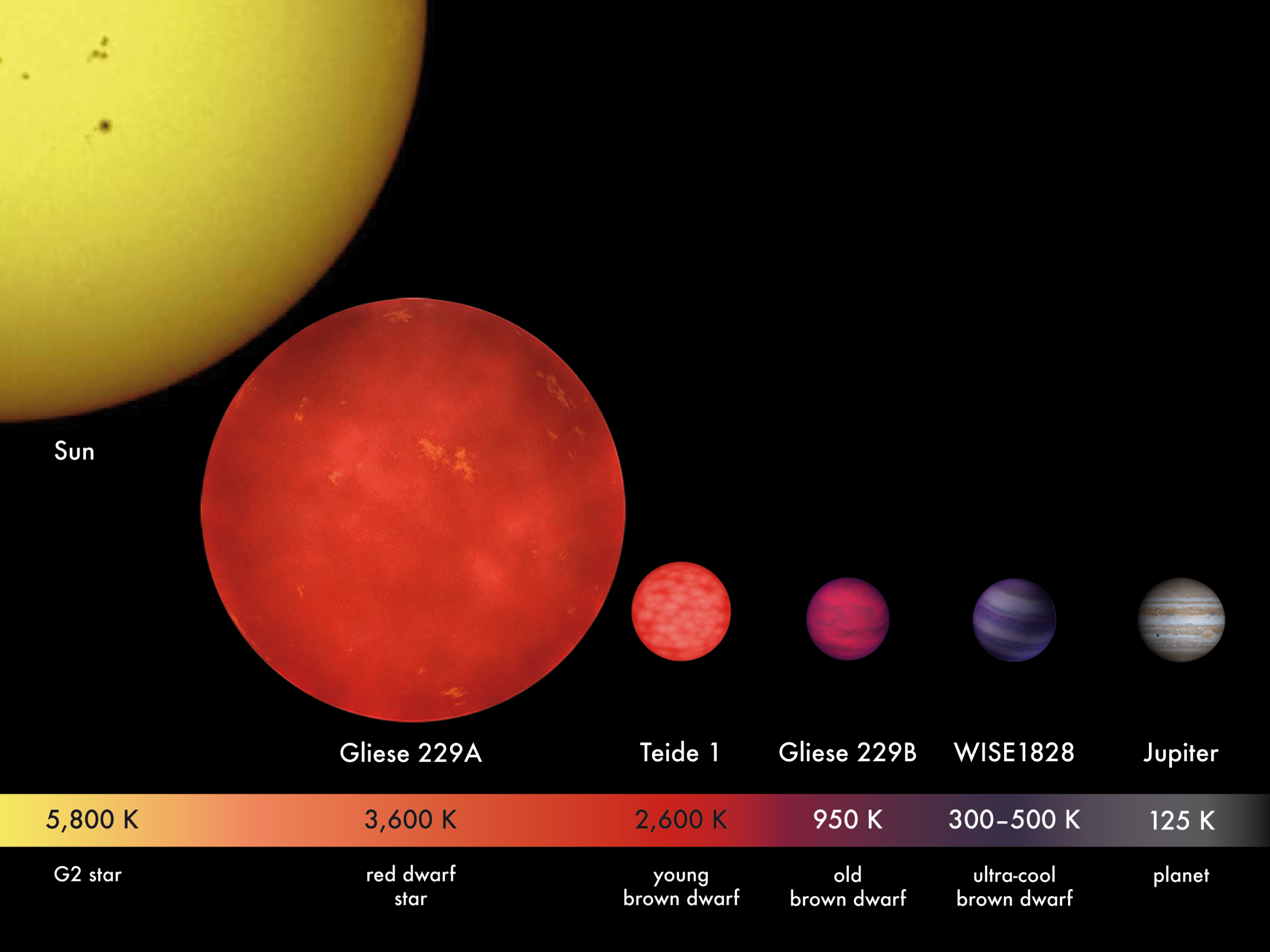
A brown dwarf may fuse deuterium for a short time, but a small star sustains hydrogen fusion for billions or trillions of years. Sustained hydrogen fusion is the key difference.
Planet
Planets also form from gas and dust clouds, but have far less mass than a brown dwarf. They never even come close to having nuclear fusion. Our Earth has a hot core due to residual heat from its formation and decomposing radioactive elements, not from nuclear fusion.


How Are Stars Formed?
Stars form in cold, dense regions of space called nebulae. Nebulae are full of large clouds of dust, gas and raw material. The density within the cloud causes the material to slowly condense together. The process takes millions of years. As the material comes together, it causes the density to increase, which causes more material from farther away to collect. The process can be more thoroughly explained to you by a physics tutor.
Eventually, the material becomes so massive enough that the density causes immense friction on the molecules in the core, igniting nuclear fusion. If there’s enough mass to sustain the fusion, it becomes stable as a main-sequence star.
This timeline highlights the phases of a star’s life cycle and how long it may spend at each stage, according to scientific estimates.
Stellar nebula
Millions - tens of millions of years
Material coalesces together slowly in a dense part of space.
Protostar
100,000 years to 10 million years
Friction causes the material to heat enough to begin nuclear fusion.
Main-sequence star
A few million years to trillions of years
Stars emit steady light and heat and have stable nuclear fusion. (Our Sun is a main-sequence star.)
Red giant or red supergiant
About 100,000 years to 1 billion years
When fuel finally runs low, nuclear fusion ceases and causes the core to collapse while the mid and outer layers of the star expand.
Planetary nebula
10,000 to 50,000 years
Mid-size stars become red giants, then planetary nebulae. The former star’s outer layers float away, creating a cloud of gas and dust, similar to the one that created the star in the first place.
White dwarf
Billions to trillions of years
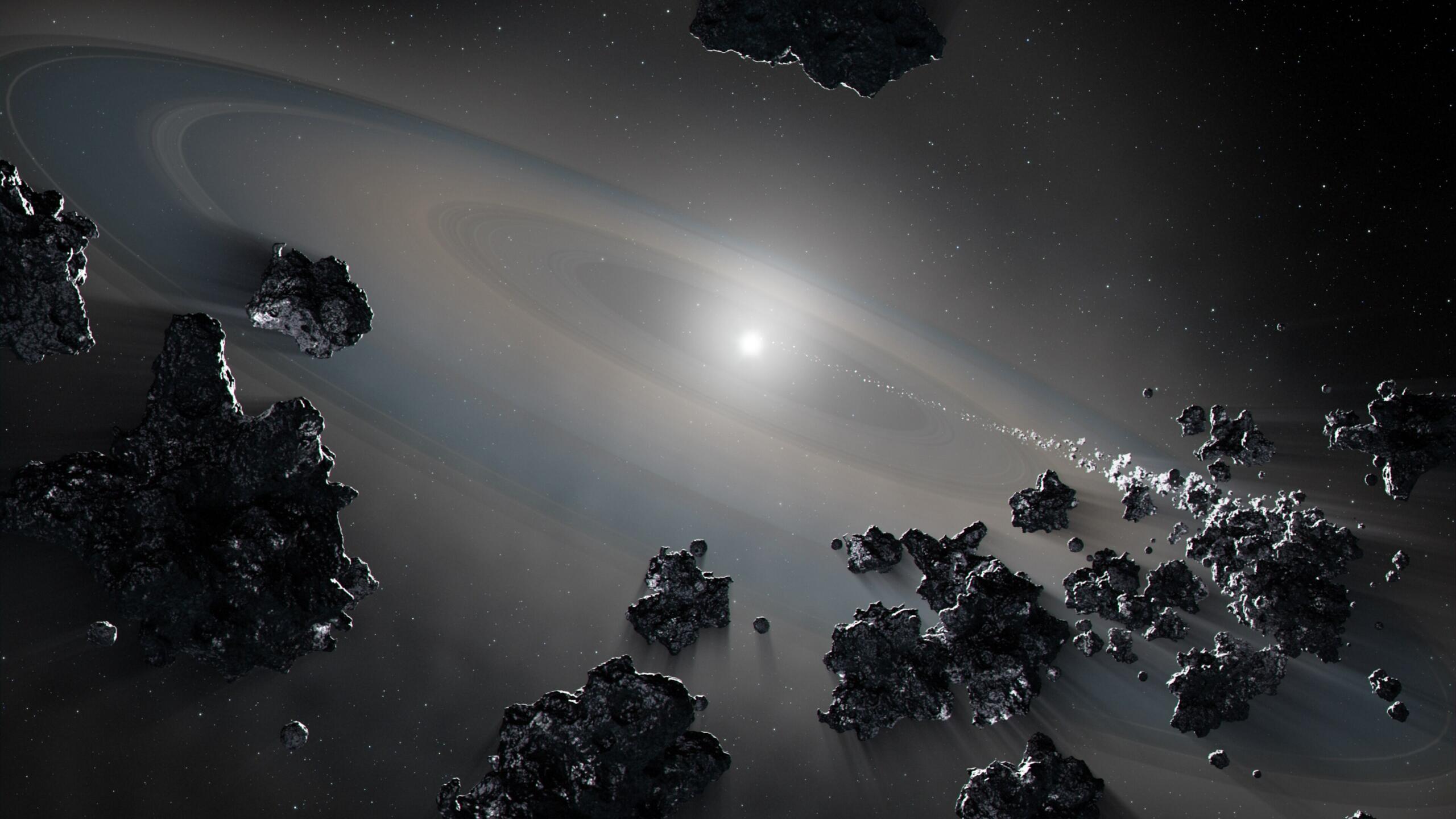
The remaining matter at the core cools and fades. They are incredibly dense and still give off light and heat. It’s theorized that they turn to black dwarfs when they lose most of their heat.
Supernova
Mere seconds for core collapse; weeks to months of bright visibility
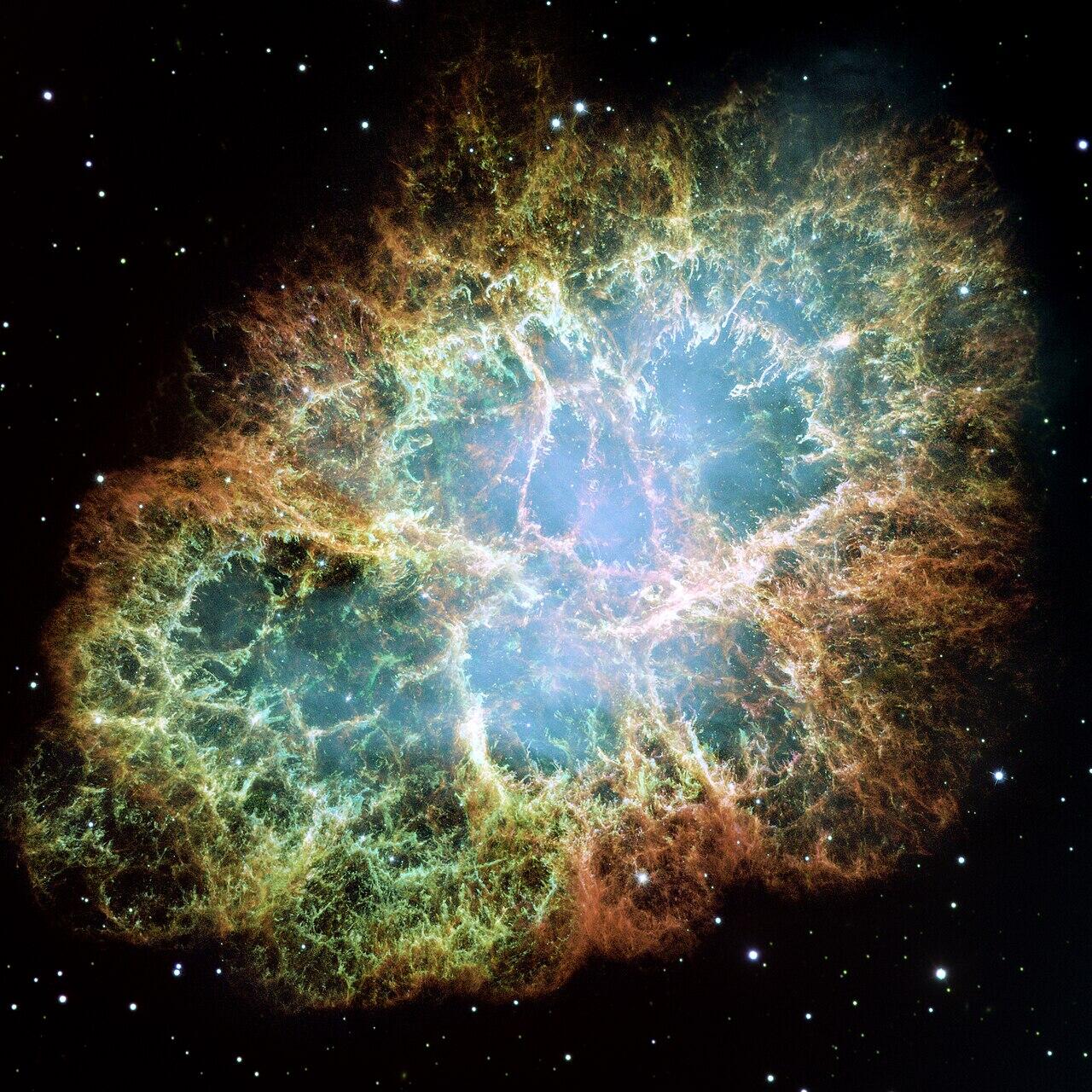
If a massive star turns into a red giant, it will collapse in a supernova instead of a planetary nebula.
Neutron star
Potentially billions of years or longer
Since there is more mass in a supernova than in a smaller-sized star’s planetary nebula, the core remaining from the red giant is big enough to still collect matter. Matter that expanded out in the supernova is re-attracted to the super-dense core, causing even more density to the point that all the atoms are smashed apart, leaving only neutrons.
Black hole
Unknown; likely to persist to be older than the current age of the universe
If the neutron star amasses even more matter, it can become even more super-dense and turn into an object so dense that no amount of matter causes the core to grow larger in volume.
Life Cycle Of A Star Step By Step
There are two main types of stars: Low-mass stars and high-mass stars. The distinction is important because the two behave differently due to their masses. Here’s an outline of the life cycles of stars at a glance:
Low-Mass Stars
- Stellar nebula
- Main-sequence star (0.8 to 8 solar masses)
- Red giant
- Planetary nebula
- White dwarf
- Black dwarf
High-Mass Stars
- Stellar nebula
- Main-sequence star (8 to 150 solar masses)
- Red supergiant
- Supernova
- Neutron star
- Black hole
Stage One: Nebulae
What is the first stage of a stars life? You can say it begins in the stellar nursery, the molecular cloud: a nebula.
A nebula is a large cloud of gas and dust in space that can be more than hundreds of lightyears across in size. Most of the gas is hydrogen, which later becomes the main fuel for a star. Some stellar nebulae are leftovers from dying stars’ collapses into planetary nebulae or supernovas. Others are regions where new stars are forming.
As matter floats around, areas where more of it comes together creates areas of higher density, which pulls parts of the nebula together in a gravitational collapse. These higher-density areas are the beginnings of potential stars.
Curious about the physics of space? Learn more with a professional tutor for physics!
Stage Two: Protostars
As the gas and dust in the nebulae collapse together, the centre where they meet becomes hotter and denser, contracting and spinning. The friction of the particles rubbing together starts to generate heat and light. This glowing object is a protostar. It’s not yet a true star, because hydrogen fusion has not yet started in the core.
In some instances, material from the nebula can start to rotate in a disk around the protostar. This is known as an accreditation disk, and it can eventually form planets, moons, asteroids and comets. That’s the story of our sun and solar system!
Stage 3: Main-Sequence Star
When the nuclear fusion in a protostar’s core becomes stable, it enters the main-sequence phase. This is the “adult” stage of a star’s life. The nuclear fusion reaction is when the heat and density in the core fuses hydrogen into helium. The outward pressure from fusion balances against the inward pressure from gravity.
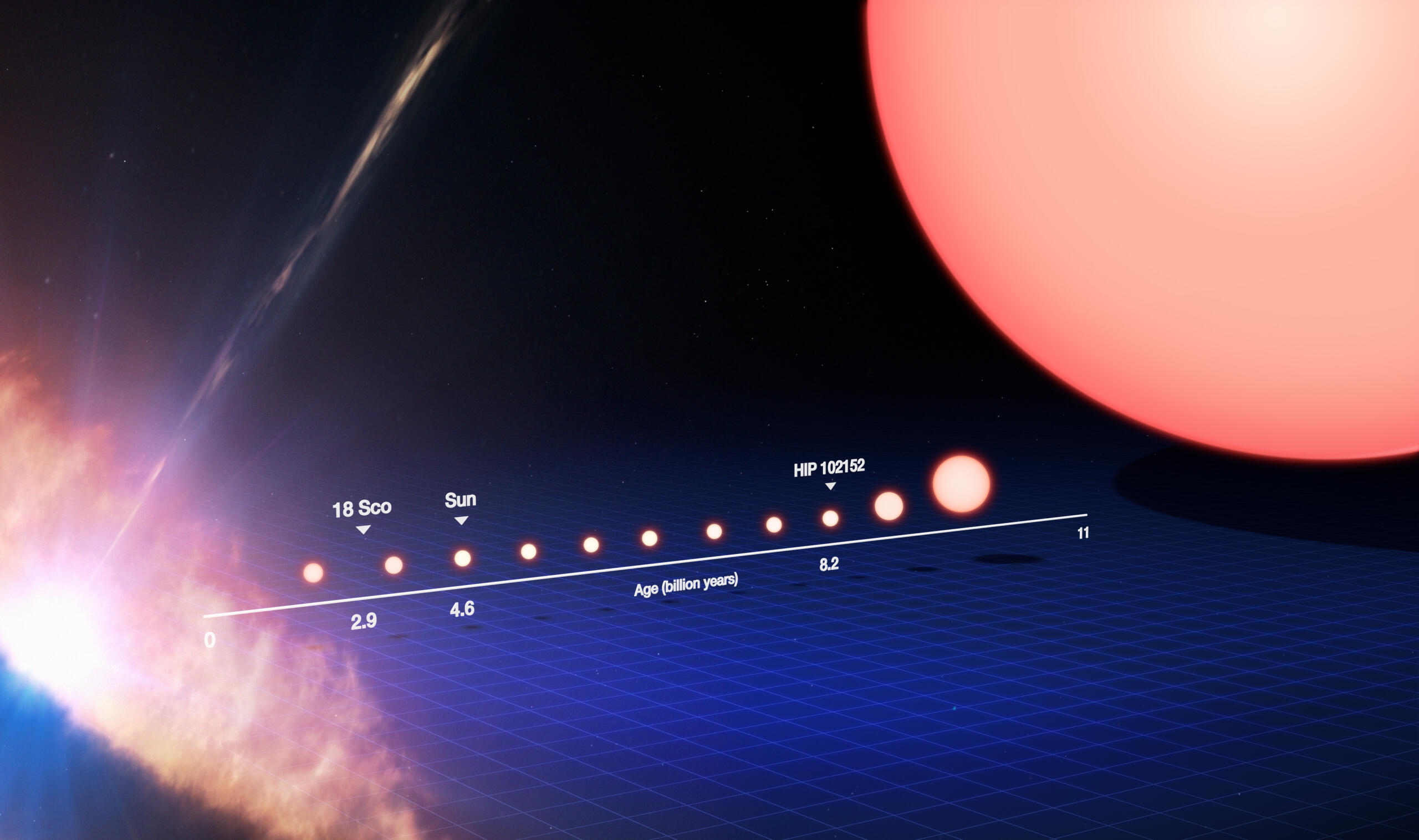
This is the longest stage of a star’s active life. They can remain “burning” (actually fusing) for trillions of years in a self-regulating process, until too many hydrogen atoms are lost and the fusion cycle becomes unstable. Smaller stars last much longer than larger ones, which tend to use up their materials faster. Our Sun is currently a main-sequence star, and most stars that have been observed in the universe are in this phase, too. Their temperatures, colours, brightness and remaining lifespans vary greatly depending on their masses.
Better understand nuclear fusion with expert explanations from a tutor for physics.
billion years
billion years
When Does A Star Actually Begin To Shine?
A true star is born when the core becomes hot and dense enough for hydrogen fusion to start. At that point, the fusion produces immense outward pressure which counters the immense inward gravitational pull, creating an equilibrium.
For a Sun-like star (which is in the mid-range of size and heat of stars), core temperatures must reach approximately 15 million degrees Celsius. Nuclear fusion begins in the densest part of the core first, before spreading to the rest of the core over millions of years.
A protostar becomes a true star when it begins sustained hydrogen fusion in its core. Fusion provides the energy that makes the star shine and helps keep it stable against gravity.
Stage 4: Red Giant or Red Supergiant
What happens when a star uses up its fuel? When core hydrogen depletes, the nuclear fusion process is disrupted. Without the constant rate of outward pressure from helium generation, the core contracts under gravity and heats up further. The outer layers expand exponentially and begin to cool down, making the star appear larger and redder.
A lower-mass star becomes a red giant, while a massive star becomes a red supergiant. The expanding outer layers can be hundreds of times wider than they were during the main sequence.
For any nearby planets, that means catastrophe. They may be engulfed in the super-heated expanding outer layers or thrown violently out of orbit, and even out of the solar system entirely. Some may be destroyed entirely, but it seems that many can survive (and by ‘survive’, we mean ‘maintain their shape’).
If you’re wondering what that means for our solar system 5 billion years from now, scientists describe a few possibilities:
- Mercury and Venus will almost definitely be engulfed by the Sun’s outer layers in the red dwarf phase
- Earth may or may not be engulfed, but the surface temperature would become far too hot, boiling all the oceans away and vaporizing everything.
- Mars will likely not be engulfed, but will also be scorched.
- Further planets may or may not be affected by the heat.
- There’s a possibility some or all planets will also start to drift away from the Sun as its mass and therefore gravitational pull reduces.
Even if Earth somehow survived the red dwarf phase, it wouldn’t be able to sustain life anymore without the usual heat and light of the sun.
[In high-mass stars,] fusion converts carbon into heavier elements like oxygen, neon, and magnesium, which will become future fuel for the core. For the largest stars, this chain continues until silicon fuses into iron… The whole process takes just a few million years. By the time silicon fuses into iron, the star runs out of fuel in a matter of days.
NASA
Stage 5: Final Outcome (Based on Mass)
A Sun-like star (that is, a lower-mass, mid-sized star) sheds its outer layers and leaves behind a white dwarf. The shed layers become a planetary nebula. White dwarf stars are ultra-dense and still give off some heat and light from residual thermal energy. They do not perform any nuclear fusion. It’s theorized that they eventually cool off enough to stop emitting light and heat, which is called the black dwarf stage. But, this stage has not yet been observed since the universe isn’t old enough to have had this happen.
High-mass stars usually explode as a supernova, leaving behind a neutron star where the core was. These are larger and denser than white dwarfs. Some stars remain at this stage. Others with larger mass can end up so ultra-dense that they turn into black holes. If you want a more personal lesson on neutron stars or black holes, learn with a personal tutor for physics on Superprof!
Neutron stars can spin so fast (about 700 rotations per second) that they blast out beams of radiation. The beam hits Earth at regular intervals, which appears as a pulse to surveying equipment. These neutron stars are called Pulsars.
In both cases, the shed outer layers and explosions spread hydrogen, helium, and heavier elements throughout space, one again in the form of dust and gas clouds. The material can be reused in new stars and planetary systems when they again find themselves pulled into a group by gravity in an eon or two.
How Does a Star Become a Black Hole?
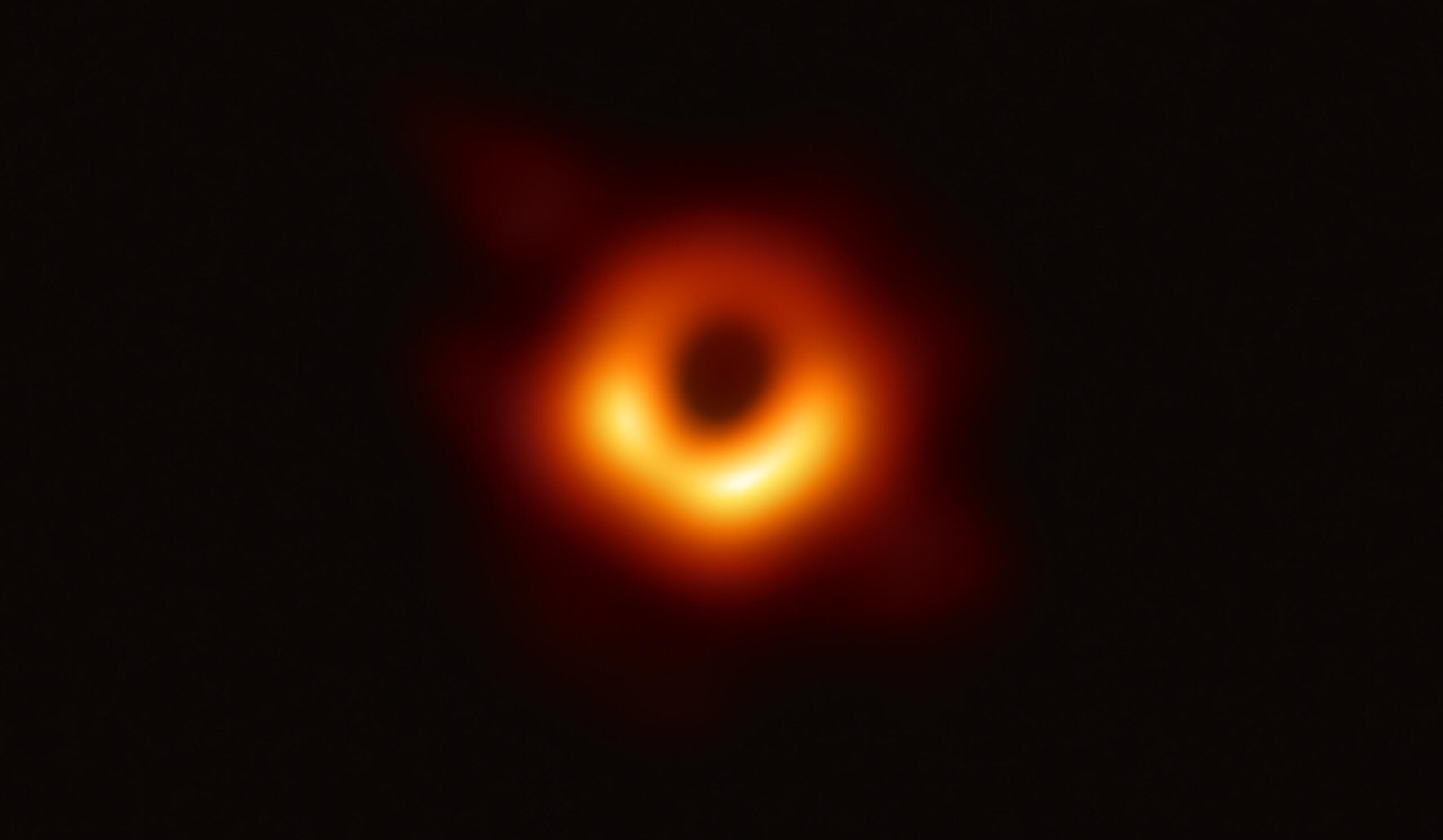
If a neutron star left after a supernova is massive enough, gravity overwhelms every other force that could stop it from collapsing in on itself. It becomes so dense, the gravity so strong, that even light cannot escape once it passes beyond the event horizon (the point of no return).
Contrary to the name, a black hole is not an empty hole in space. It’s actually a region where matter has collapsed to an extreme state. From the outside, they look completely devoid of anything because of the trapped light.
Astronomers can detect black holes by their effects on nearby stars, gas clouds, and radiating light, rather than by finding the black hole directly. Grasp all the concepts you need to understand space and more with physics lessons.
Hertzsprung-Russell Diagram Explained
The Hertzsprung-Russell (HR) diagram compares a star’s surface temperature with its luminosity, which is the total energy it emits. It’s also how we know that stars of different masses follow different stages.
The diagram displays luminosity on the vertical axis and temperature on the horizontal axis. Temperature decreases from left to right, which is different from most graphs we are used to seeing.
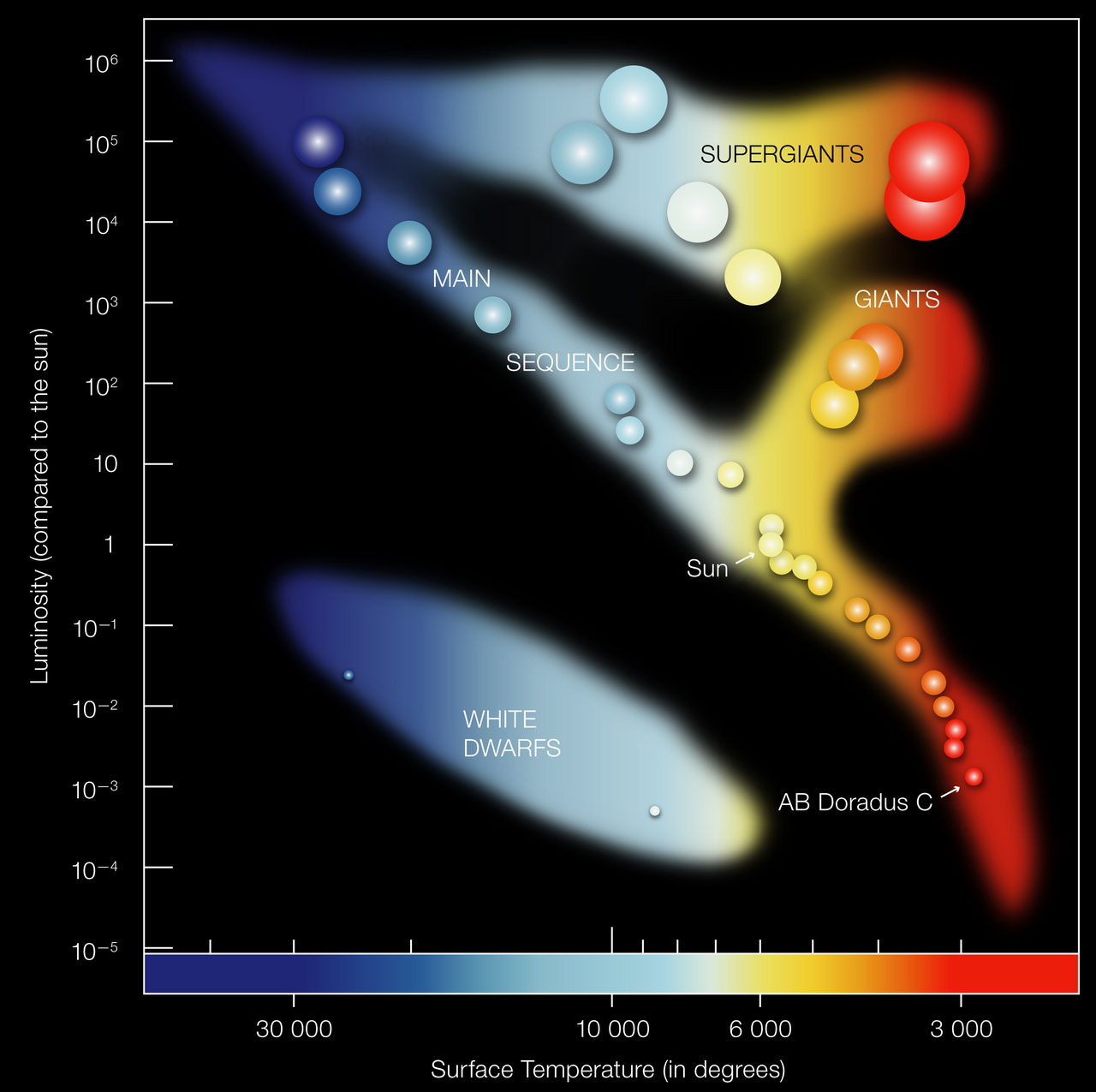
Hot, bright stars appear in the upper left quadrant, while cool, dim stars appear in the lower right.
Stars in the main sequence form a diagonal band from the upper left quadrant to the lower right. Most stars spend the majority of their lives in this band.
Red giants and supergiants lie above the main sequence because they are very luminous despite their cooler surfaces. White dwarfs lie below it, since they emit less light but maintain high heat.
Why Astronomers Use the Diagram
The diagram makes it simpler to classify stars and compare their properties. Through millions of comparisons, scientists have concluded a lot of information about stars, like their size and temperature thresholds required for nuclear fusion, for example. By comparing a star to all the known data, they can estimate its size, age, and likely stage in stellar evolution.
| Life Cycle Stage | Position On HR Diagram | Temperature | Luminosity | Example Star |
|---|---|---|---|---|
| Main-sequence star | Diagonal band | Wide range | Wide range | Sun |
| Red giant | Above and right of main sequence | Cooler surface | High | Aldebaran |
| Red supergiant | Upper right | Cool surface | Extremely high | Betelgeuse |
| White dwarf | Lower left | Hot surface | Low | Sirius B |
References
- “Brown Dwarfs.” Canadian Space Agency, 30 June 2022, www.asc-csa.gc.ca/eng/astronomy/beyond-our-solar-system/brown-dwarfs.asp. Accessed Sept. 9 2026.
- Huston, Macy. “What happens to planets when their host star dies?” Astrobites, 22 May 2021, astrobites.org/2021/05/22/dailypapersummary. Accessed Sept. 10 2026.
- Kazmierczak, Jeanette, et al. “Stars - NASA Science.” NASA Science, 12 Aug. 2026, science.nasa.gov/universe/stars. Accessed Sept. 9 2026.
- Lea, Robert. “What are pulsars?” Space, 24 Jan. 2023, www.space.com/32661-pulsars.html. Accessed Sept. 10 2026.
- “Life Cycle of a Star.” labelstars.com/en, 16 July 2026, labelstars.com/en/blog/life-cycle-of-a-star.html. Accessed Sept. 9 2026.
- Stellar Evolution | the Schools’ Observatory. www.schoolsobservatory.org/learn/space/stars/evolution. Accessed Sept. 9 2026.
Summarize with AI:
Did you like this article? Leave a rating!


 Loading...